
ISO 9001:2015ITAR RegisteredRoHS · REACHLead time from 3 business daysMOQ = 1 part
PifyC
Services
Materials
Industries
Applications
Resources
Locations
Company
Request a quote
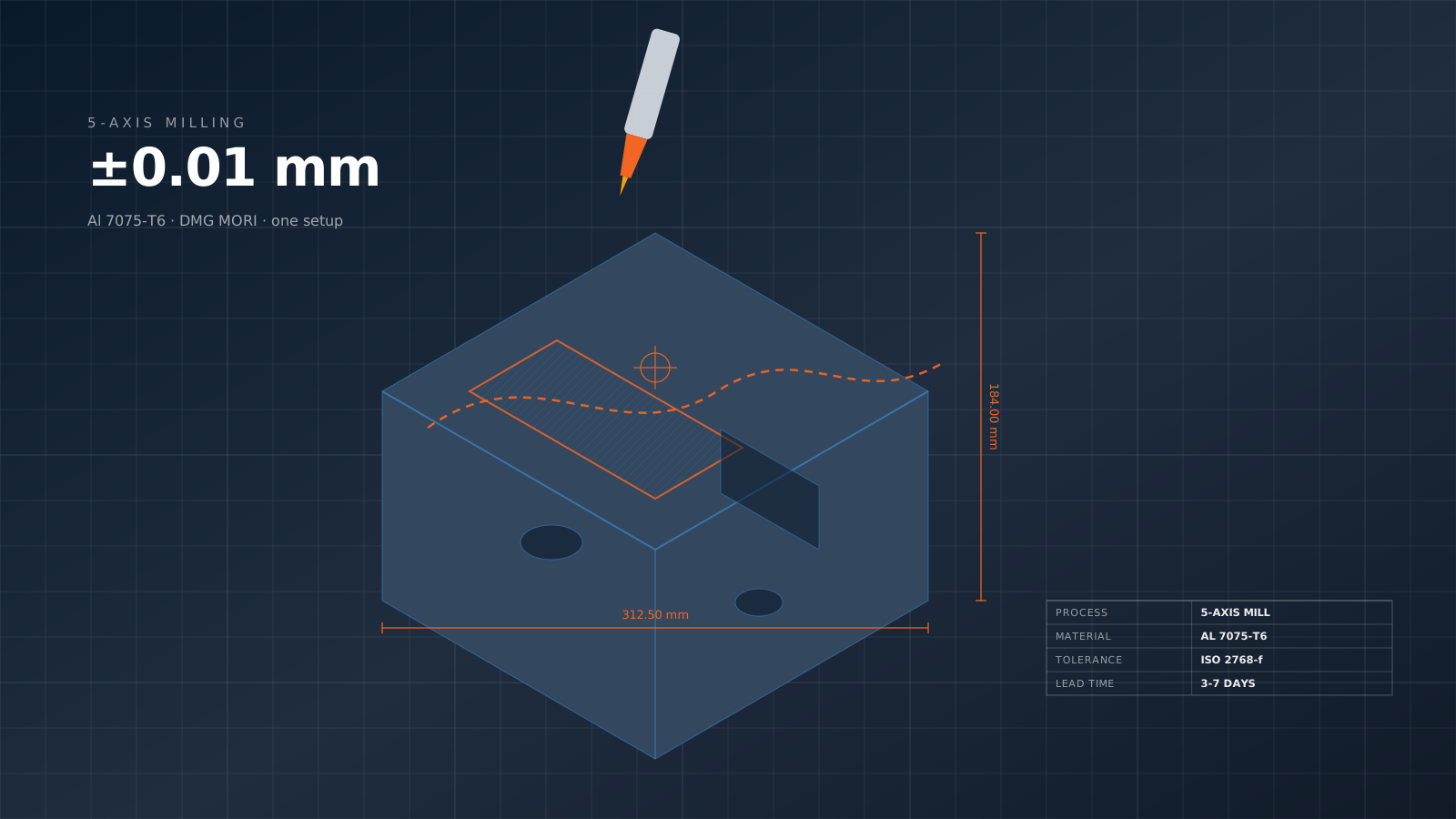
5-axis CNC milling drawing: Al 7075-T6 block with pockets, toolpath and dimensions
Thread Standards Guide

UNC. UNF. Metric. Pipe. ACME.

Every thread standard engineers actually use. Drilling charts, tap sizes, class fits, and decision guides for picking the right thread for your application. Practical machinist reference.

Threads, welds & jointsWuxi, ChinaMOQ 1 partDFM review included

Five thread families.

UNC / UNF (ANSI)

Unified Thread Standard. UNC coarse (6-32, 1/4-20, 1/2-13), UNF fine (10-32, 1/4-28, 1/2-20). Standard for US fasteners, general mechanical.

ISO Metric

M2 × 0.4 through M64 × 6. Metric coarse and fine pitch. Dominant standard for new designs globally. Specify major diameter × pitch.

NPT Pipe

National Pipe Thread. Tapered, seals via thread interference + sealant. Sizes 1/16-27 NPT through 4-8 NPT. Plumbing, industrial pipe.

BSP / G Thread

British Standard Pipe. BSPP (parallel, seals with O-ring), BSPT (tapered). Common in hydraulic, pneumatic systems globally.

ACME Power

ACME and Stub ACME for linear actuators, lead screws, vice screws. 29° thread angle, better power transmission than 60° V-thread.

TR Trapezoidal

Metric equivalent to ACME. 30° thread angle. Standard for metric lead screws, actuators. Specify as TR20×4 etc.

BA British

British Association. Legacy small-thread standard (0BA through 16BA). Still seen in older British equipment, instruments.

Taperlock & Specialty

SAE O-ring boss (ORB), JIC 37° flare, DIN 2353. For hydraulic fittings — better sealing than pipe thread.

Buttress Threads

Asymmetric thread profile for one-direction high-load transmission. Ammunition breeches, oil-field casing, precision lead screws.

Common tap drill sizes.

#4-40 UNC#43 (2.26 mm)
#6-32 UNC#36 (2.71 mm)
#8-32 UNC#29 (3.45 mm)
#10-24 UNC#25 (3.80 mm)
#10-32 UNF#21 (4.04 mm)
1/4-20 UNC#7 (5.11 mm)
1/4-28 UNF#3 (5.41 mm)
5/16-18 UNCF (6.53 mm)
3/8-16 UNC5/16 (7.94 mm)
1/2-13 UNC27/64 (10.72 mm)
5/8-11 UNC17/32 (13.49 mm)
3/4-10 UNC21/32 (16.67 mm)
M2 × 0.41.6 mm
M2.5 × 0.452.05 mm
M3 × 0.52.5 mm
M4 × 0.73.3 mm
M5 × 0.84.2 mm
M6 × 1.05.0 mm
M8 × 1.256.8 mm
M10 × 1.58.5 mm
M12 × 1.7510.2 mm
M14 × 2.012.0 mm
M16 × 2.014.0 mm
M20 × 2.517.5 mm

Drill sizes for 75% thread engagement (standard). For softer materials or through-holes, 65% engagement allows larger drill. For harder materials, stay at 75% or move to 85% engagement.

Working on a live project? Send the STEP file and the two or three features you are unsure about — an engineer replies with DFM notes and a price, usually within four working hours.

FAQ

UNC — questions

UNC vs UNF — when to use each?

UNC (Unified Coarse) has fewer threads per inch — easier to start, less prone to cross-threading, faster to assemble, more forgiving to contamination. Use for: general fasteners, thick materials, field assembly, outdoor use. UNF (Unified Fine) has more threads per inch — higher tensile strength, better for thin materials, better vibration resistance. Use for: precision adjustment, aerospace, high-strength aluminum, thin-wall applications.

Metric coarse vs metric fine?

Same trade-off as UNC/UNF. Metric coarse (default): M10 × 1.5 pitch, used for 90% of general applications. Metric fine: M10 × 1.25 pitch, for precision adjustment, aerospace, thin-wall. Note: metric threads always specified with pitch (M10×1.5 vs M10×1.25), while inch threads use threads-per-inch (1/2-13 vs 1/2-20). Don't mix up pitch and threads per inch.

Which pipe thread standard for my application?

NPT (US tapered pipe thread): sealing against tapered mating threads. Requires thread sealant or PTFE tape. Standard for US plumbing, industrial fittings. BSP (British Standard Pipe) comes in tapered (BSPT, like NPT but different taper) and parallel (BSPP/G, requires gasket or O-ring). Common in UK, EU, industrial applications. JIS (Japanese) similar to BSP. For hydraulic fittings, consider SAE O-ring boss instead of pipe thread — better sealing.

What thread class should I specify?

Class 2A/2B (external/internal) is default for 90% of threads — standard assembly fit. Class 3A/3B: tighter fit for precision applications, aerospace, vibration-prone assemblies. Class 1A/1B: loose fit, dirt-tolerant, agricultural. Metric equivalents: 6H (default internal), 6g (default external), 4H/4h (tight), 7H/7g (loose). Match class to assembly requirements.

Can you cut custom thread profiles?

Yes — ACME power threads for linear actuators, Stub ACME, buttress threads, trapezoidal (TR) metric threads, custom square threads. Single-point lathe threading for special pitches not available in standard taps. For very small or unusual threads, thread milling with CNC is often the best approach. Specify pitch, major diameter, minor diameter, and any special thread form requirements.

What tolerance can you hold on threads?

Standard threads (tap or thread-mill): Class 2B/6H typical, acceptable for production use. Precision threads (single-point lathe threading): Class 3B/4H with go/no-go gauge verification. Thread pitch diameter measurement with thread micrometer or 3-wire method. For aerospace or safety-critical threads, per-part inspection available with calibrated gauges. Rolled threads (for production volumes) typically best accuracy but require specific material and equipment.

5-axis CNC milling drawing: Al 7075-T6 block with pockets, toolpath and dimensions

Send a CAD file. Get an engineering-reviewed quote.

No minimum quantity, free DFM feedback from a senior manufacturing engineer, and an NDA signed before file review on request.