
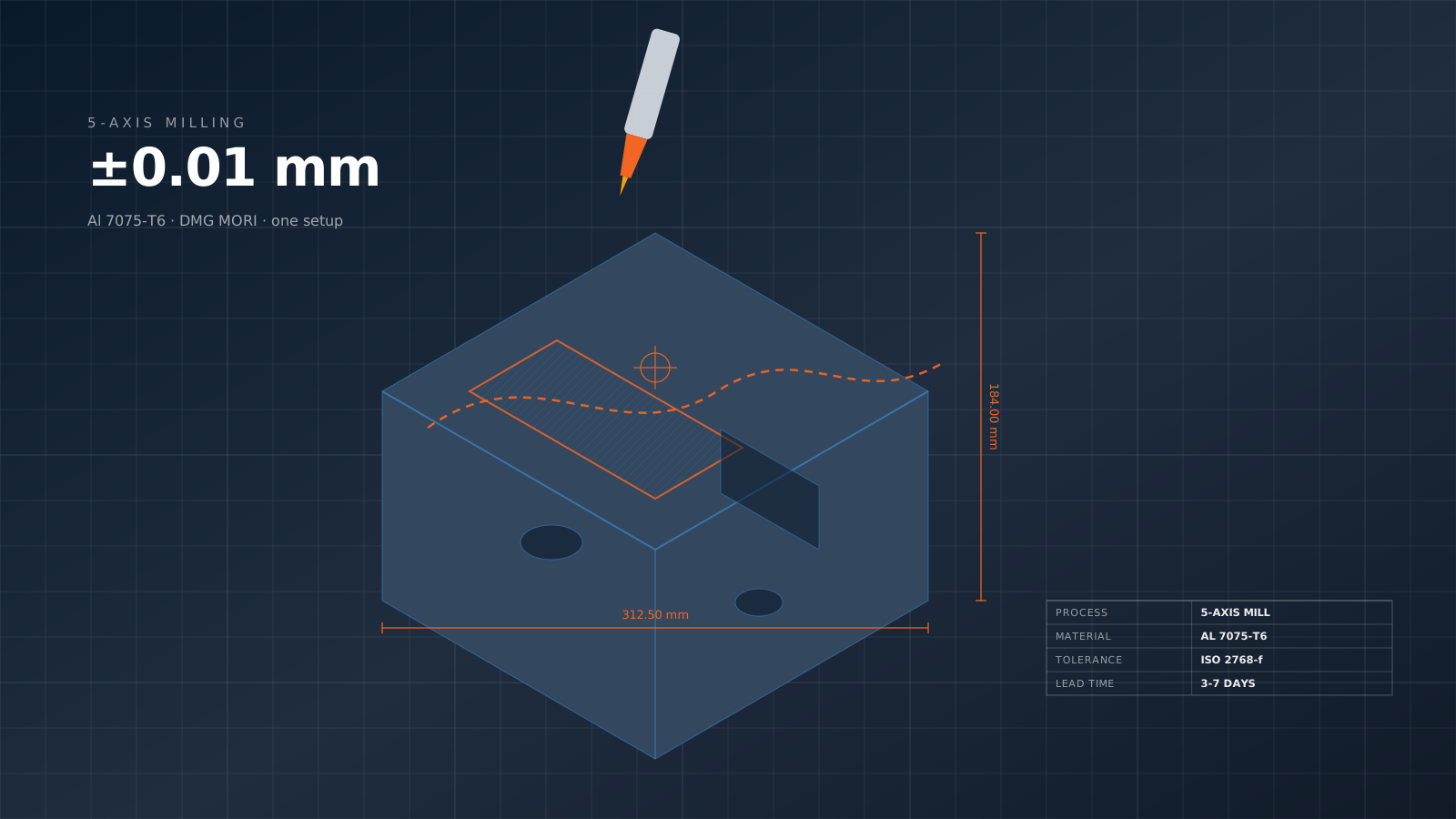
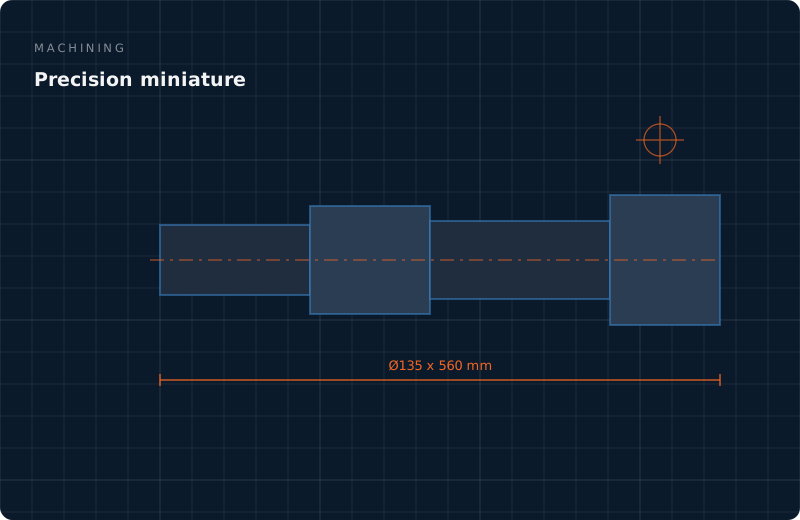
Precision miniature. Long & slender. ±0.005 mm tolerance.
Swiss-type CNC turning for small-diameter precision parts. Sliding headstock provides bearing support next to the cutting action — enabling long slender parts impossible on conventional lathes. ±0.005 mm tolerance, Ra 0.2 µm finish, parts down to 0.3 mm diameter.
Swiss screw machining
Swiss-type CNC turning uses a sliding headstock design where the workpiece moves longitudinally through a guide bushing while the tool is stationary. This design provides bearing support immediately adjacent to the cutting action, eliminating the deflection that occurs when turning long slender part
How Swiss Screw Machining works.
Swiss-type CNC turning uses a sliding headstock design where the workpiece moves longitudinally through a guide bushing while the tool is stationary. This design provides bearing support immediately adjacent to the cutting action, eliminating the deflection that occurs when turning long slender parts on a conventional lathe.
The original "Swiss" design emerged from the Swiss watchmaking industry — hence the name. Modern Swiss CNC adds live tooling (rotating tools that enable milling, drilling cross-holes, tapping), multiple turrets for simultaneous operations, and bar feeders for lights-out production of high-volume precision parts.
Result: precision parts with length-to-diameter ratios up to 20:1 (impossible on conventional lathes without tailstock support), tolerances to ±0.005 mm, surface finish Ra 0.2 µm, and part sizes as small as 0.3 mm diameter. The dominant process for medical implants, surgical instruments, watchmaking, and precision screw machine work.
Capability specs.
Our Swiss lathe capacity. Bar stock up to 32 mm diameter fed from bar feeder
Smallest practical diameter on our Swiss equipment. Below this, micro-machining territory
Standard precision tolerance. ±0.002 mm achievable on select features
Single-pass finish on free-machining materials like C360 brass, 303 stainless
Length-to-diameter ratio achievable — impossible on conventional lathes
Cross-holes, flats, milling features while part is turning. No second setup needed
Automatic bar feeder enables unmanned production of high-volume precision parts
Typical main spindle speed. Sub-spindle for back-working without re-chucking
Where Swiss Screw Machining excels.
Medical bone screws
Orthopedic surgical screws in Ti Gr.5 or 316L — ±0.005 mm thread precision
Dental implants
Dental implant screws in Ti Gr.4 — Swiss machining provides surface finish needed for osseointegration
Watch components
Horological pivots, arbors, balance staffs, escapement wheels — traditional Swiss application
Surgical instruments
Miniature surgical tools — forceps tips, micro-scissor blades, probe components
Precision shafts
Motor shafts, encoder shafts, precision mechanical shafts under 32 mm
Fiber optic ferrules
Ceramic and metal fiber-optic alignment hardware with sub-micron tolerance
Aerospace fasteners
Specialty aerospace screws per NAS/AS standards — titanium, Inconel
Electronic connectors
Precision pin hardware, miniature connector shells, IC socket pins
Automotive sensors
Small-diameter sensor bodies, thermocouple sheaths, ABS sensor components
Not suitable for:
Every process has its limits. Being honest about where Swiss Screw Machining isn\'t the right answer saves time and money.
- Parts larger than 32 mm diameter — use conventional turning or milling instead
- Prismatic (non-cylindrical) parts — requires milling
- Parts with L/D below 3:1 — conventional turning is cheaper
- Very low volume (1–5 pieces) — setup cost per part may exceed conventional turning
- Parts requiring complex 3D geometry beyond cross-axis features
- Material thicker than 32 mm bar stock
Get an instant quote
Send your CAD — we reply with detailed pricing, lead time, and DFM feedback within 4 working hours.
Talk to an engineer
WhatsApp our team directly. Most messages answered within 12 minutes during work hours.
Explore all services
CNC, 3D printing, injection molding, sheet metal, casting, finishing — one quality system, one partner.
Precision miniature — questions
How is Swiss-type different from conventional CNC turning?
Conventional turning: part is held in chuck with free end extending unsupported (or supported by tailstock for long parts). Tool translates along part. Swiss turning: part passes through guide bushing with support immediately adjacent to cutting action. As cutting progresses, bar feeds through guide bushing. Result: deflection during cutting is essentially eliminated, enabling long slender parts with tight tolerances.
When should I specify Swiss machining?
When all three apply: (1) part diameter under 32 mm, (2) length-to-diameter ratio above 3:1, (3) tolerance requirements below ±0.025 mm on critical features. For cylindrical parts meeting these criteria, Swiss typically wins on quality and cost. For parts outside these criteria, conventional turning or milling is appropriate.
What is "back working" or sub-spindle?
Swiss machines have two spindles — main spindle holds the bar and does primary work, sub-spindle grips the finished part and enables back-side machining without re-chucking. Example: turn the OD profile on main spindle, cut off the part, sub-spindle grabs it, back-side features (facing, drilling, threading) machined. Eliminates secondary operations and tolerance stack-up.
Materials suitable for Swiss machining?
Best: free-machining brass C360 (easiest, fastest), 303 stainless (free-machining), leaded steel 12L14, aluminum 2011 or 6061. Standard: 304/316L stainless, 4140 steel, titanium Gr.5, Inconel. Challenging but possible: PEEK, Vespel (harder plastic), hardened steel (pre-turned, harder to machine). Swiss handles virtually any CNC-compatible material; free-machining grades run fastest.
Production volumes?
Swiss is most cost-effective for volumes above 100 pieces. Setup is time-consuming (programming, tool setting, bar feeder configuration) but once running, parts come off fast. High volume sweet spot: 500–10,000+ pieces per order. For low volume (below 50 pieces), conventional turning often cheaper. For extreme volume (100,000+), dedicated screw machines (cam-operated) may beat CNC Swiss economically.
Lead times?
Simple Swiss parts in common materials: 3–5 business days. Complex Swiss parts with live tooling features: 7–10 business days. Specialty materials (titanium, Inconel) add 2–5 days for material. Swiss production once running is very fast — primarily setup/programming time drives initial lead time.
Keep reading
Quote
Get a free CNC machining, 3D printing, injection molding quote from PifyC. Send CAD via WhatsApp or email — q…
Read more →MachiningCNC turning
Precision CNC turning in Wuxi: 10 conventional lathes and 4 Citizen Swiss-type lathes. Diameters 2–450 mm, lengt…
Read more →MachiningCNC machine
ISO 9001 certified CNC machining in Wuxi, China. 3, 4 and 5-axis milling, Swiss turning, 40+ materials, ±0.01 mm…
Read more →Additive manufacturing3D printing service
Industrial-grade 3D printing from Wuxi, Jiangsu, China: SLA, SLS, MJF and DMLS metal. Functional prototypes and …
Read more →Moulding & castingInjection molding
Plastic injection molding from China: rapid aluminum tooling in 14 days for 500–10,000 parts, production P20/H13…
Read more →Sheet metal & fabricationSheet metal
Precision sheet metal fabrication from Wuxi: 4 kW fiber laser cutting, Amada press brake bending (±0.1 mm), TIG/…
Read more →Finishing & treatmentFinishing services
Complete in-house surface finishing: Type II/III anodize, powder coating, electroplating, passivation, bead blas…
Read more →PifyCMaterials
PifyC's 50+ production-grade materials: aluminum, stainless steel, titanium, brass, copper, and engineering p…
Read more →Send a CAD file. Get an engineering-reviewed quote.
No minimum quantity, free DFM feedback from a senior manufacturing engineer, and an NDA signed before file review on request.