
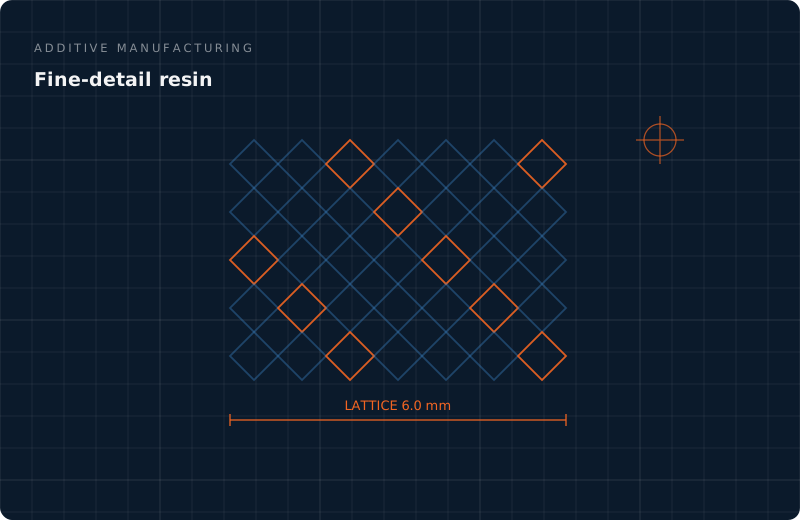
Fine-detail resin. Smooth surface. Next-day capable.
SLA (stereolithography) 3D printing with photopolymer resin. Finest detail of any 3D printing process. Smooth Ra 2-5 µm surfaces, transparent and colored resins, engineering resins with mechanical properties. Visual prototypes, master patterns, dental models.
SLA 3D printing service
Resin choice determines mechanical properties, appearance, and application suitability. We stock common engineering and visual resins.
SLA resin categories.
Standard resin
General-purpose visual prototype resin. Standard colors, smooth finish. Not durable enough for functional testing.
Clear resin
Transparent resin for see-through parts. Can be polished to optical clarity. Light pipes, visual concept models.
Tough resin
Engineering-grade tough resin with impact resistance similar to ABS. Snap-fit parts, functional prototypes.
Flexible resin
Flexible/rubbery resin for gasket prototypes, living hinges, soft-touch prototypes.
High-temp resin
High-temperature resin for hot-air blow fixture prototypes, injection mold prototypes.
Castable resin
Jewelry casting resin — burns out cleanly in kiln leaving cavity for metal casting. Investment casting patterns.
Dental resin
Dental models, surgical guides, orthodontic appliances. FDA/CE certified biocompatibility.
Engineering
Specialty resins for specific applications — ESD-safe, ceramic-filled, high-impact.
Resin choice determines mechanical properties, appearance, and application suitability. We stock common engineering and visual resins.
Where SLA excels.
Visual prototypes
Design review models with smooth finish for presentation
Master patterns
Master patterns for silicone molding and urethane casting
Investment casting patterns
Burnable resin patterns for metal investment casting
Jewelry prototypes
Detailed jewelry designs for master patterns and direct casting
Dental models
Dental arch models, surgical guides, aligner production
Light pipes
Transparent light pipes and lenses for concept demonstration
Consumer product models
Cosmetic concept models with fine surface detail
Architectural models
Scale models for architectural presentations
Miniatures
Tabletop gaming miniatures with extreme fine detail
Get an instant quote
Send your CAD — we reply with detailed pricing, lead time, and DFM feedback within 4 working hours.
Talk to an engineer
WhatsApp our team directly. Most messages answered within 12 minutes during work hours.
Explore all services
CNC, 3D printing, injection molding, sheet metal, casting, finishing — one quality system, one partner.
Fine-detail resin — questions
SLA tolerance and detail?
SLA achieves ±0.1 mm dimensional accuracy typical, ±0.05 mm for small features with careful orientation. Feature detail: 0.1 mm minimum feature size. Layer thickness 25-100 µm (25 µm for finest detail, slower). SLA is the finest-detail 3D printing process — captures features smaller than SLS/MJF can reproduce.
Why are SLA parts fragile?
Standard SLA resins have limited toughness — brittle, low impact resistance. They break rather than deform. Suitable for visual/static applications. For functional testing, use tough resin grades or consider SLS/MJF nylon which has full production-grade mechanical properties. Standard resin parts work as handling models but should not be drop-tested.
UV stability issue?
Most SLA resins yellow and become brittle under UV exposure — cured photopolymer continues to degrade. Standard SLA parts have 1-3 year indoor service life. For long-service parts: use UV-stabilized resin grades, or recognize SLA as prototype-only material. For production parts requiring UV stability, consider other processes.
Post-processing requirements?
Every SLA part requires: (1) support structure removal (printed supports for overhanging geometry), (2) isopropanol wash (removes uncured resin from surface), (3) UV post-cure (completes polymerization). Additional optional: sanding, polishing for optical clarity on clear parts, priming and painting for cosmetic parts. Post-processing typically 1-4 hours per part.
Build size and lead time?
Our SLA machines: 200 × 200 × 300 mm build envelope. Larger parts split into assemblies and bonded. Lead time: 24 hours for simple parts (single build cycle) — upload by 5 PM, ship next morning. Typical orders: 2-3 days. Large orders (20+ parts): 3-5 days for build capacity scheduling.
Cost compared to MJF or CNC?
SLA is cost-competitive with MJF for small parts (under 50mm). Becomes expensive for large parts — SLA resin costs more per cc than MJF nylon powder. For functional testing, MJF typically better value. For visual prototypes with fine detail, SLA is unbeaten. We quote both and recommend based on your priority (detail vs function vs cost).
Keep reading
Quote
Get a free CNC machining, 3D printing, injection molding quote from PifyC. Send CAD via WhatsApp or email — q…
Read more →Process comparisonsSLA vs SLS vs MJF
SLA vs SLS vs MJF 3D printing comparison: materials, mechanical properties, surface finish, cost, lead time. Dec…
Read more →MachiningCNC machine
ISO 9001 certified CNC machining in Wuxi, China. 3, 4 and 5-axis milling, Swiss turning, 40+ materials, ±0.01 mm…
Read more →Additive manufacturing3D printing service
Industrial-grade 3D printing from Wuxi, Jiangsu, China: SLA, SLS, MJF and DMLS metal. Functional prototypes and …
Read more →Moulding & castingInjection molding
Plastic injection molding from China: rapid aluminum tooling in 14 days for 500–10,000 parts, production P20/H13…
Read more →Sheet metal & fabricationSheet metal
Precision sheet metal fabrication from Wuxi: 4 kW fiber laser cutting, Amada press brake bending (±0.1 mm), TIG/…
Read more →Finishing & treatmentFinishing services
Complete in-house surface finishing: Type II/III anodize, powder coating, electroplating, passivation, bead blas…
Read more →PifyCMaterials
PifyC's 50+ production-grade materials: aluminum, stainless steel, titanium, brass, copper, and engineering p…
Read more →
Send a CAD file. Get an engineering-reviewed quote.
No minimum quantity, free DFM feedback from a senior manufacturing engineer, and an NDA signed before file review on request.