
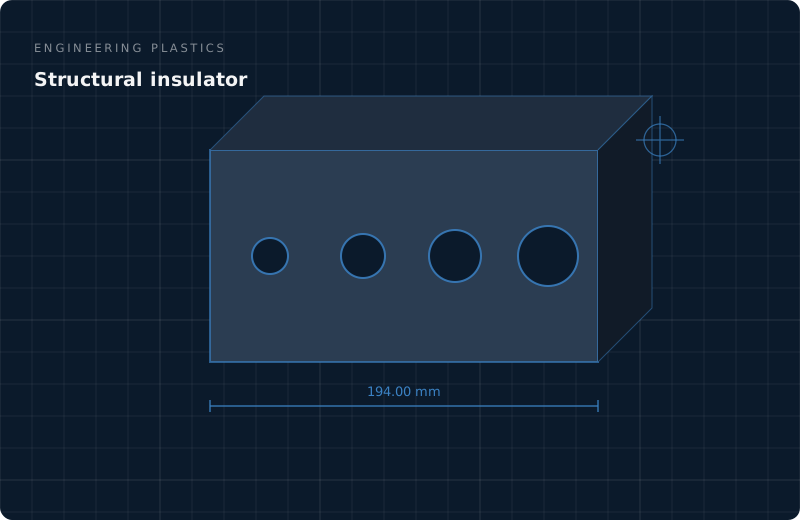
Structural insulator. Stiffer than Delrin. FR-rated.
G10 (and its flame-retardant cousin FR4) combines glass fiber strength with epoxy dielectric properties. Tensile 260 MPa, flexural modulus 18 GPa — stiffer than most engineering thermoplastics. The backbone of the PCB industry, also valued for electrical standoffs and structural insulators.
At a glance
- Density
- 1.80 g/cc
- Tensile strength
- 260 MPa
- Flexural modulus
- 18 GPa
- Hardness
- M 100 Rockwell
- HDT
- 140 °C
- Dielectric strength
- 20 kV/mm
- Water absorption
- 0.2 %
- Flame (FR4 only)
- UL 94 V-0
Key data
- Density
- 1.80 g/cc
- Tensile strength
- 260 MPa
- Flexural modulus
- 18 GPa
- Hardness
- M 100 Rockwell
- HDT
- 140 °C
- Dielectric strength
- 20 kV/mm
- Water absorption
- 0.2 %
- Flame (FR4 only)
- UL 94 V-0
G10/FR4 variants.
G10
Glass-cloth epoxy laminate. Standard grade with excellent mechanical and electrical properties. Not flame retardant — used where FR isn't required.
FR4
Flame-retardant variant of G10. Bromine-based or halogen-free FR package. Standard PCB substrate, electrical enclosures, insulators near electrical components.
FR5
Higher Tg version for elevated-temperature PCB applications (190 °C vs 140 °C for FR4). Lead-free solder reflow compatible.
G11
High-temperature G10 with improved performance at elevated temperature. Used for mechanical parts needing temperature stability without FR requirement.
Halogen-free FR4
Phosphorus or nitrogen-based FR instead of bromine. RoHS and halogen-free compliance for European and Asian markets.
Rogers / Taconic
Specialty high-frequency PCB laminates (PTFE-glass, ceramic-filled). For RF circuit boards above 1 GHz. Machined through specialty partners.
Four common variants of glass-epoxy laminate cover most applications. Differences primarily in flame retardancy, thermal performance, and frequency characteristics.
Why G10/FR4.
Electrical insulation
20 kV/mm dielectric strength — high-voltage standoffs, bus-bar separators, transformer insulation. Volume resistivity 10^14 Ω·cm.
Mechanical stiffness
18 GPa flexural modulus — 4× nylon, 5× Delrin. Structural insulator bars, mounting plates for electrical and transformer applications.
Dimensional stability
0.2% water absorption, minimal thermal expansion. Critical for PCB registration and multi-layer board stability.
Machinability
Cuts cleanly with carbide tooling. Dusty (glass fibers airborne) — requires dust extraction. Fast to machine relative to engineering thermoplastics.
The combination of electrical insulation, mechanical stiffness, and machinability makes G10/FR4 unique. No single-material alternative offers all three.
G10/FR4 applications.
PCB substrate prototypes
Custom PCB shapes and mechanical features for specialty applications
Electrical standoffs
High-voltage insulator standoffs for electrical panel builds
Transformer insulators
Bobbins, spacers, insulation bars for power transformers
Battery separator plates
Non-conductive separator plates between battery cells
Busbar insulators
High-current bus-bar separator bars for switchgear
Knife handle scales
G10 handles for high-end knives — durable, dimensionally stable, cosmetic
Aerospace structural
FR5 structural components for avionics and high-temp insulators
Test fixtures
Electrical test fixtures requiring insulation and dimensional stability
Firearm grip panels
G10 textured grip panels for handguns and tactical firearms
G10/FR4 finishing.
As-machined
Visible glass fiber surface. Dark green (FR4), yellowish (G10 natural). Functional finish.
Beveled edges
Sharp edges chip readily — chamfer or radius edges improves handling.
Textured
G10 is often surface-textured (knife handles) for grip. Machined texture patterns possible.
Machined threads
Threads hold in G10/FR4 but are subject to breakdown under repeated cycling. Heli-coils recommended for critical fasteners.
Pressed inserts
Threaded inserts pressed into G10 for assembly hardware.
Painted
Accepts standard paints. Smooth surface requires light sanding for adhesion.
Laminate orientation
Stacking direction matters — specify fiber orientation for critical mechanical properties.
Sealed edges
Machined edges can wick moisture — seal with epoxy or conformal coat for humid service.
Get an instant quote
Send your CAD — we reply with detailed pricing, lead time, and DFM feedback within 4 working hours.
Talk to an engineer
WhatsApp our team directly. Most messages answered within 12 minutes during work hours.
Explore all services
CNC, 3D printing, injection molding, sheet metal, casting, finishing — one quality system, one partner.
Structural insulator — questions
G10 vs FR4 — what is the difference?
G10 and FR4 are nearly identical glass-epoxy laminates. The only difference: FR4 contains flame retardant (usually bromine-based) to achieve UL 94 V-0 rating. G10 burns if ignited. For electronics applications, FR4 is mandatory for safety. For mechanical applications where fire rating doesn't matter (knife handles, standoffs outside electronics), G10 is slightly cheaper and mechanically similar.
Is G10 machining hazardous?
Glass fiber dust is a respiratory and skin irritant. Machining G10/FR4 requires: dust extraction (HEPA or better filtering), protective clothing and gloves, eye protection, and dedicated tooling (dust contaminates other shop equipment). Our G10 machining is in dedicated area with proper ventilation. For customers: handling finished G10 parts is safe — the hazard is during machining only.
Can G10 be used structurally?
Yes — G10 is a true structural composite. Tensile 260 MPa, flexural modulus 18 GPa. Used for battery separator plates, test fixtures, knife handles. Loads are anisotropic (varies with fiber direction), so specify fiber orientation on drawings. Limitations: brittle failure mode vs tough thermoplastics, glass-fiber dust hazards during machining.
Does G10 handle high voltage?
Yes — dielectric strength 20 kV/mm (short-term). For sustained high-voltage service, derate to 5–10 kV/mm. Standard for medium-voltage electrical insulation, transformer bobbins, and switchgear components. For applications above 100 kV, specialty insulating ceramics or silicone elastomers are preferred.
Can you machine PCB material to specialty shapes?
Yes. We regularly machine FR4 to custom PCB shapes for specialty applications: spacecraft PCBs with weight cutouts, automotive PCBs with mechanical interlocks, industrial control PCBs with custom mounting features. We also machine PCB substrates for mechanical brackets that happen to also be conductive pathways. Non-standard PCB mechanical shapes are our specialty.
Keep reading
Quote
Get a free CNC machining, 3D printing, injection molding quote from PifyC. Send CAD via WhatsApp or email — q…
Read more →PifyCMaterials
PifyC's 50+ production-grade materials: aluminum, stainless steel, titanium, brass, copper, and engineering p…
Read more →MachiningCNC machine
ISO 9001 certified CNC machining in Wuxi, China. 3, 4 and 5-axis milling, Swiss turning, 40+ materials, ±0.01 mm…
Read more →Additive manufacturing3D printing service
Industrial-grade 3D printing from Wuxi, Jiangsu, China: SLA, SLS, MJF and DMLS metal. Functional prototypes and …
Read more →Moulding & castingInjection molding
Plastic injection molding from China: rapid aluminum tooling in 14 days for 500–10,000 parts, production P20/H13…
Read more →Sheet metal & fabricationSheet metal
Precision sheet metal fabrication from Wuxi: 4 kW fiber laser cutting, Amada press brake bending (±0.1 mm), TIG/…
Read more →Finishing & treatmentFinishing services
Complete in-house surface finishing: Type II/III anodize, powder coating, electroplating, passivation, bead blas…
Read more →Engineering plasticsPTFE Teflon
Precision CNC machining of PTFE (Teflon). Chemically inert, 260 °C service, lowest coefficient of friction of an…
Read more →Send a CAD file. Get an engineering-reviewed quote.
No minimum quantity, free DFM feedback from a senior manufacturing engineer, and an NDA signed before file review on request.