
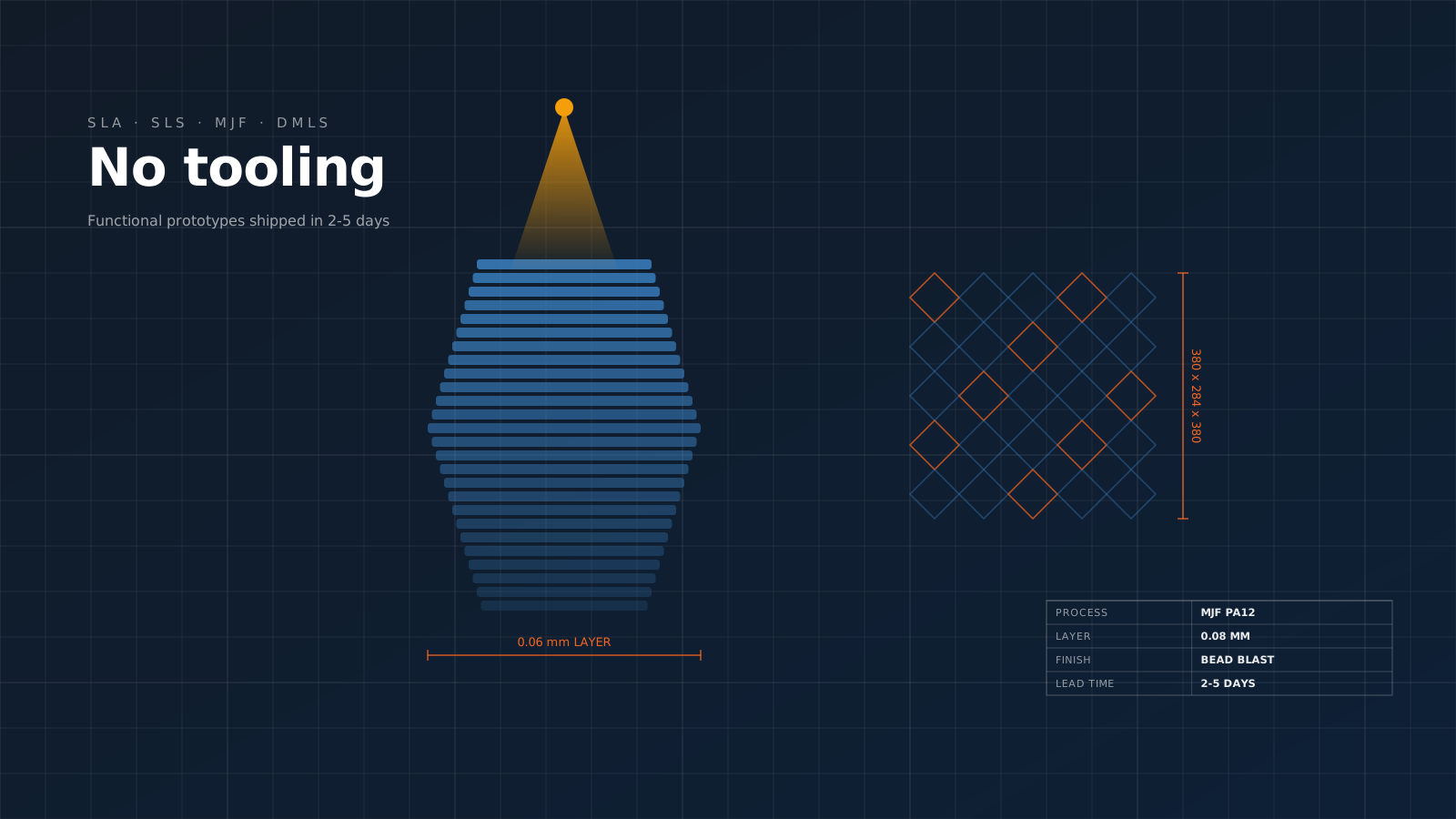
Best nylon surface. HP Multi Jet Fusion. Production ready.
HP Multi Jet Fusion 3D printing — best surface finish of any nylon 3D print process. Ra 6-8 µm vs SLS's Ra 8-12 µm. Faster than SLS for batch production. PA12 and PA11 available. For production-intent prototypes and low-volume end-use parts.
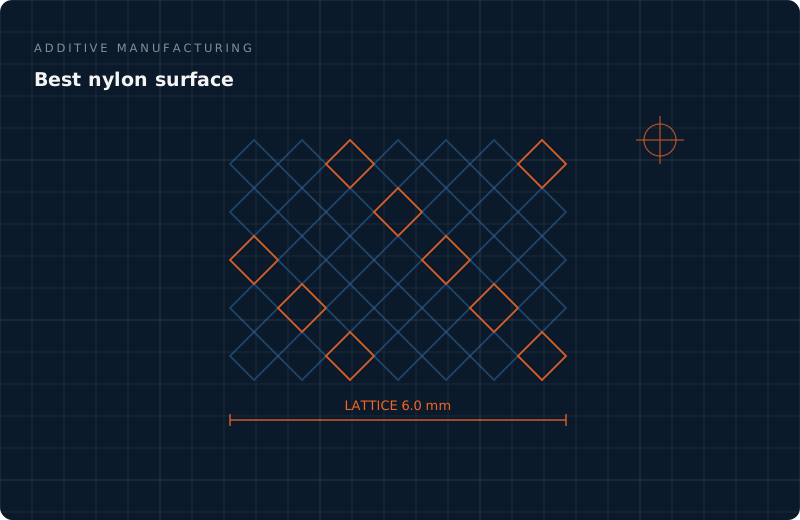
MJF 3D printing service
MJF combines SLS-like production capability with better surface finish, faster speed, and consistent part properties.
Why MJF over other 3D printing.
Best nylon surface
Smoother than SLS (8-12 µm) and FDM (15-30 µm). Cosmetically better, closer to injection molded appearance.
Faster than SLS
HP MJF fuses entire layer at once vs SLS's point-by-point laser. Faster print cycles = faster delivery and lower cost.
Dyed black
Most MJF parts finished in uniform black dye. Consistent color across all parts — unlike SLS grey-white that varies.
Production capable
MJF is used for production, not just prototypes. HP and partners produce millions of parts per year.
PA12 standard
Same PA12 nylon as SLS. Full production-grade mechanical properties.
PA11 elastomeric
Plant-based nylon 11 for impact-critical applications. Higher cost than PA12.
Conductive PA12
Carbon-reinforced conductive PA12 for ESD-safe electronics housings.
Dimensional accuracy
Consistent across batches. Tighter than SLS for some feature sizes.
MJF combines SLS-like production capability with better surface finish, faster speed, and consistent part properties.
Where MJF wins.
Bridge production
Production before injection tool ready — 100-1000 parts in MJF while waiting for tool
Low-volume end-use parts
Under 10,000 pieces annually — MJF economical vs injection tooling investment
Consumer product prototypes
Presentation-quality cosmetic prototypes with better surface than SLS
Functional testing
Drop-testing, snap-fits, mechanical validation — real PA12 properties
Industrial components
Low-volume industrial parts — brackets, housings, fixtures
Wearable devices
Consumer wearables and electronics housings
Medical external
Non-implantable medical devices — wearables, patient accessories
Automotive accessories
Interior components, brackets, aftermarket applications
Aerospace interior
Aircraft interior components per FAR flammability — FR MJF available
Get an instant quote
Send your CAD — we reply with detailed pricing, lead time, and DFM feedback within 4 working hours.
Talk to an engineer
WhatsApp our team directly. Most messages answered within 12 minutes during work hours.
Explore all services
CNC, 3D printing, injection molding, sheet metal, casting, finishing — one quality system, one partner.
Best nylon surface — questions
MJF vs SLS — which is better?
MJF advantages: better surface finish (Ra 6-8 vs 8-12 µm), faster print cycle (40-60% faster), consistent color with dyeing, improved detail on small features. SLS advantages: more material options (including PA12-GF, PA12-CF), slightly better for very large parts (EOS machines have larger build envelope). For most nylon prototyping and production, MJF is newer and generally better. SLS still dominant in aerospace and specialty material applications.
Production volumes MJF can handle?
HP MJF production capacity: 10,000-50,000 parts per year economical. Above that, injection molding typically cheaper. Major applications use MJF for: medical wearables, automotive interior components, specialty electronics housings, consumer products where design iterates frequently. For stable high-volume designs, injection molding remains cost-effective. For evolving designs, MJF's tool-free production is advantageous.
Why are MJF parts dyed black?
Post-print dyeing (vat dye) provides: uniform color across all parts (unlike variable natural PA12 color), hides surface variation for better cosmetic, common industry expectation. Natural color available but shows more surface detail. Dark blue, dark grey dyeing also available. For brand-specific colors, standardization typically happens at the painting step rather than dyeing.
Dimensional accuracy?
MJF: ±0.15 mm typical on critical features, ±0.05 mm possible on small features with careful orientation. Better than SLS for small features. Like all powder bed fusion, accuracy depends on part size and thermal conditions during print. For tighter tolerances, post-print CNC or grinding brings specific features to CNC tolerance while keeping overall MJF geometry.
Lead time for MJF?
Our MJF: 48 hours for simple parts (one print cycle). Typical 3-5 days for medium orders. Batch multiple customers per build for cost efficiency — shared builds typical for prototype work, dedicated builds for production orders. Rush 24-hour turnaround possible at premium.
Cost comparison?
MJF cost driven by volume (material per part) and build time. Typical small part: $15-40. Medium: $40-120. Large: $120-500. Batch of 100 parts nested in single build: per-part cost drops 30-40% vs single parts. For production volumes (500+ parts monthly), establish relationship for batch scheduling and pricing optimization.
Keep reading
Quote
Get a free CNC machining, 3D printing, injection molding quote from PifyC. Send CAD via WhatsApp or email — q…
Read more →Process comparisonsSLA vs SLS vs MJF
SLA vs SLS vs MJF 3D printing comparison: materials, mechanical properties, surface finish, cost, lead time. Dec…
Read more →MachiningCNC machine
ISO 9001 certified CNC machining in Wuxi, China. 3, 4 and 5-axis milling, Swiss turning, 40+ materials, ±0.01 mm…
Read more →Additive manufacturing3D printing service
Industrial-grade 3D printing from Wuxi, Jiangsu, China: SLA, SLS, MJF and DMLS metal. Functional prototypes and …
Read more →Moulding & castingInjection molding
Plastic injection molding from China: rapid aluminum tooling in 14 days for 500–10,000 parts, production P20/H13…
Read more →Sheet metal & fabricationSheet metal
Precision sheet metal fabrication from Wuxi: 4 kW fiber laser cutting, Amada press brake bending (±0.1 mm), TIG/…
Read more →Finishing & treatmentFinishing services
Complete in-house surface finishing: Type II/III anodize, powder coating, electroplating, passivation, bead blas…
Read more →PifyCMaterials
PifyC's 50+ production-grade materials: aluminum, stainless steel, titanium, brass, copper, and engineering p…
Read more →
Send a CAD file. Get an engineering-reviewed quote.
No minimum quantity, free DFM feedback from a senior manufacturing engineer, and an NDA signed before file review on request.