
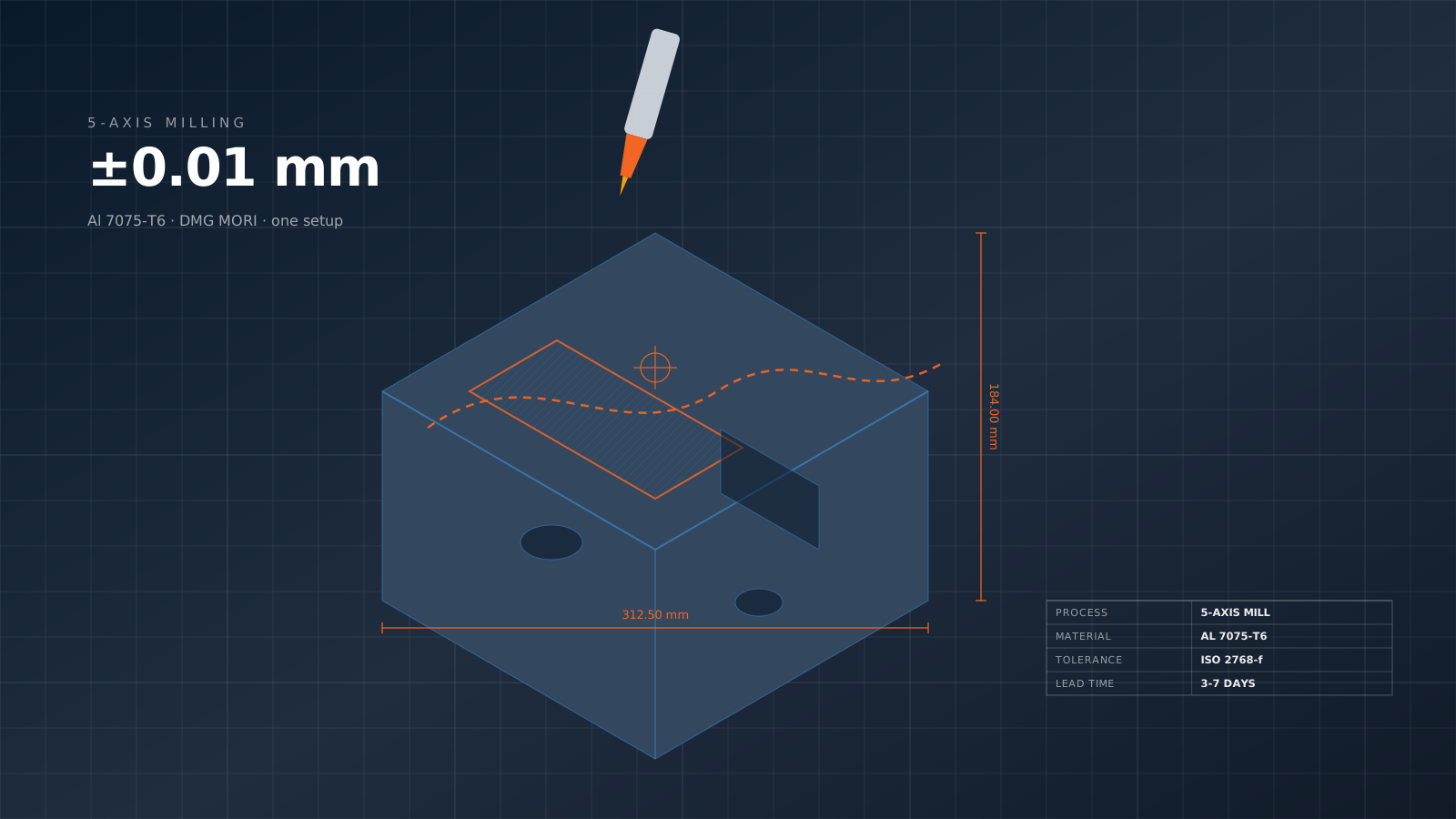
50 to 5,000 parts. No mass tooling. Flexible production.
Low-volume production manufacturing. Bridge between prototypes and mass production. 50-5,000 parts per order using CNC, MJF 3D printing, urethane casting, or rapid injection molding — matched to optimal economic process for your specific part.
Low volume production
Low-volume production has no single "right" answer — the optimal process depends on material, quantity, complexity, and budget. Here's our decision framework.
Best process by quantity and material.
50-200 parts, nylon
Economical MJF nylon production. No tooling cost, consistent part quality.
50-200 parts, metal
CNC cost-effective at this volume. Real production materials, tight tolerance.
50-200 parts, other plastic
Silicone mold casting in ABS-like, PC-like urethanes. Matches production material properties.
200-500 parts, metal
Still CNC-competitive. Batch production reduces setup cost per part.
500-5,000 parts, plastic
Aluminum tooling economical at this volume. Real production thermoplastic.
500-5,000 parts, metal
CNC remains competitive especially for complex geometry. Batch production.
1,000+ parts, simple plastic
Break-even zone between aluminum and steel tooling. Economics-driven decision.
2,000+ parts, metal
Die casting for high volume aluminum/zinc, CNC for steel/stainless or complex features.
Mixed needs
Sometimes best solution combines CNC for precision features + 3D printing for complex geometry + assembly.
Low-volume production has no single "right" answer — the optimal process depends on material, quantity, complexity, and budget. Here's our decision framework.
Where low-volume production wins.
Bridge production
Launch product while steel tooling builds — 1,000 parts of aluminum tool production
Specialty products
Niche products with lifetime volumes below 20,000 — steel tooling never justified
Limited editions
Premium products in limited quantities — watches, vehicles, luxury goods
Market validation
Test market response before committing to high-volume production
Regulatory samples
Produce quantities for FDA, CE, or other regulatory submissions
Clinical trials
Medical device clinical trial quantities (50-200 units)
Launch volumes
New product launches with uncertain initial demand
End-of-life
Legacy product replacement parts where tooling is gone
Custom configurations
Build-to-order products with customer-specific variants
Get an instant quote
Send your CAD — we reply with detailed pricing, lead time, and DFM feedback within 4 working hours.
Talk to an engineer
WhatsApp our team directly. Most messages answered within 12 minutes during work hours.
Explore all services
CNC, 3D printing, injection molding, sheet metal, casting, finishing — one quality system, one partner.
50 to 5,000 parts — questions
How do you select the right process?
Key questions: (1) Material — determines available processes (MJF nylon vs CNC metal). (2) Quantity — determines tooling economics (injection tooling above 500-1000 pieces). (3) Part complexity — determines feasibility (deep internal features = 3D printing or casting). (4) Tolerance — determines precision (CNC for ±0.025 mm). (5) Lead time — determines process (3D printing fastest). We quote multiple processes and recommend best economic path for YOUR specific part.
Can you handle ongoing production?
Yes — ongoing production orders welcomed. For repeating production: we maintain programs, tooling, material stock. Monthly or quarterly production schedules supported. Ongoing customer relationships reduce per-job quoting overhead. Standing quotes for repeat products at negotiated volume pricing.
Quality control at low volume?
Same QC processes as high volume: first-article inspection, dimensional verification, material certification. Additional flexibility: smaller-batch inspection frequency, statistical sampling adapted to batch size. For critical applications: 100% inspection feasible at low volumes. Documentation package per customer requirements (PPAP levels, AS9102 FAI, ISO 13485 docs).
Mixed prototype and production orders?
Common workflow. Example: 10 prototypes first (validation), 100 parts next (pilot production), 1000 parts monthly after that (ongoing production). Same manufacturer reduces transition risk — all processes validated once on initial prototype work. Our low-volume capability means no transition to different manufacturer as volume scales.
When should I move to high-volume manufacturing?
Indicators: (1) Annual volume > 20,000 parts, (2) Part design stable (no expected changes), (3) Price pressure requiring cost reduction, (4) Required cycle time faster than low-volume methods. Transition typically moves to injection molding (plastic), die casting (Al/Zn), or stamping (sheet metal). We can manage the transition — continue low-volume production while customer builds high-volume supplier relationships.
Quantity breakpoints in pricing?
Typical low-volume pricing breakpoints: 10, 25, 50, 100, 250, 500, 1000 parts. Per-part cost drops significantly with quantity due to: amortized setup, efficient material utilization, streamlined handling, reduced per-part inspection overhead. At 1000 parts, CNC parts typically 40-60% of 10-part pricing. Above 1000, additional breakpoints for production scheduling.
Keep reading
Quote
Get a free CNC machining, 3D printing, injection molding quote from PifyC. Send CAD via WhatsApp or email — q…
Read more →Process comparisonsInjection molding vs 3D printing
Injection molding vs 3D printing: cost per part, tooling investment, quantity breakpoints, material options, qua…
Read more →MachiningCNC machine
ISO 9001 certified CNC machining in Wuxi, China. 3, 4 and 5-axis milling, Swiss turning, 40+ materials, ±0.01 mm…
Read more →Additive manufacturing3D printing service
Industrial-grade 3D printing from Wuxi, Jiangsu, China: SLA, SLS, MJF and DMLS metal. Functional prototypes and …
Read more →Moulding & castingInjection molding
Plastic injection molding from China: rapid aluminum tooling in 14 days for 500–10,000 parts, production P20/H13…
Read more →Sheet metal & fabricationSheet metal
Precision sheet metal fabrication from Wuxi: 4 kW fiber laser cutting, Amada press brake bending (±0.1 mm), TIG/…
Read more →Finishing & treatmentFinishing services
Complete in-house surface finishing: Type II/III anodize, powder coating, electroplating, passivation, bead blas…
Read more →PifyCMaterials
PifyC's 50+ production-grade materials: aluminum, stainless steel, titanium, brass, copper, and engineering p…
Read more →Send a CAD file. Get an engineering-reviewed quote.
No minimum quantity, free DFM feedback from a senior manufacturing engineer, and an NDA signed before file review on request.