
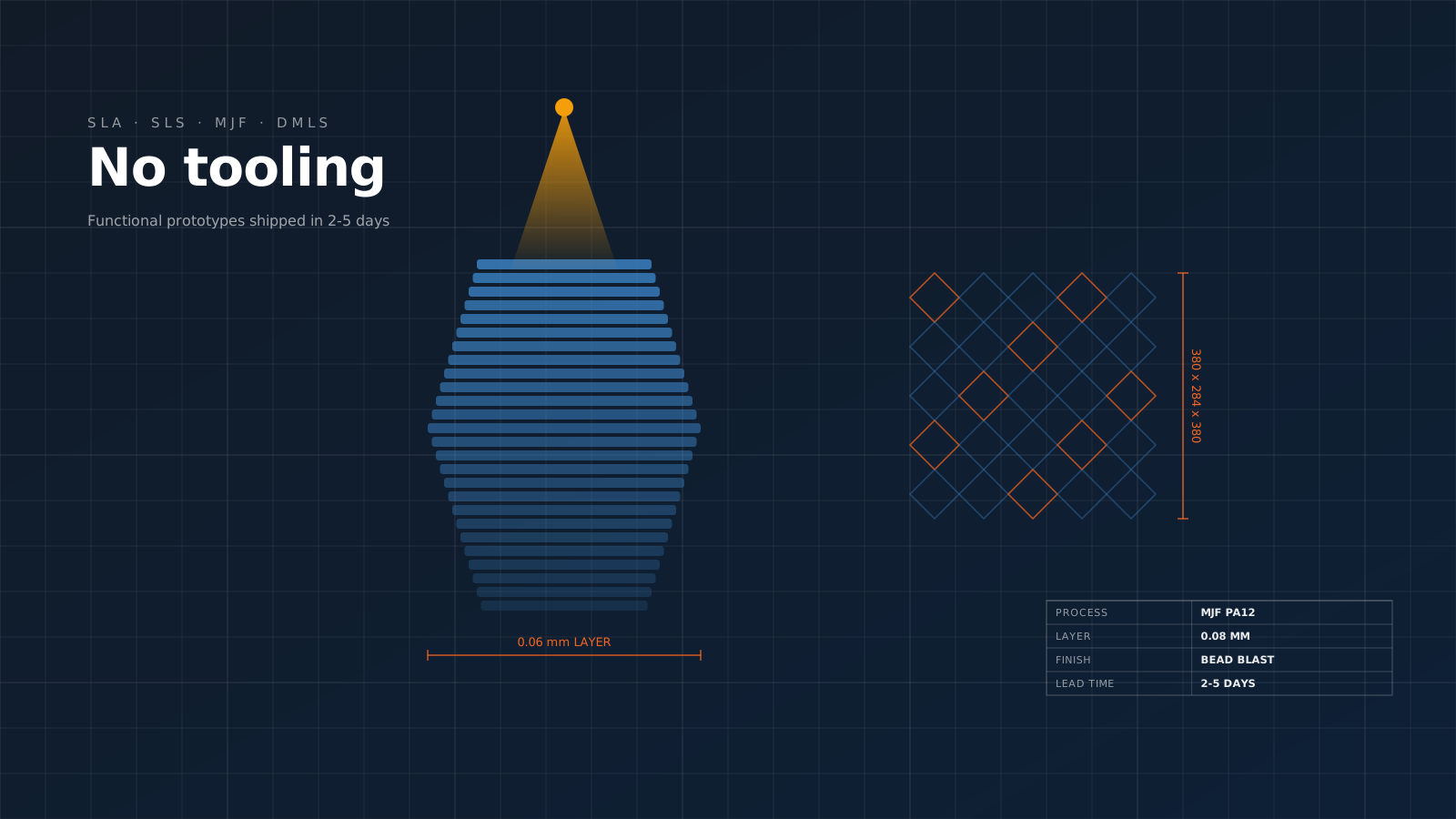
Print-grade parts. Production-ready. Shipped in 2–5 days.
SLA, SLS, MJF and DMLS metal — on industrial printers from EOS, HP and Formlabs. 20+ production-grade materials. Free DFM review, MOQ = 1, worldwide shipping.
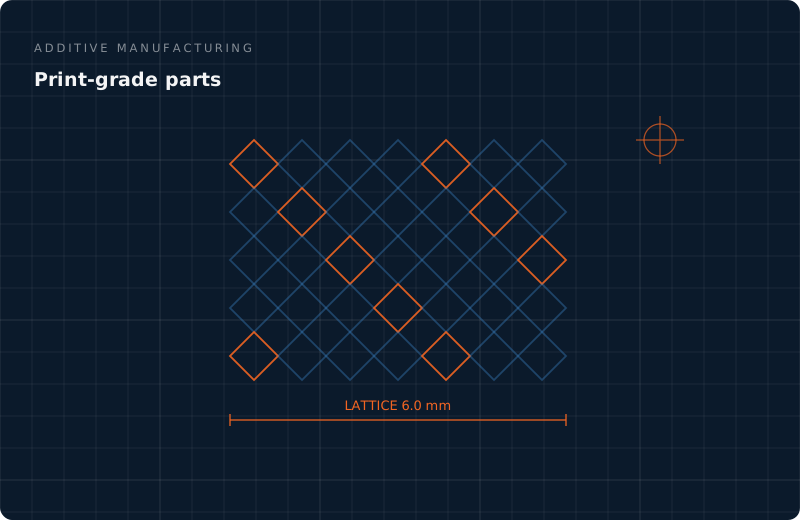
3D printing service
Each process has different material properties, surface finish, and cost economics. The wrong choice can double your lead time or leave you with parts that fail in service.
Four 3D printing technologies. Pick the right one.
Key data
- Resolution
- 50–100 µm layer
- Build
- 380×284×380 mm
- Tol
- ±0.1 mm
- Speed
- 2–3 days
- Resolution
- 100 µm layer
- Build
- 340×340×620 mm
- Tol
- ±0.3 mm
- Speed
- 3–5 days
- Resolution
- 80 µm layer
- Build
- 380×284×380 mm
- Tol
- ±0.3 mm
- Speed
- 3–5 days
- Resolution
- 30 µm layer
- Build
- 250×250×300 mm
- Tol
- ±0.1 mm
- Speed
- 5–10 days
Each process has different material properties, surface finish, and cost economics. The wrong choice can double your lead time or leave you with parts that fail in service.
SLA · Stereolithography
Uses a UV laser to cure liquid photopolymer. Smoothest surface finish of any 3D process, near-class-A cosmetic. Ideal for visual prototypes, display models, concept reviews and master patterns for vacuum casting.
Standard resin, tough (ABS-like), rigid (10K modulus), high-temp (238 °C HDT), flexible (Shore A 70), clear, biocompatible (Class VI), castable
SLS · Selective Laser Sintering
Laser sinters fine nylon powder layer by layer — no support structures needed, so complex geometries print at no extra cost. Functional parts, living hinges, snap fits, end-use brackets. Slightly rough surface, excellent impact resistance.
PA12 (nylon), PA11, PA12-GF (glass-filled), PA12-CF (carbon-filled), PA12-FR (flame retardant), TPU elastomer
MJF · Multi Jet Fusion (HP 5200)
Inkjets fusing + detailing agents, fuses with IR. More isotropic mechanical properties than SLS. Faster for larger batches. Black parts have class-A appearance after bead blast. Production-grade for 1–10,000 part runs.
PA12, PA11, PA12-GB (glass-bead), PA12-GF, TPU, PP (polypropylene), ESD-safe variants
DMLS · Direct Metal Laser Sintering
Laser melts fine metal powder. Enables geometries impossible in CNC: conformal cooling channels, lattice structures, topology-optimized aerospace brackets. Post-HIP and machining bring parts to flight-qualified condition.
Titanium Ti-6Al-4V, aluminum AlSi10Mg, stainless steel 316L / 17-4 PH, Inconel 625, Inconel 718, tool steel MS1
When 3D printing is the right call.
Complex internal geometry
Conformal cooling, internal lattices, hollow parts — impossible to machine, trivial to print. Metal 3DP dominates aerospace bracket optimization.
Fast-iteration prototypes
From CAD to part in 48 hours for SLA. Iterate 3× per week instead of 3× per month. Critical for startup hardware timelines.
Low-volume production (1–500)
Below ~500 parts, MJF/SLS often beats injection molding total cost because there's no tooling amortization. No MOQ, no setup charges per batch.
High-mix, low-volume parts
Dozens of different geometries in tiny quantities — ideal for medical, dental, and custom fixturing where every part is different.
Parts with undercuts or inaccessibility
Internal features CNC cutters cannot reach. Assemblies that 3D print in one piece, eliminating fasteners and tolerance stack-up.
Topology-optimized structures
Weight reduction via generative design. Metal 3DP brackets routinely 40–60% lighter than machined equivalents with equal stiffness.
3D printing isn't a universal replacement for CNC or injection molding — but for the right part, it's 10× faster and cheaper. Here's when to choose it.
Technology deep dives
Print-grade parts — questions
Which 3D printing technology should I choose?
SLA (stereolithography) for smooth cosmetic prototypes and high-detail jigs. SLS (selective laser sintering) for functional nylon parts that need impact resistance. MJF (multi-jet fusion) for production-grade PA12 parts with isotropic properties. DMLS for metal parts in titanium, aluminum, stainless steel or Inconel. A full comparison is in our process matrix below.
What is the largest part you can 3D print?
Our maximum build envelope across all printers: SLA 380 × 284 × 380 mm, SLS 340 × 340 × 620 mm, MJF 380 × 284 × 380 mm, DMLS 250 × 250 × 300 mm. Larger parts can be printed in sections and bonded or mechanically assembled — consult our engineers for parts exceeding these dimensions.
How fast can you deliver 3D printed parts?
Standard lead time is 2–5 business days for SLA/SLS/MJF, 5–10 days for DMLS metal, excluding international shipping. Rush service at 24–48 hours available on request for SLA prototypes under 150 mm. Lead time includes post-processing (support removal, cleaning, and basic finishing).
What tolerances can 3D printing hold?
SLA: ±0.1 mm or ±0.2% of the dimension (whichever is greater). SLS/MJF: ±0.3 mm or ±0.3%. DMLS: ±0.1 mm or ±0.2% in the as-printed state; tighter tolerances achievable with post-machining of critical features. For functional tolerances below these ranges, we recommend hybrid workflows: print the geometry, then CNC-finish the mating surfaces.
Can 3D printed parts be used for end-use production?
Yes. MJF and SLS nylon PA12 is used in production for thousands of applications including medical devices, aerospace ducting, automotive brackets and industrial housings. DMLS titanium is flight-qualified. SLA parts are typically for prototypes, fixtures and tooling rather than end-use.
What post-processing is available for 3D printed parts?
Support removal, bead blasting, vapor smoothing (nylon), dyeing (multiple colors), painting, clear coating, sanding to class-A cosmetic, CNC finishing of critical features, heat treatment (metal), HIP (hot isostatic pressing for DMLS). For cosmetic parts we can achieve appearance comparable to injection molded surfaces.
Do you 3D print in biocompatible or flame-retardant materials?
Yes. Biocompatible SLA resins (USP Class VI, skin contact) available. Flame-retardant SLS PA12 FR (UL 94 V-0). ESD-safe SLS and MJF materials available. Medical grade Ti-6Al-4V for DMLS. Full material datasheets available on request.
What file formats do you accept for 3D printing?
STL is the standard format. Also accepted: STEP, IGES, 3MF, OBJ, X_T (Parasolid). For color MJF parts, include color data in 3MF or OBJ+MTL. Minimum feature size: 0.5 mm for SLA, 0.8 mm for SLS/MJF, 0.3 mm for DMLS.
Keep reading
Quote
Get a free CNC machining, 3D printing, injection molding quote from PifyC. Send CAD via WhatsApp or email — q…
Read more →Additive manufacturingSLA 3D printer
Industrial SLA and DLP stereolithography from PifyC. 50–100 µm layer resolution, build volume up to 380 × 284…
Read more →Additive manufacturingSLS printer technology
Production-grade SLS and MJF 3D printing: nylon PA12, PA11, glass-filled PA12-GF, carbon-filled PA12-CF, flame-r…
Read more →Additive manufacturingMetal 3D printing
Direct Metal Laser Sintering (DMLS) from PifyC: titanium Ti-6Al-4V, aluminum AlSi10Mg, stainless 316L, Incone…
Read more →Additive manufacturingOvernight 3D printing
Overnight 3D printing service: SLA resin parts next-day, SLS nylon parts 48 hours, MJF parts 48 hours. Upload ST…
Read more →Additive manufacturingLarge format 3D printing
Large format 3D printing service: parts up to 900 mm via large-format SLS, industrial FDM, and segmented assembl…
Read more →Additive manufacturingMJF 3D printing service
HP Multi Jet Fusion (MJF) 3D printing: best surface finish in nylon, production-scale batch processing, faster t…
Read more →Additive manufacturingMetal 3D printing DMLS
Metal 3D printing service: DMLS/SLM (Direct Metal Laser Sintering/Selective Laser Melting). Ti Gr.23, Inconel 71…
Read more →
Send a CAD file. Get an engineering-reviewed quote.
No minimum quantity, free DFM feedback from a senior manufacturing engineer, and an NDA signed before file review on request.