
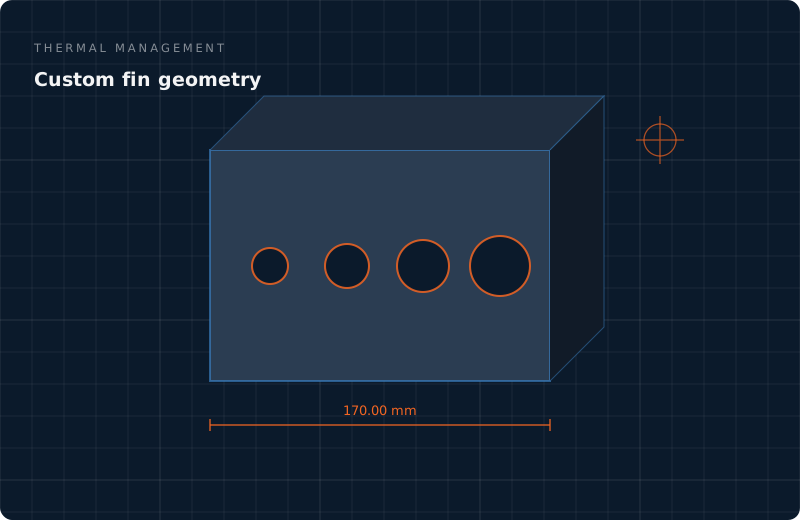
Custom fin geometry. Pin fin arrays. Liquid cold plates.
CNC machined heat sinks and thermal management hardware for custom applications. Custom fin patterns, pin fin arrays, liquid cold plates, embedded heat pipes. 6063 aluminum, OFE copper, Mo-Cu composites. LED drivers, lasers, power electronics, CPU thermal.
CNC for heat sinks
Different thermal challenges call for different heat sink architectures. Here's what we build most often.
Heat sink types we build.
Extruded-profile finned
Standard extruded aluminum profiles cut and machined to length. Added features: mounting holes, precision flatness.
CNC-milled fin arrays
Fully CNC-machined fin geometry. Custom spacing, orientation, non-uniform patterns for optimized heat transfer.
Pin fin arrays
Pin fin geometry maximizes surface area per volume. Used for high-density thermal management.
Liquid cold plates
Cold plates with internal serpentine liquid channels. Machined base + brazed cover for leak-tight liquid cooling.
Cross-cut fin
Crossed-fin patterns for omnidirectional airflow — used when airflow direction varies.
Heat spreaders
Thermal interface hardware matching CTE to semiconductor. Mo-Cu for silicon/GaAs matching.
Heat pipe integrated
Heat sinks with embedded heat pipes for spreading heat from point sources.
LED heat sinks
High-volume LED luminaire heat sinks. Optimized for thermal + manufacturing cost.
Cryogenic cold plates
Cryogenic cold plates for liquid nitrogen or helium cooling. OFE copper for thermal conductivity at cryogenic temperature.
Different thermal challenges call for different heat sink architectures. Here's what we build most often.
Thermal customers we serve.
Power electronics
IGBT baseplates, traction inverter heat sinks, server power supply thermal
Laser manufacturers
Laser diode heat sinks, laser cavity cooling, high-power laser thermal management
LED luminaires
Industrial and commercial LED thermal — outdoor, indoor, street lighting
CPU/GPU cooling
High-performance computing and server rack cooling hardware
Automotive electronics
EV motor controller, on-board charger thermal management
Medical imaging
MRI gradient amplifier cooling, X-ray tube thermal management
Aerospace electronics
Avionics and satellite electronics thermal management
Telecom infrastructure
5G base station thermal, network switch cooling
Research equipment
Scientific instrument thermal management, laser laboratory hardware
Get an instant quote
Send your CAD — we reply with detailed pricing, lead time, and DFM feedback within 4 working hours.
Talk to an engineer
WhatsApp our team directly. Most messages answered within 12 minutes during work hours.
Explore all services
CNC, 3D printing, injection molding, sheet metal, casting, finishing — one quality system, one partner.
Custom fin geometry — questions
Aluminum vs copper for heat sinks?
Aluminum 6061: 167 W/m·K conductivity. 6063: 201 W/m·K (extruded alloy). Copper C101: 391 W/m·K (2.4× aluminum). Weight: copper 3× aluminum. Cost: copper 2-3× aluminum. For cost-sensitive consumer/industrial: aluminum. For maximum thermal performance regardless of cost/weight: copper. Common compromise: copper base/embedded heat pipes with aluminum fins. We can design and manufacture either.
Liquid cold plate vs air-cooled?
Air-cooled: simpler, cheaper, no fluids or pumps. Limited to ~100 W/cm² thermal flux with aggressive fan cooling. Liquid-cooled: 500-1,000+ W/cm² achievable. Requires pump, coolant, plumbing, reservoir. For very high-density (EV motor controllers, laser diode arrays): liquid. For moderate density (most industrial): air cooling adequate. Design decisions made with thermal analysis.
Fin thickness limits in CNC?
Practical CNC fin minimum: 0.5 mm thickness, 5 mm spacing (for machining access). Below 0.5 mm, fins bend during machining. For very fine fin geometry, extruded profiles (0.8 mm thickness, 1.5 mm spacing achievable) are better than CNC. Or: skived fin geometry (specialty process) for very fine features. CNC wins on custom shapes extrusion cannot produce.
Surface treatment for thermal performance?
Black anodize: +3-5 °C improvement vs bare aluminum on radiation-dominated cooling. Also provides thermal emissivity ~0.85 vs 0.1 for bare. For radiative cooling in vacuum or high-temperature: critical. For forced-air convection: marginal benefit. Nickel plating: protects copper from oxidation in long-term service. Specify surface treatment during design based on thermal analysis.
Heat pipe integration?
Heat pipes dramatically improve heat sink effectiveness by spreading heat from concentrated source across fin area. Standard practice: machine heat sink base with grooves matching heat pipe diameter, solder or thermally-epoxy heat pipes into grooves, ensure continuous thermal path. Heat pipe performance up to 50,000 W/m·K effective conductivity. For high-heat-flux point sources, heat pipe integration is often essential.
Lead times for custom heat sinks?
CNC-machined heat sinks: 7-14 days. Liquid cold plates with brazed lids: 3-4 weeks. Custom extrusion-based (requires die): 6-8 weeks if new die needed, 2-3 weeks if existing extrusion. Complete thermal systems with integration (pumps, controls): 8-16 weeks. For prototype validation, CNC is fastest path; for production, consider extrusion economics.
Keep reading
Quote
Get a free CNC machining, 3D printing, injection molding quote from PifyC. Send CAD via WhatsApp or email — q…
Read more →Material-specific partsCustom copper parts
Custom copper parts: OFE copper C101 for electrical conductivity, C110 for general copper, C17200 BeCu for sprin…
Read more →MachiningCNC machine
ISO 9001 certified CNC machining in Wuxi, China. 3, 4 and 5-axis milling, Swiss turning, 40+ materials, ±0.01 mm…
Read more →Additive manufacturing3D printing service
Industrial-grade 3D printing from Wuxi, Jiangsu, China: SLA, SLS, MJF and DMLS metal. Functional prototypes and …
Read more →Moulding & castingInjection molding
Plastic injection molding from China: rapid aluminum tooling in 14 days for 500–10,000 parts, production P20/H13…
Read more →Sheet metal & fabricationSheet metal
Precision sheet metal fabrication from Wuxi: 4 kW fiber laser cutting, Amada press brake bending (±0.1 mm), TIG/…
Read more →Finishing & treatmentFinishing services
Complete in-house surface finishing: Type II/III anodize, powder coating, electroplating, passivation, bead blas…
Read more →PifyCMaterials
PifyC's 50+ production-grade materials: aluminum, stainless steel, titanium, brass, copper, and engineering p…
Read more →Send a CAD file. Get an engineering-reviewed quote.
No minimum quantity, free DFM feedback from a senior manufacturing engineer, and an NDA signed before file review on request.