
ISO 9001:2015ITAR RegisteredRoHS · REACHLead time from 3 business daysMOQ = 1 part
PifyC
Services
Materials
Industries
Applications
Resources
Locations
Company
Request a quote
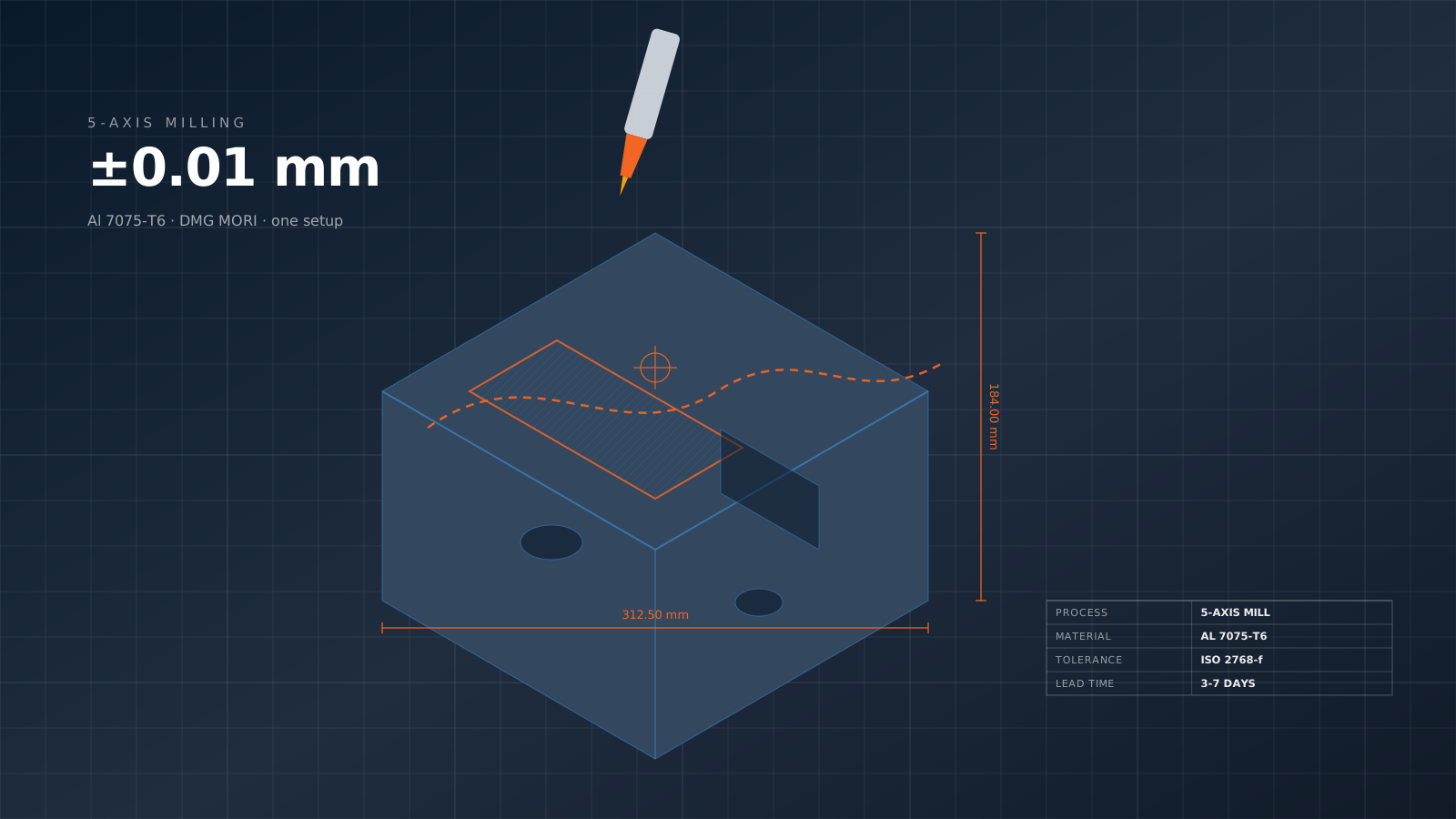
5-axis CNC milling drawing: Al 7075-T6 block with pockets, toolpath and dimensions
Press Fit vs Adhesive

Interference pressure. Or chemical bond. Both permanent.

For permanent cylindrical joint assembly, press fit uses dimensional interference. Adhesive bonding uses chemical bonding. Both produce permanent joints but with very different properties, assembly requirements, and failure modes.

Design for manufacturingWuxi, ChinaMOQ 1 partDFM review included

Side-by-side summary.

Press Fit (Interference)

Shaft slightly larger than hole. Forced assembly creates radial pressure and friction-based retention. No adhesive needed. Permanent but reversible with force. Standard for bearings, shaft couplings.

Adhesive Bonding (Loctite retaining)

Anaerobic adhesive applied to clearance-fit joint. Cures in absence of air. Fills gap, provides structural bond, locks threaded assemblies. Dissolves with heat (200°C). Adaptable to various gap sizes.

Feature-by-feature breakdown.

AttributePress FitAdhesive Bonding
Holding mechanismFriction from pressureChemical bond
Gap requirementInterference (0.005-0.05 mm)Clearance (0.05-0.2 mm)
Assembly forceHigh (arbor press)None (slip fit)
DisassemblyHigh force requiredHeat to 200°C (organics burn off)
Surface finish requiredRa 0.8 µm or betterRa 1.6-3.2 µm OK
Temperature service-200 to +400°CUp to 200°C (typical)
Strength (axial load)10-50 kN (typical)5-30 kN (typical)
Strength (rotational)ExcellentExcellent
Stress on componentsHigh (fatigue, creep)Low
Surface contamination sensitivityLowHigh (must be clean)
Speed of assemblyImmediateCure time (minutes to hours)
Typical applicationsBearings, gears, shaftsThread locking, motor assembly

When to choose each.

Choose Press Fit (Interference) when:

Choose Adhesive Bonding (Loctite retaining) when:

Get an instant quote

Send your CAD — we reply with detailed pricing, lead time, and DFM feedback within 4 working hours.

Talk to an engineer

WhatsApp our team directly. Most messages answered within 12 minutes during work hours.

Explore all services

CNC, 3D printing, injection molding, sheet metal, casting, finishing — one quality system, one partner.

Working on a live project? Send the STEP file and the two or three features you are unsure about — an engineer replies with DFM notes and a price, usually within four working hours.

FAQ

Interference pressure — questions

How much interference for press fit?

Typical light press: 0.005-0.015 mm per 10mm diameter. Standard press (H7/p6): 0.015-0.035 mm/10mm. Heavy press (H7/u6): 0.035-0.08 mm/10mm. Shrink fit: 0.05-0.15 mm/10mm (requires heating housing). Too much interference: cracks housing or yields shaft. Too little: slides under load. Design per ISO 286 or custom calculated for specific load. Our press fit experience covers most standard applications.

Adhesive strength limits?

Anaerobic adhesives (Loctite 603, 638 for retaining compounds): shear strength 20-35 MPa on small-gap joints. Bond fills 0.05-0.2 mm gap. For larger gaps, structural adhesives (epoxies): 15-25 MPa. Compared to press fit: press fit strength can exceed adhesive if properly designed. Adhesive strength degrades with temperature (most limited to 150°C), with chemistry exposure, over time. Press fit doesn't age.

When press fit is risky?

Thin-wall outer component (housing): too much interference cracks the housing. Rule of thumb: housing OD should be at least 2× hole diameter. For thin-wall applications, use adhesive instead. Similarly, high-strength ceramic or hardened steel with little ductility — cracks easily under interference stress. Choose adhesive for thin-wall or brittle material assemblies.

Adhesive cure time?

Anaerobic adhesives (no air): cure in 5-20 minutes in active joints (metal), 30-120 minutes on inactive surfaces (stainless, plated). Fixture cures in 30 minutes, full strength 24 hours. For production assemblies, cure time affects throughput. Accelerators (primer) reduce cure time significantly. For assemblies requiring immediate loading, press fit or mechanical fastening better.

Disassembly needs?

Press fit: disassembly requires pulling force equal or greater than assembly force. Bearing puller or hydraulic press needed. Can damage parts during removal. Adhesive: heat joint to 200°C+ to decompose anaerobic adhesive, then slip-fit disassembly easy. Preferred when: (1) periodic service required, (2) damage to parts during disassembly unacceptable, (3) field serviceability important.

Mixing press fit + adhesive?

Yes — common practice. Small interference (just enough to hold for assembly) + adhesive for locking. Benefits: reduced assembly force vs full press fit, eliminated slip risk of pure adhesive, tolerance accommodation from gap. Typical for: automotive manufacturing, motor assembly, precision instruments. Design considerations: ensure adhesive fills gap, clean both surfaces before assembly.

5-axis CNC milling drawing: Al 7075-T6 block with pockets, toolpath and dimensions

Send a CAD file. Get an engineering-reviewed quote.

No minimum quantity, free DFM feedback from a senior manufacturing engineer, and an NDA signed before file review on request.