
Internal threads. Any size, any material. Tap or thread mill.
Complete internal threading capability: production tapping for standard holes, thread milling for tight tolerances and hard materials, heli-coil installation for high-cycle applications. Any thread standard (UNC, UNF, metric, pipe, BSP).
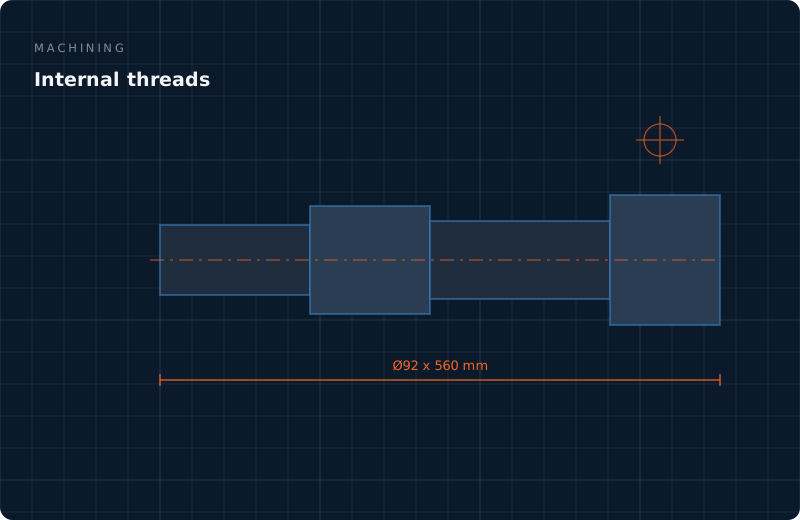
Tapping services
Internal threading (creating threads inside a hole) is accomplished through three primary processes, each suited to different applications:
How Tapping works.
Internal threading (creating threads inside a hole) is accomplished through three primary processes, each suited to different applications:
Tapping: A fluted cutting tool (tap) is rotated into a pre-drilled hole, cutting the thread as it advances. Fast, standard, adequate for most applications. Limited tolerance (Class 2B/6H typical), doesn't work well in hardened materials, can break in blind holes. Standard for production volumes in soft to medium materials.
Thread milling: A small single-point or multi-point thread mill tool spirals through the hole while the CNC machine moves in a helical path. Superior tolerance control, works in hardened materials, handles blind holes well, tool is easily replaced if broken. More expensive than tapping but better for precision.
Heli-coil installation: Tapped hole oversized for insert, then a helical wire coil inserted to provide strong internal threads. Used for: soft materials (aluminum, plastic) where tapped threads would strip, high-cycle applications where threads must survive repeated fastener removal, repair of damaged existing threads.
Capability specs.
Standard metric tapping range. Specialty sizes outside this through thread milling
Standard UNC/UNF range. Tap wrenches handle up to 2" diameter
Default thread class. Class 3B / 4H precision available
Blind tapping requires special taps; through-hole is easier and cheaper
Seconds per tap on CNC — minimal cycle time impact on production
Thread milling works in hardened materials where tapping fails
Thread insert installation for high-strength threads in soft materials
Steel, stainless, aluminum, plastics, titanium, brass — all tappable
Where Tapping excels.
Production fasteners
High-volume CNC production with tapped holes — fast integrated cycle
Aluminum housings
M3, M4, M5 tapped holes in aluminum enclosures and housings
Steel structural
Tapped holes in steel brackets, fixtures, industrial hardware
Hardened steel (thread mill)
Thread milling in tool steel, hardened alloys where tapping fails
Blind holes (thread mill)
Deep blind holes — thread mill avoids tap breakage risk
Pipe threads
NPT, BSPT, BSPP pipe thread tapping for fluid connections
High-cycle threads (heli-coil)
Panels with repeated fastener installation — heli-coil prevents wear
Aluminum strength-critical
Structural aluminum threads using heli-coils for strength
Damaged thread repair
Heli-coil repair of stripped existing threads
Not suitable for:
Every process has its limits. Being honest about where Tapping isn\'t the right answer saves time and money.
- Very large threads (>2") — specialty equipment required
- Non-cylindrical hole shapes — tapping requires round pre-drilled hole
- Materials hard enough that thread mill breaks quickly — wire EDM may be needed
- Situations requiring thread tolerance tighter than Class 3B — grinding or precision thread milling
- Through-holes where exit burrs are critical — may need deburring operation after tapping
Get an instant quote
Send your CAD — we reply with detailed pricing, lead time, and DFM feedback within 4 working hours.
Talk to an engineer
WhatsApp our team directly. Most messages answered within 12 minutes during work hours.
Explore all services
CNC, 3D printing, injection molding, sheet metal, casting, finishing — one quality system, one partner.
Internal threads — questions
Tap vs thread mill — which is better?
Tapping advantages: much faster (seconds per hole), cheaper tool, standard sizes readily available. Thread milling advantages: better tolerance control, works in hardened materials, single tool handles multiple sizes, no breakage risk in blind holes. For production of standard threads in soft-to-medium materials: tap. For precision threads, hardened materials, or blind holes where tap breakage would ruin the part: thread mill. Thread milling is the "safer" choice; tapping is the "faster" choice.
When should I specify heli-coils?
Three scenarios. (1) Soft materials (aluminum, plastic) under high fastener load — tapped threads may strip; heli-coils distribute load better. (2) High-cycle applications — threads installed/removed repeatedly (panels, service covers); tapped threads wear out. (3) Repair of damaged threads — oversized tap and heli-coil restore functional threads. Cost: $2–5 per installed insert. Plan hole size to accommodate insert diameter.
Tap breakage in blind holes?
Classic problem. Tap broken in blind hole is very difficult to remove — often scrapping the part. Mitigations: (1) Use spiral-point taps (push chips forward out of hole). (2) Reduce hole depth to leave clearance below threads. (3) Use thread milling instead — no breakage risk. For critical blind-hole parts, we often specify thread milling automatically to avoid tap breakage incidents.
Tap drill size?
Standard 75% thread engagement. Example: M6 × 1.0 thread needs 5.0 mm tap drill. Reduced engagement (60%) allows larger drill (5.1 mm) for softer materials, easier tapping. Higher engagement (85%) for strength-critical in hard materials. We specify appropriate drill size based on material and application. See our thread standards guide for complete tap drill chart.
Production cost of tapping?
On CNC: tapping integrates into machining cycle. Adds ~2–5 seconds per tapped hole. Cost: essentially negligible on per-part basis for production. For rush or small-batch, tapping can be done on drill press after CNC — slightly more expensive but keeps CNC time focused on primary machining. Thread milling costs slightly more (longer cycle time) but eliminates tap breakage risk and produces better threads.
Lead times?
Standard tapping: no meaningful lead time impact — integrated with CNC production. Specialty threads (non-standard sizes, custom threads): may require custom tooling with 1–2 week lead time. Heli-coil installation: adds 1–2 days to lead time for inserts sourcing and installation. For urgent orders with custom threads, verify feasibility before PO.
Keep reading
Quote
Get a free CNC machining, 3D printing, injection molding quote from PifyC. Send CAD via WhatsApp or email — q…
Read more →Threads, welds & jointsThread standards guide
Complete thread standards reference: ANSI/ASME (UNC, UNF, UNEF), ISO metric coarse and fine, pipe threads (NPT, …
Read more →MachiningCNC machine
ISO 9001 certified CNC machining in Wuxi, China. 3, 4 and 5-axis milling, Swiss turning, 40+ materials, ±0.01 mm…
Read more →Additive manufacturing3D printing service
Industrial-grade 3D printing from Wuxi, Jiangsu, China: SLA, SLS, MJF and DMLS metal. Functional prototypes and …
Read more →Moulding & castingInjection molding
Plastic injection molding from China: rapid aluminum tooling in 14 days for 500–10,000 parts, production P20/H13…
Read more →Sheet metal & fabricationSheet metal
Precision sheet metal fabrication from Wuxi: 4 kW fiber laser cutting, Amada press brake bending (±0.1 mm), TIG/…
Read more →Finishing & treatmentFinishing services
Complete in-house surface finishing: Type II/III anodize, powder coating, electroplating, passivation, bead blas…
Read more →PifyCMaterials
PifyC's 50+ production-grade materials: aluminum, stainless steel, titanium, brass, copper, and engineering p…
Read more →Send a CAD file. Get an engineering-reviewed quote.
No minimum quantity, free DFM feedback from a senior manufacturing engineer, and an NDA signed before file review on request.