
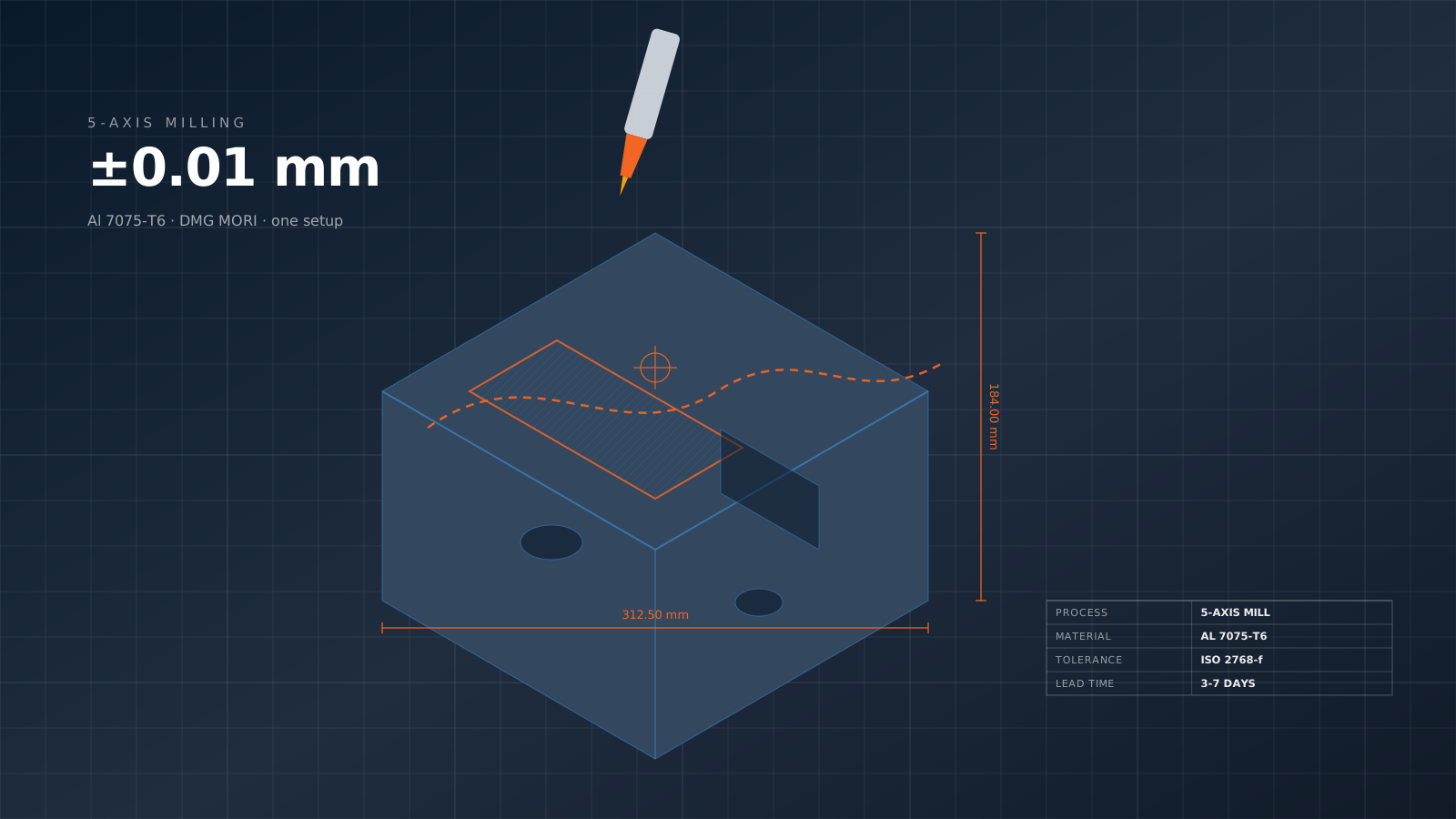
Keyways. Splines. Square holes. Fast & precise.
Broaching cuts complex internal features in a single pass with a multi-tooth tool — keyways, splines, square and hex holes, gear teeth. Fast for production, holds tight tolerance, produces complex profiles other processes cannot.
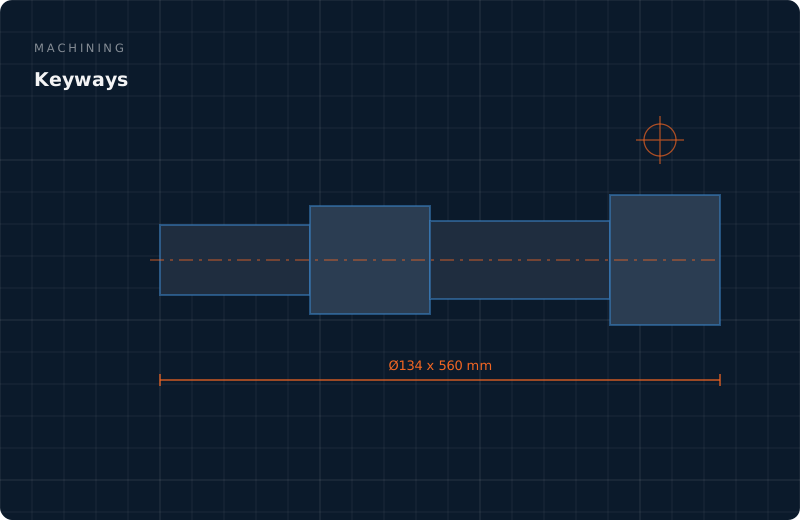
Broaching services
Broaching is a metal-cutting process that uses a multi-tooth tool (broach) to cut a specific profile through a workpiece in a single linear pass. Each tooth of the broach is slightly larger than the previous one, so each tooth removes a small amount of material progressively deeper into the cut. The
How Broaching works.
Broaching is a metal-cutting process that uses a multi-tooth tool (broach) to cut a specific profile through a workpiece in a single linear pass. Each tooth of the broach is slightly larger than the previous one, so each tooth removes a small amount of material progressively deeper into the cut. The result: complex internal profiles cut to final dimension in one stroke.
Linear broaching pulls or pushes the broach through a pre-drilled hole, cutting internal features like keyways, internal splines, square holes, and hex holes. Rotary broaching (polygon turning) uses a rotating broach tool on a lathe to cut external polygonal features like hex heads, square heads, and Torx recesses.
Broaching wins where other processes struggle: complex internal geometry impossible with end mills, production speed (single pass per feature), and excellent surface finish (Ra 0.8 µm typical). Primary limitation: each broach is geometry-specific, so custom profiles require custom tooling ($500–3000+ per broach design).
Capability specs.
Standard broaching tolerance on production work. Tighter achievable with precision broaches
Single-pass finish. Better than milling, comparable to precision grinding
Typical keyway: 5–10 seconds per part. Fastest production process for these features
Internal broaching bore range. Smaller via micro-broach specialty
Steel, stainless, aluminum, brass, Inconel, titanium — any machinable metal
Tooling investment for non-standard profiles. Amortizes over production volume
Spline broaching achieves AGMA class 8 gear tooth quality routinely
Hex, square, Torx external features — rotary broaching on CNC lathe
Where Broaching excels.
Internal keyways
Standard keyways in pulleys, gears, sprockets — single-pass broaching
Internal splines
Involute splines and parallel splines for drive shafts, gear connections
Square holes
Square internal holes for drive features, shaft couplings
Hex holes
Internal hex patterns for fastener recesses, drive connections
Gear teeth
Internal gear teeth in ring gears, planetary gear internal teeth
External hex/square
Rotary broached external hex heads on shafts — socket head fasteners
Torx external
External Torx drive features on fasteners — T-series sizes
Automotive drivetrain
Splined shafts, coupling hubs, drive connections in transmissions
Power transmission
Keyed pulleys, splined gears, sprockets with internal drive features
Not suitable for:
Every process has its limits. Being honest about where Broaching isn\'t the right answer saves time and money.
- Unique/one-off geometry — custom broach cost unjustified for single parts
- Simple features already achievable via milling or wire EDM cost-effectively
- Very hard materials (>55 HRC) — broach tool life too short
- Very small features below 3 mm — specialty micro-broach territory
- Parts where broach pull-through would damage other features
Get an instant quote
Send your CAD — we reply with detailed pricing, lead time, and DFM feedback within 4 working hours.
Talk to an engineer
WhatsApp our team directly. Most messages answered within 12 minutes during work hours.
Explore all services
CNC, 3D printing, injection molding, sheet metal, casting, finishing — one quality system, one partner.
Keyways — questions
When to specify broaching vs keyway milling or EDM?
Volume drives the decision. Single part: end mill a keyway (cheaper setup). Medium volume (10–100): wire EDM the keyway (no custom tooling). High volume (100+ pieces): broach the keyway (fastest per part despite tool cost). Broach tool cost ($500–1500 for standard keyway) amortizes over production — per-part cost drops below other processes above ~100 units.
Tolerances on broached features?
Production broaching: ±0.025 mm standard on keyway widths and depths. Precision broaching (matched broach sets, slower speeds): ±0.01 mm achievable. Broach tooling also wears, so broach sharpness and tool life tracking matters for consistent tolerance. We monitor broach tool condition and replace before tolerance drift.
Can broaching cut hardened material?
Yes up to about 45 HRC. Above that, broach tool life becomes uneconomical — tools dull after a few parts. For hardened materials, alternatives: wire EDM (works on any hardness), grinding of keyways (slower but works on hardened), or broach before heat treatment (then heat treat the whole part if distortion acceptable).
What about external broaching (rotary)?
Rotary broaching (also called polygon turning or wobble broaching) cuts external polygonal features on a CNC lathe. Spinning broach tool, offset slightly from the workpiece axis, "wobbles" around the part creating polygon shape. Common applications: hex heads on shafts, square heads on custom fasteners, external Torx features. Much faster than milling these features.
Custom broach development time?
Custom broach tooling: 3–6 weeks to design and manufacture (cutting broach teeth in hardened tool steel is specialty work). Standard broach geometries (keyway widths per ANSI B17.1): available as stock tooling, no lead time. For custom projects, design broach early in product development to avoid tooling lead time bottlenecking production.
Broaching cost per part?
Production broaching: $0.50–3 per feature cut depending on complexity. Simple keyway at 1000 pieces: <$1 per part. Complex internal spline: $3–5 per part. Amortized tool cost at 5000-part volume: pennies per part. Very cost-effective for production volumes — often cheaper than any alternative for the specified feature.
Keep reading
Quote
Get a free CNC machining, 3D printing, injection molding quote from PifyC. Send CAD via WhatsApp or email — q…
Read more →MachiningCNC milling
Precision CNC milling in Wuxi, China. 3, 4 and 5-axis milling centers from Haas and DMG MORI. ±0.01 mm tolerance…
Read more →MachiningCNC machine
ISO 9001 certified CNC machining in Wuxi, China. 3, 4 and 5-axis milling, Swiss turning, 40+ materials, ±0.01 mm…
Read more →Additive manufacturing3D printing service
Industrial-grade 3D printing from Wuxi, Jiangsu, China: SLA, SLS, MJF and DMLS metal. Functional prototypes and …
Read more →Moulding & castingInjection molding
Plastic injection molding from China: rapid aluminum tooling in 14 days for 500–10,000 parts, production P20/H13…
Read more →Sheet metal & fabricationSheet metal
Precision sheet metal fabrication from Wuxi: 4 kW fiber laser cutting, Amada press brake bending (±0.1 mm), TIG/…
Read more →Finishing & treatmentFinishing services
Complete in-house surface finishing: Type II/III anodize, powder coating, electroplating, passivation, bead blas…
Read more →PifyCMaterials
PifyC's 50+ production-grade materials: aluminum, stainless steel, titanium, brass, copper, and engineering p…
Read more →Send a CAD file. Get an engineering-reviewed quote.
No minimum quantity, free DFM feedback from a senior manufacturing engineer, and an NDA signed before file review on request.