
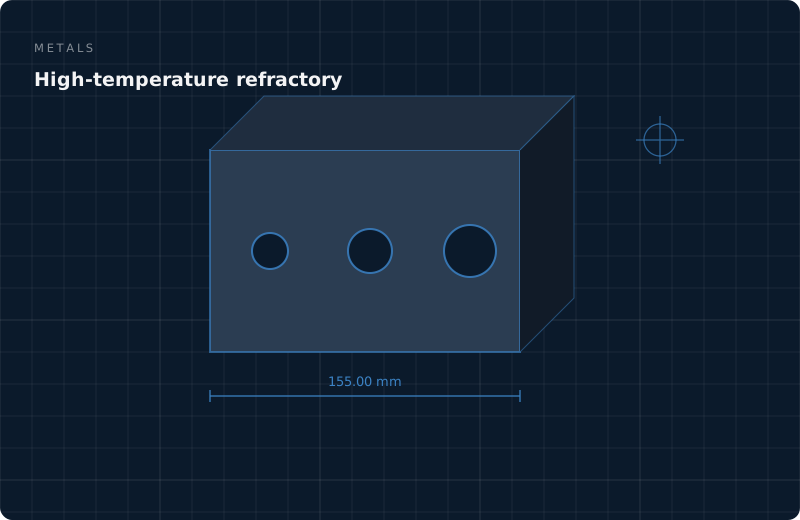
High-temperature refractory. Semiconductor furnace. 1800 °C service.
Molybdenum serves where refractory metals are required — 1800 °C continuous service, low thermal expansion matching semiconductor materials, low activation for nuclear applications. Standard for semiconductor furnace hardware, glass melting electrodes, aerospace hot section.
At a glance
- Density
- 10.28 g/cc
- Tensile strength
- 700 MPa
- Melting point
- 2623 °C
- Young's modulus
- 330 GPa
- CTE
- 5.5 ppm/°C
- Thermal conductivity
- 138 W/m·K
- Electrical resistivity
- 5.3 µΩ·cm
- Non-magnetic
- Yes
Key data
- Density
- 10.28 g/cc
- Tensile strength
- 700 MPa
- Melting point
- 2623 °C
- Young's modulus
- 330 GPa
- CTE
- 5.5 ppm/°C
- Thermal conductivity
- 138 W/m·K
- Electrical resistivity
- 5.3 µΩ·cm
- Non-magnetic
- Yes
Molybdenum variants.
Pure Molybdenum
Commercially pure molybdenum. Standard refractory grade for furnace components, glass melting electrodes.
TZM Alloy
Mo with 0.5% Ti, 0.08% Zr. Higher strength at temperature than pure Mo. Aerospace hot section, forged tooling.
Mo-Cu Composite
Molybdenum matrix infiltrated with copper. CTE matches silicon and GaAs. Used for semiconductor heat spreaders, IC packaging.
Mo-Re Alloy
Molybdenum with rhenium for ductility. Used for thermocouple wire, nuclear applications.
Mo-La Alloy
Lanthanum oxide dispersed in Mo. Better creep resistance at high temperature. Used for glass industry, lighting filaments.
Mo Sheet
Rolled Mo sheet in thicknesses from 0.1 mm to 10 mm. Standard form for furnace shields, reflectors.
Pure Mo for basic applications, TZM alloy for improved strength at temperature, Mo-Cu composite for semiconductor heat spreaders.
Why molybdenum.
High temperature
1800 °C continuous service — far beyond any steel or superalloy. Glass melting, semiconductor furnace, vacuum furnace hot zones.
Low thermal expansion
5.5 ppm/°C matches sapphire and silicon. Used for semiconductor packaging where CTE mismatch causes failures.
High thermal conductivity
138 W/m·K — 3× typical steel. Makes Mo-Cu heat spreaders effective for high-power semiconductors.
Low neutron cross-section
Nuclear applications — Mo is used where low neutron absorption matters (reactor structural, waste handling).
Molybdenum occupies a niche: higher temperature than steel, lower cost than tungsten or tantalum, well-understood refractory metal.
Molybdenum applications.
Semiconductor furnace
Silicon crystal growth hot zones, shields, susceptors — standard material for semiconductor fab equipment
Glass melting electrodes
Direct electrode heating of molten glass in specialty glass manufacturing
Vacuum furnace components
Hot zone structural components, radiation shields, support hardware
Sapphire growth
Crucibles for sapphire crystal growth for LEDs and watch glass
Aerospace hot section
Rocket engine components, hot structural parts in hypersonic applications
Semiconductor heat spreaders
Mo-Cu composite for high-power IC thermal management
Lighting filaments
High-temperature lighting filament hardware
X-ray anode
X-ray tube anode material for medical and industrial X-ray equipment
Nuclear fuel cladding
Specialty nuclear fuel cladding applications — low neutron absorption
Molybdenum finishing.
As-machined
Silver-grey. Brittle in air at room temperature — careful handling. Ra 1.6 µm typical.
Ground
Precision grinding for tight tolerances on Mo components.
Stress relief
Post-machining stress relief at 1200-1300 °C in hydrogen or vacuum reduces residual stress, prevents brittle fracture.
Vacuum cleaned
Ultrasonic + vacuum cleaning for semiconductor applications — zero contamination critical.
Welded
Electron beam or TIG welding in ultra-dry inert atmosphere. Mo absorbs oxygen catastrophically above 400 °C in air.
Brazed
Brazing in vacuum with nickel or copper-silver filler. Standard for joining Mo to dissimilar metals.
Polished
Mirror finish achievable. Used for radiation reflectors and optical-grade applications.
Coated
Silicide or aluminide coatings protect Mo from oxidation during use above 500 °C in air.
Get an instant quote
Send your CAD — we reply with detailed pricing, lead time, and DFM feedback within 4 working hours.
Talk to an engineer
WhatsApp our team directly. Most messages answered within 12 minutes during work hours.
Explore all services
CNC, 3D printing, injection molding, sheet metal, casting, finishing — one quality system, one partner.
High-temperature refractory — questions
Why does Mo oxidize badly in air?
Molybdenum forms volatile MoO3 above 500 °C in oxidizing atmosphere — the oxide sublimes away, exposing fresh metal, which oxidizes further. Catastrophic loss of material. In vacuum or inert atmosphere, Mo is stable to 1800 °C+. In reducing atmosphere (hydrogen), similar. For Mo service above 500 °C in air: oxidation-resistant coating required (silicide, aluminide), or switch to oxidation-resistant refractory (e.g., niobium alloys).
Pure Mo vs TZM alloy?
Pure Mo: 550 MPa strength at room temperature, 200 MPa at 1000 °C. Standard for shields, structural in vacuum. TZM alloy: 900 MPa at room temp, 500 MPa at 1000 °C. Better creep resistance. Used where Mo must maintain strength at temperature. TZM is premium cost (roughly 2× pure Mo) — justify only when elevated-temperature strength is needed.
Machining Mo — special considerations?
Pure Mo is brittle at room temperature — can crack from over-aggressive machining. Sharp tools, light cuts, moderate speeds. TZM is slightly tougher but similar. Use carbide tooling, flood coolant, climb milling. Avoid sharp notches in design (stress concentrators). Plan for slightly longer machining time vs steel. Our experience includes Mo furnace components for semiconductor industry.
Mo-Cu heat spreaders for electronics?
Molybdenum matrix infiltrated with copper. Balances thermal conductivity (from Cu) with low thermal expansion (from Mo). CTE can be tuned from 5-12 ppm/°C by adjusting Cu content. Matches silicon (3 ppm/°C), GaAs (6 ppm/°C), and ceramic packaging materials. Critical for high-power RF electronics, laser diode mounts, power transistor thermal management. Standard product form for semiconductor packaging.
Cost of Mo parts?
Pure Mo raw material: $50-100/kg. TZM: $80-150/kg. Mo-Cu: $100-200/kg. Machining similar cost to steel. Finishing (grinding, stress relief) adds cost. Typical finished Mo parts: 3-5× cost of equivalent steel parts. For applications where Mo's unique properties are needed, cost is justified by enabling the application.
Lead times?
Pure Mo: 3-4 weeks for standard bar stock sizes. TZM: 4-6 weeks. Mo-Cu composites: 6-8 weeks. Sheet Mo: 2-3 weeks for standard thicknesses. Custom sizes: add 2-4 weeks. With stress relief or coating: add 1-2 weeks. Plan 6-10 weeks for typical Mo project lead time.
Keep reading
Quote
Get a free CNC machining, 3D printing, injection molding quote from PifyC. Send CAD via WhatsApp or email — q…
Read more →PifyCMaterials
PifyC's 50+ production-grade materials: aluminum, stainless steel, titanium, brass, copper, and engineering p…
Read more →MachiningCNC machine
ISO 9001 certified CNC machining in Wuxi, China. 3, 4 and 5-axis milling, Swiss turning, 40+ materials, ±0.01 mm…
Read more →Additive manufacturing3D printing service
Industrial-grade 3D printing from Wuxi, Jiangsu, China: SLA, SLS, MJF and DMLS metal. Functional prototypes and …
Read more →Moulding & castingInjection molding
Plastic injection molding from China: rapid aluminum tooling in 14 days for 500–10,000 parts, production P20/H13…
Read more →Sheet metal & fabricationSheet metal
Precision sheet metal fabrication from Wuxi: 4 kW fiber laser cutting, Amada press brake bending (±0.1 mm), TIG/…
Read more →Finishing & treatmentFinishing services
Complete in-house surface finishing: Type II/III anodize, powder coating, electroplating, passivation, bead blas…
Read more →MetalsTungsten parts
Precision CNC machining of pure tungsten and tungsten heavy metal (W-Ni-Fe, W-Ni-Cu). Extreme density (19.3 g/cc…
Read more →Send a CAD file. Get an engineering-reviewed quote.
No minimum quantity, free DFM feedback from a senior manufacturing engineer, and an NDA signed before file review on request.