
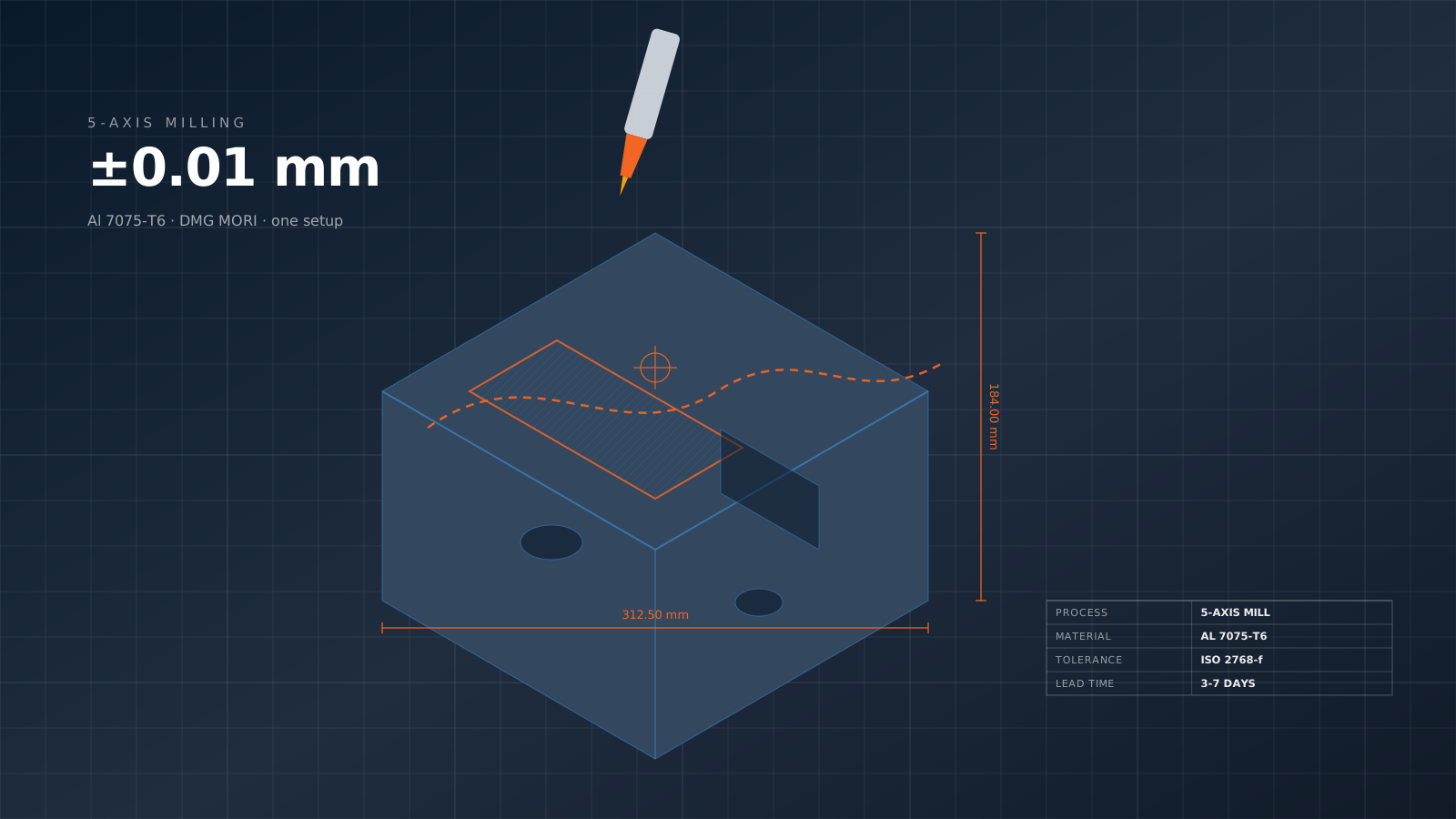
Same supplier. Prototype → production. Faster launch.
Single-source manufacturing through complete product lifecycle: prototype → functional validation → pilot production → mass production. Reduces supplier qualification time, maintains quality consistency, eliminates technology transfer risk between suppliers.
Prototype to production
Single supplier through all stages eliminates qualification time and quality variation between suppliers. Especially valuable for regulated industries.
Lifecycle stages we support.
Concept prototypes
Initial concept validation. SLA or MJF 3D printing for visual + functional review. Lead time 2-5 days. Cost: low.
Functional prototypes
Functional validation in production-like material. CNC machining of metal/plastic parts. Lead time 1-3 weeks. Cost: moderate.
Engineering verification
Engineering verification testing (EVT) — mechanical, environmental, regulatory testing. Multiple iterations expected. Lead time 3-6 weeks per iteration.
Design verification
Design verification testing (DVT) — production-representative samples. Often using pre-production tooling or representative process.
Pilot production
Pilot production for market validation, regulatory samples, beta testing. Often using rapid tooling or transitional process.
Production ramp
Production launch ramp. Scaling from pilot to commercial production. Quality stabilization, process optimization.
Sustained production
Ongoing production at commercial scale. Continuous improvement, cost optimization, quality maintenance.
Engineering changes
Design changes during production — managed through ECN process with appropriate validation.
End-of-life
End-of-life support — last-time buy quantities, transition to replacement product, service spares.
Single supplier through all stages eliminates qualification time and quality variation between suppliers. Especially valuable for regulated industries.
Single-source advantages.
No re-qualification
Same supplier means no re-qualification at each stage
Quality consistency
Same quality team, same processes, predictable results
DFM continuity
DFM lessons from each stage applied to next
Tool / fixture continuity
Tooling investments build on each other through stages
Documentation continuity
Single documentation chain from prototype through production
Supplier relationship
Long-term relationship — cost optimization, problem solving
Faster launch
Eliminate supplier transition delays
Reduced risk
Known supplier reduces production launch risk
Cost optimization
Volume scaling justifies process improvements over time
Get an instant quote
Send your CAD — we reply with detailed pricing, lead time, and DFM feedback within 4 working hours.
Talk to an engineer
WhatsApp our team directly. Most messages answered within 12 minutes during work hours.
Explore all services
CNC, 3D printing, injection molding, sheet metal, casting, finishing — one quality system, one partner.
Same supplier — questions
When should I commit to single-source?
Single-source most valuable when: (1) Regulatory pathway expected (medical, aerospace) — supplier change requires re-qualification. (2) Production volumes will exceed 1000-5000 units. (3) Long product life (3+ years). (4) Complex parts where supplier learning matters. For simple commodity parts or short product runs, multiple suppliers may be appropriate. For complex products with long lifecycle, single-source through PifyC valuable.
How does pricing work across stages?
Pricing scales with volume — prototype prices reflect setup overhead and small quantities. Production prices reflect amortization over volume and process efficiencies. Typical pricing: prototype $200-2000 per unit, production $20-200 per unit (10× reduction common). Customer not locked into prototype pricing — prices renegotiated for production volumes. Transparent cost structure — customer sees how pricing changes with volume.
Can I take prototype to other supplier for production?
Yes — customer always free to take design elsewhere. We do not lock customers into our supply chain. However: (1) Re-qualification at new supplier costs time and money. (2) New supplier has learning curve. (3) Tooling investments stay with original supplier. (4) DFM lessons learned with us must be transferred. Most customers find it more cost-effective to continue with original supplier through production. Decision is customer's.
What if production volumes don't materialize?
Common reality — many products have lower production volumes than projected. We handle this gracefully: (1) Production volumes adjusted as actual demand develops. (2) Tooling investments recovered through volume buildup if possible. (3) Per-unit pricing adjusted as volumes settle. (4) End-of-life buys supported. We commit to long-term relationship even if volumes are smaller than expected.
Engineering change management?
Production ECNs (Engineering Change Notices) handled through standard process: (1) Customer notifies of change. (2) We assess impact (cost, schedule, validation needed). (3) Customer approves cost/schedule impact. (4) Implementation per agreed schedule. (5) Validation per customer requirement (FAI re-execution if needed). (6) Production transition managed for inventory consumption. Standard process protects both parties through change.
End-of-life support?
For products approaching end-of-life: (1) Last-time-buy quantity coordinated. (2) Specific spares production for warranty service. (3) Tool retirement or storage for future spares. (4) Documentation archive maintained per industry retention. (5) Materials sourcing for legacy production may be challenging — we work with customer through obsolescence issues. End-of-life is part of full lifecycle support.
Keep reading
Quote
Get a free CNC machining, 3D printing, injection molding quote from PifyC. Send CAD via WhatsApp or email — q…
Read more →Process guidesPrototyping strategy guide
Engineering prototyping strategy: when to 3D print, when to machine, when to urethane cast, when to build toolin…
Read more →MachiningCNC machine
ISO 9001 certified CNC machining in Wuxi, China. 3, 4 and 5-axis milling, Swiss turning, 40+ materials, ±0.01 mm…
Read more →Additive manufacturing3D printing service
Industrial-grade 3D printing from Wuxi, Jiangsu, China: SLA, SLS, MJF and DMLS metal. Functional prototypes and …
Read more →Moulding & castingInjection molding
Plastic injection molding from China: rapid aluminum tooling in 14 days for 500–10,000 parts, production P20/H13…
Read more →Sheet metal & fabricationSheet metal
Precision sheet metal fabrication from Wuxi: 4 kW fiber laser cutting, Amada press brake bending (±0.1 mm), TIG/…
Read more →Finishing & treatmentFinishing services
Complete in-house surface finishing: Type II/III anodize, powder coating, electroplating, passivation, bead blas…
Read more →PifyCMaterials
PifyC's 50+ production-grade materials: aluminum, stainless steel, titanium, brass, copper, and engineering p…
Read more →Send a CAD file. Get an engineering-reviewed quote.
No minimum quantity, free DFM feedback from a senior manufacturing engineer, and an NDA signed before file review on request.