
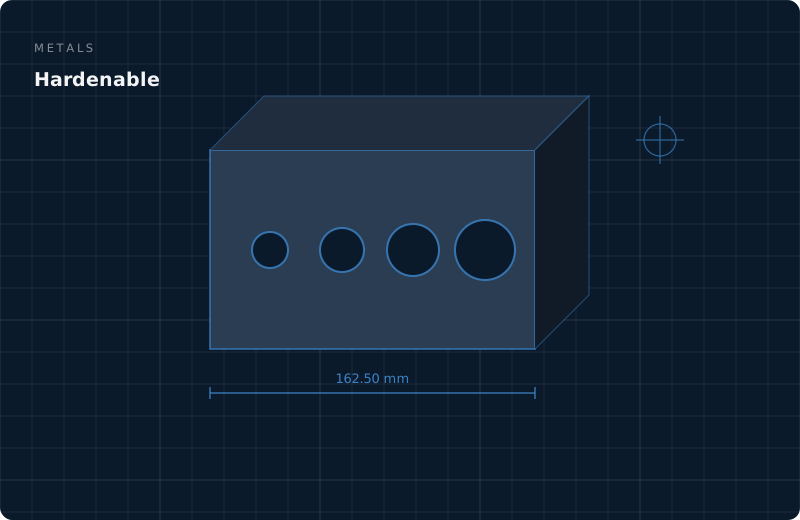
Hardenable. Wear-resistant. Up to 62 HRC.
Where aluminum and stainless fall short on strength and wear, alloy and tool steels deliver. From pre-hardened 4140 shafts to through-hardened D2 cutting tools — heat-treated, ground, and ready for duty.
At a glance
- Density
- 7.85 g/cc
- Yield strength
- 655 MPa
- Tensile strength
- 1,020 MPa
- Elongation
- 17 %
- Hardness (QT)
- 28–32 HRC
- Impact (Charpy)
- 54 J
- Modulus
- 205 GPa
- Machinability
- 65%
Key data
- Density
- 7.85 g/cc
- Yield strength
- 655 MPa
- Tensile strength
- 1,020 MPa
- Elongation
- 17 %
- Hardness (QT)
- 28–32 HRC
- Impact (Charpy)
- 54 J
- Modulus
- 205 GPa
- Machinability
- 65%
Alloy & tool steel grades.
4140 (Chromoly)
Chrome-moly alloy steel. Pre-hardened to 28–32 HRC or through-hardened to 55+ HRC. Shafts, bolts, brackets, general high-strength structural.
4340
Ni-Cr-Mo alloy. Higher strength than 4140 (yield 860 MPa QT). Aerospace structural, landing gear components, critical shafts.
A2 Tool Steel
Chromium tool steel, air-hardening. Good wear resistance, moderate toughness. Knives, punches, stripper plates, general tooling.
D2 Tool Steel
High-chromium tool steel. Excellent wear resistance, good corrosion resistance. Blanking dies, cutting tools, forming rolls.
H13 Tool Steel
Hot-work tool steel. Resists thermal fatigue at 600+ °C. Hardened to 45–52 HRC. Die casting dies, forging dies, extrusion tooling.
O1 Tool Steel
Oil-hardening tool steel. Tightest dimensional control after heat treat. Precision tooling, punches, gauges.
S7 Tool Steel
Shock-resistant tool steel. High impact toughness combined with wear resistance. Chisel punches, power hammers.
M2 HSS
Cobalt-enhanced HSS for cutting tool inserts, drills, end mills, taps. Tempered to 62–65 HRC.
1018 Mild Steel
Plain carbon steel. Cheapest machinable steel. Bolts, non-critical brackets, weldments. Not heat treatable.
Alloy steels for structural strength. Tool steels for wear resistance and heat resistance in tooling and die applications.
Why alloy and tool steels.
High-strength structural
Yield strengths of 650–1500 MPa after heat treatment. Shaft applications, high-load brackets, suspension components, fasteners.
Wear resistance
D2 at 60 HRC resists abrasive wear far beyond any stainless. Standard for cutting tools, blanking dies, forming rolls.
Heat resistance
H13 retains hardness at 600 °C — essential for die casting, forging, and extrusion tooling.
Cost per strength
4140 delivers steel-level strength at roughly 1/5 the cost of titanium or premium aerospace aluminum per kg.
Four scenarios where alloy and tool steels are the right answer — and no other material family comes close.
Alloy & tool steel applications.
Transmission shafts
4140 or 4340 through-hardened, precision ground bearing seats
High-strength bolts
4140 or 4340, grade 8 or better, with rolled threads
Gear blanks
4340 core with case-hardened (carburized) tooth surfaces
Blanking & forming dies
D2 or A2 through-hardened punches, dies, strippers
Injection mold inserts
H13 for glass-filled plastic production, P20 for standard
Die casting dies
H13 hot-work tool steel — resists thermal cycling
Cutting tools
D2, M2 HSS for punches, trimming tools, inserts
Precision punches
A2 or O1 tool steel — hold dimensions after heat treat
Landing gear components
4340 through-hardened and shot-peened for fatigue
Alloy/tool steel finishes.
Oiled
Light oil film for short-term corrosion protection during shipment.
Black oxide
Chemical conversion black finish with mild corrosion resistance. Common on fasteners, firearm parts.
Zinc plating
Thin electroplate Zn + yellow/clear chromate. Cost-effective outdoor protection.
Manganese phosphate
Oil-retentive dark grey finish. Standard on automotive gears, firearm components.
Hard chrome
25–100 µm electroplated chrome for wear surfaces. Hydraulic rods, pump shafts.
Nitride
Gas or salt-bath nitriding. Surface hardness 65+ HRC with ductile core. Gears, shafts under cyclic load.
Case hardening
Carburize, carbonitride, or induction harden for hard surface with tough core.
Precision ground
Post-HT grinding to ±0.005 mm tolerance and Ra 0.4 µm finish on bearing diameters.
Get an instant quote
Send your CAD — we reply with detailed pricing, lead time, and DFM feedback within 4 working hours.
Talk to an engineer
WhatsApp our team directly. Most messages answered within 12 minutes during work hours.
Explore all services
CNC, 3D printing, injection molding, sheet metal, casting, finishing — one quality system, one partner.
Hardenable — questions
4140 vs 4340 — which should I choose?
4140 is the workhorse: lower cost, easier to machine, adequate for most high-strength applications. 4340 contains nickel which improves hardenability and toughness — specify when the part needs tough-at-depth properties (thick sections, high stress) or for aerospace critical applications where fatigue performance matters. 4340 is approximately 1.3× the cost of 4140.
Do you heat-treat in-house?
We perform hardening, tempering, stress relief, and light case hardening in-house on most alloy and tool steels. Specialty treatments (vacuum hardening, deep cryogenic treatment, plasma nitriding) are outsourced to qualified partners. All heat treatment documented with process records for aerospace and automotive orders.
Can you machine hardened tool steels?
Yes. We routinely hard-mill and hard-turn D2, H13, and A2 up to 62 HRC using CBN (cubic boron nitride) and carbide tooling. For features below 0.005 mm tolerance on hardened steel, grinding or EDM is used instead of direct machining.
What is the difference between pre-hardened and through-hardened steel?
Pre-hardened: delivered from the mill in mid-range hardness (e.g., 4140 at 28–32 HRC). Machine to final shape — no distortion or grinding needed. Used when mid-range hardness is adequate. Through-hardened: machine slightly oversized, then heat-treat to full hardness (55+ HRC), then grind to final tolerance. Used when maximum hardness is required; requires grinding allowance (typically 0.2–0.5 mm per surface).
When do I need tool steel vs alloy steel?
Tool steel when: wear is the primary concern (cutting, forming, dies), part needs hardness above 55 HRC, application involves elevated temperature service (hot-work). Alloy steel when: primary concern is tensile or yield strength, hardness of 28–45 HRC is adequate, part is structural rather than wear-critical. Alloy steels are 2–3× cheaper than most tool steels.
Keep reading
Quote
Get a free CNC machining, 3D printing, injection molding quote from PifyC. Send CAD via WhatsApp or email — q…
Read more →PifyCMaterials
PifyC's 50+ production-grade materials: aluminum, stainless steel, titanium, brass, copper, and engineering p…
Read more →MachiningCNC machine
ISO 9001 certified CNC machining in Wuxi, China. 3, 4 and 5-axis milling, Swiss turning, 40+ materials, ±0.01 mm…
Read more →Additive manufacturing3D printing service
Industrial-grade 3D printing from Wuxi, Jiangsu, China: SLA, SLS, MJF and DMLS metal. Functional prototypes and …
Read more →Moulding & castingInjection molding
Plastic injection molding from China: rapid aluminum tooling in 14 days for 500–10,000 parts, production P20/H13…
Read more →Sheet metal & fabricationSheet metal
Precision sheet metal fabrication from Wuxi: 4 kW fiber laser cutting, Amada press brake bending (±0.1 mm), TIG/…
Read more →Finishing & treatmentFinishing services
Complete in-house surface finishing: Type II/III anodize, powder coating, electroplating, passivation, bead blas…
Read more →MetalsTungsten parts
Precision CNC machining of pure tungsten and tungsten heavy metal (W-Ni-Fe, W-Ni-Cu). Extreme density (19.3 g/cc…
Read more →Send a CAD file. Get an engineering-reviewed quote.
No minimum quantity, free DFM feedback from a senior manufacturing engineer, and an NDA signed before file review on request.