
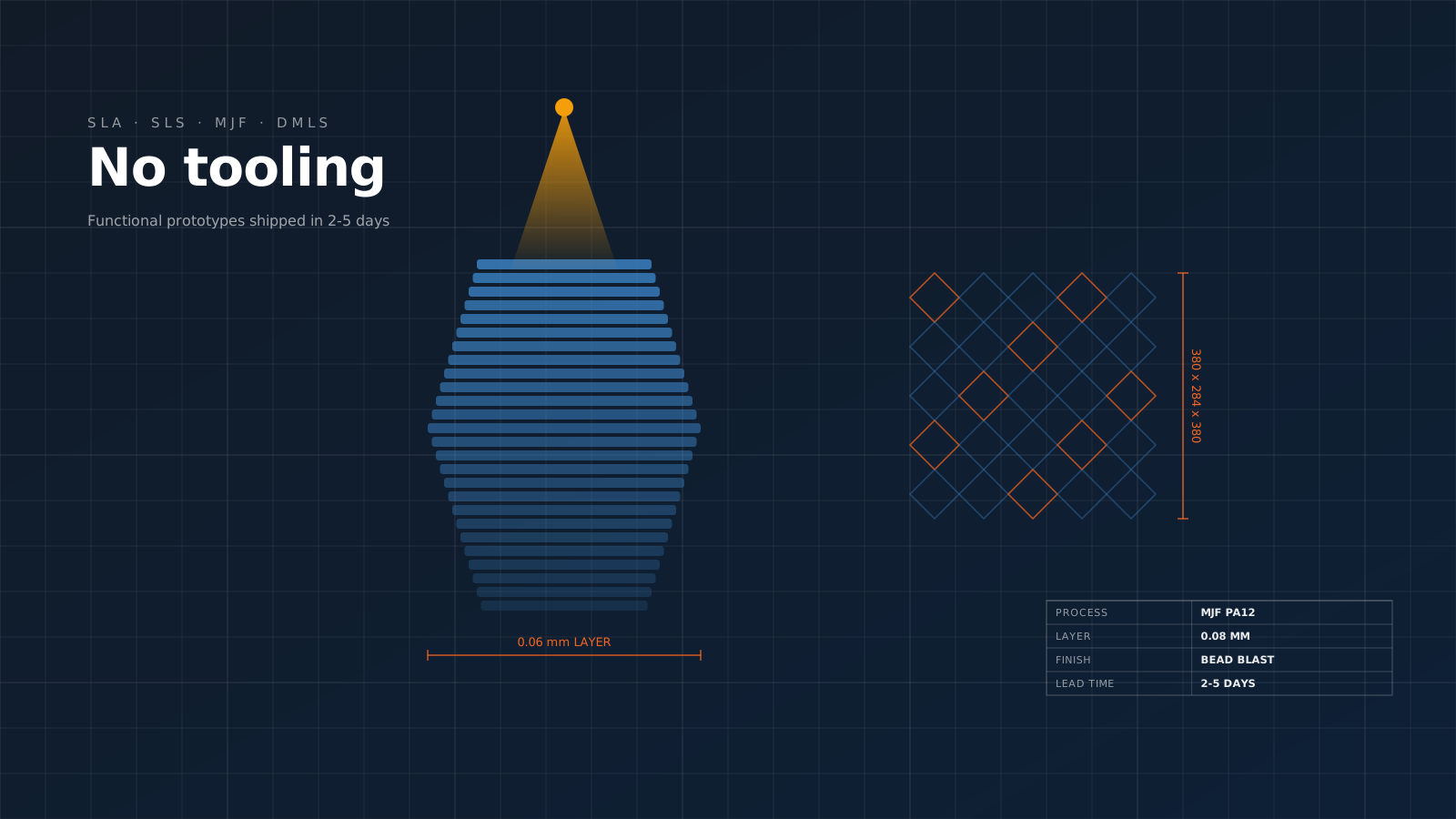
Ti Gr.23. Inconel 718. 316L. CoCr. Complex geometry.
Metal 3D printing via DMLS/SLM for complex geometry impossible to machine. Titanium Ti Gr.23 (medical), Inconel 718 (aerospace hot section), 316L stainless, AlSi10Mg aluminum, CoCr (medical). Post-machined critical features for tight tolerance.
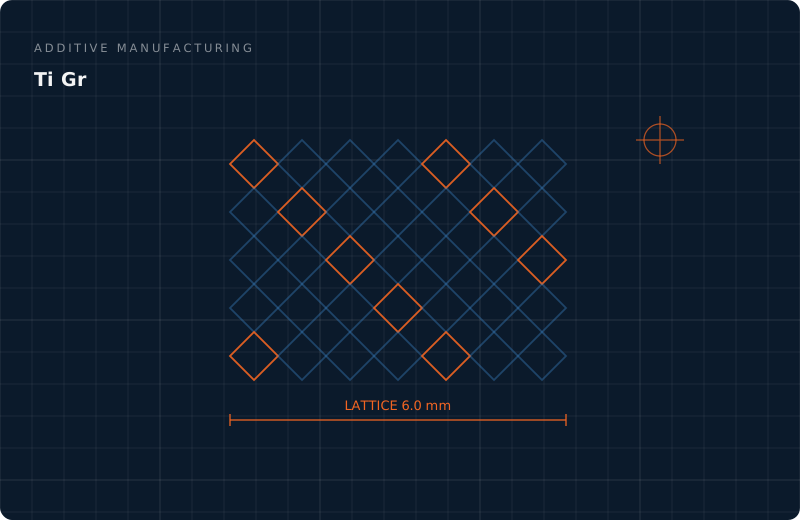
Metal 3D printing DMLS
Metal 3D printing uses powder-bed fusion of metal powders. Material choice drives cost, properties, and lead time. Common aerospace and medical materials available.
Metal 3D printing materials.
Ti-6Al-4V Gr.23
ELI titanium for medical implants and aerospace. Full heat treatment available for T6 temper.
Ti-6Al-4V Gr.5
Standard titanium alloy. Aerospace brackets, racing components, industrial applications.
Inconel 718
Nickel superalloy for jet engine hot section, rocket components. Up to 650 °C service.
Inconel 625
Corrosion + high-temperature. Marine hot section, chemical processing, oil & gas sour service.
316L Stainless
General corrosion-resistant stainless. Medical devices, marine, chemical processing.
17-4 PH SS
Precipitation-hardenable stainless. High-strength + corrosion resistance. Aerospace structural.
AlSi10Mg
Aluminum alloy similar to A356 casting alloy. Lightweight automotive, aerospace brackets.
CoCr
Cobalt-chromium for dental crowns, joint replacement, implantable hardware.
Metal 3D printing uses powder-bed fusion of metal powders. Material choice drives cost, properties, and lead time. Common aerospace and medical materials available.
Where metal 3D printing wins.
Complex aerospace brackets
Topology-optimized aerospace brackets — 30-50% weight reduction vs CNC equivalents
Conformal cooling inserts
Injection mold inserts with conformal cooling channels impossible to drill or mill
Medical implants
Custom patient-specific implants — cranial, spine, orthopedic
Turbine blades
Jet engine turbine blades with internal cooling channels
Rocket engine parts
SpaceX-class rocket engine injectors, combustion chamber inserts
Dental implants
Patient-specific dental implants and surgical guides
Fluid manifolds
Complex internal fluid routing impossible to machine
Heat exchangers
Compact heat exchangers with non-standard flow geometry
Bionic structures
Biomimetic lattice structures for medical and aerospace
Get an instant quote
Send your CAD — we reply with detailed pricing, lead time, and DFM feedback within 4 working hours.
Talk to an engineer
WhatsApp our team directly. Most messages answered within 12 minutes during work hours.
Explore all services
CNC, 3D printing, injection molding, sheet metal, casting, finishing — one quality system, one partner.
Ti Gr — questions
Metal 3D printing cost?
Metal 3D printing is expensive. Small Ti bracket: $500-2,000 per part. Medium part: $2,000-10,000. Large aerospace bracket: $10,000+. Compared to CNC equivalent: 3-10× cost. Justify when: (1) geometry impossible to machine (internal channels, lattices), (2) topology-optimized design enables weight savings that justify cost, (3) very low quantity of very complex parts. For most applications, CNC is more cost-effective.
Dimensional accuracy for metal 3D print?
DMLS/SLM: ±0.1-0.3 mm typical, depends on part size and thermal conditions. Better on small parts, worse on large. For tight tolerance features (bearing fits, mating surfaces), post-machining required. Standard workflow: 3D print → heat treat → HIP (if required) → post-machine critical features. This combines 3D printing's geometry freedom with CNC's precision.
Heat treatment and HIP?
As-printed metal parts have internal stress and porosity (0.5-2%). Stress relief heat treatment after printing: reduces residual stress. Full heat treatment (solution + aging): achieves full material properties. HIP (Hot Isostatic Pressing): eliminates porosity for aerospace/medical certification. Typical aerospace workflow: print → stress relief → HIP → solution + age → post-machine. Each step adds 5-10 days to lead time.
Aerospace qualification?
Metal 3D printed aerospace parts require qualification: AMS 7003 for material, specific customer qualification for each part. Qualification involves: mechanical testing of coupons from each build, NDE (non-destructive evaluation) of parts, chemistry verification, fatigue testing. Qualification establishes process capability. Post-qualification, individual parts tested per customer spec.
Build size and batching?
DMLS build envelopes vary by machine: 250 × 250 × 300 mm typical for our capability. Large parts split into sub-components with welding/brazing. Multiple small parts nested in single build for cost efficiency. Typical build cycle 12-48 hours depending on part height and complexity. Post-print processing (powder removal, support removal, heat treatment, machining) adds several days.
Surface finish and post-processing?
As-printed: Ra 6-12 µm with stair-step from layer lines. Post-processing options: bead blast (uniform matte Ra 3-6 µm), chemical milling (smoother), tumbling (general), machining (CNC finish Ra 0.8 µm on critical surfaces). For aerospace parts, CNC post-machining of mating surfaces standard — ensures dimensional accuracy and required finish.
Keep reading
Quote
Get a free CNC machining, 3D printing, injection molding quote from PifyC. Send CAD via WhatsApp or email — q…
Read more →Process comparisonsCNC vs 3D printing
CNC machining vs 3D printing comparison: materials, tolerances, surface finish, cost, lead time, strength. Decis…
Read more →MachiningCNC machine
ISO 9001 certified CNC machining in Wuxi, China. 3, 4 and 5-axis milling, Swiss turning, 40+ materials, ±0.01 mm…
Read more →Additive manufacturing3D printing service
Industrial-grade 3D printing from Wuxi, Jiangsu, China: SLA, SLS, MJF and DMLS metal. Functional prototypes and …
Read more →Moulding & castingInjection molding
Plastic injection molding from China: rapid aluminum tooling in 14 days for 500–10,000 parts, production P20/H13…
Read more →Sheet metal & fabricationSheet metal
Precision sheet metal fabrication from Wuxi: 4 kW fiber laser cutting, Amada press brake bending (±0.1 mm), TIG/…
Read more →Finishing & treatmentFinishing services
Complete in-house surface finishing: Type II/III anodize, powder coating, electroplating, passivation, bead blas…
Read more →PifyCMaterials
PifyC's 50+ production-grade materials: aluminum, stainless steel, titanium, brass, copper, and engineering p…
Read more →
Send a CAD file. Get an engineering-reviewed quote.
No minimum quantity, free DFM feedback from a senior manufacturing engineer, and an NDA signed before file review on request.