
ISO 9001:2015ITAR RegisteredRoHS · REACHLead time from 3 business daysMOQ = 1 part
PifyC
Services
Materials
Industries
Applications
Resources
Locations
Company
Request a quote
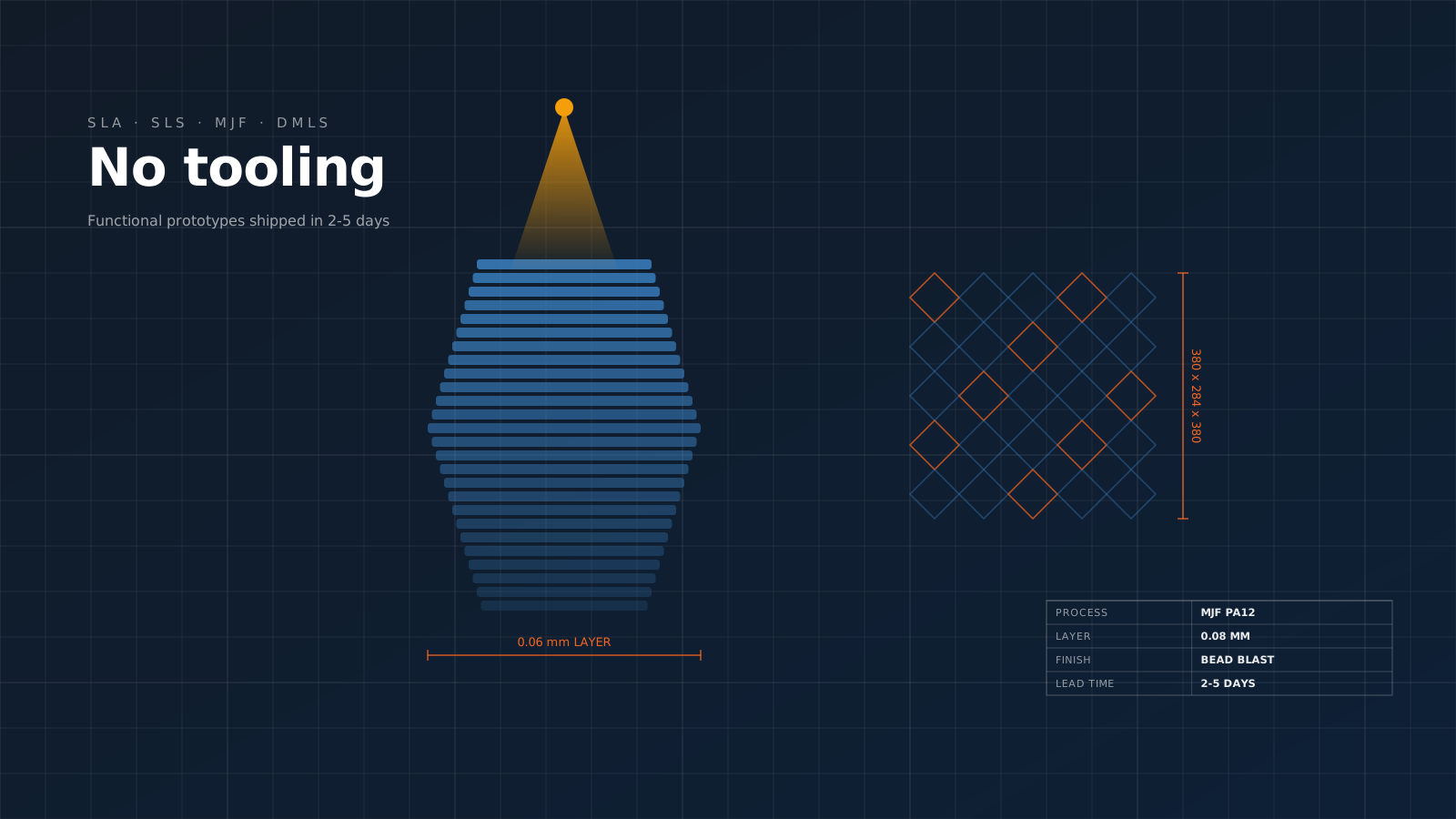
Additive manufacturing drawing: MJF layer stack, laser beam and lattice structure
3D Printing Comparison

Resin or nylon? SLS or MJF? Each has its place.

Three dominant 3D printing technologies for functional prototyping and low-volume production. SLA uses photopolymer resin. SLS uses powder-bed nylon with laser fusion. MJF (HP Multi Jet Fusion) uses powder-bed nylon with inkjet fusing agent. Here's how to pick.

Process comparisonsWuxi, ChinaMOQ 1 partDFM review included

Side-by-side summary.

SLA (Stereolithography)

UV laser cures photopolymer resin layer by layer. Smoothest surface finish of any 3D print process. Resin-based — limits material properties. Best for cosmetic prototypes and visual models.

SLS / MJF (Nylon Powder)

Both fuse nylon powder into solid parts. SLS uses laser; MJF uses inkjet fusing agent. Production-grade nylon PA12 mechanical properties. Best for functional prototypes and low-volume production.

Feature-by-feature breakdown.

AttributeSLASLS / MJF
MaterialPhotopolymer resin (various grades)Nylon PA12 (most common), PA11, PA12-GF
Mechanical (yield)~60–80 MPa (tough resins)~45–50 MPa (PA12)
Impact resistancePoor to moderateExcellent (nylon flexibility)
Drop test passFails on standard resinsPasses (production-grade nylon)
Surface finishRa 2–5 µm (smoothest)Ra 6–10 µm (slightly grainy)
Dimensional accuracy±0.1 mm typical±0.2 mm typical
Transparent/translucentYes (clear resins available)No (nylon is white/grey)
Cost (per cc of material)ModerateLower
Build volume300 × 300 × 300 mm typical380 × 284 × 380 mm (HP MJF)
Lead time24–48 hours48–72 hours
Post-processingSupport removal + UV cureDepowdering + bead blast
Color optionsClear, colored resins, paintableWhite (MJF), grey (SLS), dyeable
Chemical resistancePoorGood (nylon general-purpose)
Outdoor UV stabilityPoor (most resins)Moderate (nylon with UV)
Best useVisual prototypes, cosmeticFunctional prototypes, low-volume production

When to choose each.

Choose SLA (Stereolithography) when:

Choose SLS / MJF (Nylon Powder) when:

Get an instant quote

Send your CAD — we reply with detailed pricing, lead time, and DFM feedback within 4 working hours.

Talk to an engineer

WhatsApp our team directly. Most messages answered within 12 minutes during work hours.

Explore all services

CNC, 3D printing, injection molding, sheet metal, casting, finishing — one quality system, one partner.

Working on a live project? Send the STEP file and the two or three features you are unsure about — an engineer replies with DFM notes and a price, usually within four working hours.
FAQ

Resin or nylon? SLS or MJF? Each has its p — questions

SLS vs MJF — what's the difference?

Both fuse nylon powder using powder bed fusion. SLS (Selective Laser Sintering): uses laser to fuse powder point-by-point. MJF (Multi Jet Fusion, HP proprietary): inkjet deposits fusing agent, then heats entire layer. MJF is faster (40–60% less print time), slightly better surface finish (Ra 6 vs 8 µm), more consistent part density. SLS is more established, slightly better for glass-filled materials. For most nylon prototype work, MJF is the better modern choice.

Can I 3D print threaded features?

Yes on all three processes, but effectiveness varies. SLS and MJF nylon: threads can be printed directly and hold adequately for low-cycle applications. Standard practice: print slightly oversized hole, then thread-tap after printing for reliable threads. Heat-set brass inserts also work well in nylon. SLA resin: threads are fragile and often strip — heat-set inserts recommended. For critical threaded connections, use inserts regardless of 3D print process.

MJF vs injection molding for 100 parts?

Depends on part complexity. Simple part with no undercuts: injection molding typically cheaper at 100 parts once tooling amortizes ($3000 tool spread over 100 parts is $30/part tooling cost). Complex geometry impossible to injection mold without complex tooling: MJF can be cheaper because no tooling required. Also: MJF supports design iteration without tooling changes. For production parts that won't change, injection molding wins. For production parts that might iterate, MJF wins.

Lead times for each?

SLA: 24–48 hours typical for standard parts. Rush: 24 hours possible. SLS: 3–5 business days typical. Rush: 48 hours possible. MJF: 3–5 business days typical. Rush: 48 hours possible. All scale linearly with quantity — SLS/MJF batch many parts in one print, MJF slightly faster because single build cycle fuses entire layer at once.

Dimensional accuracy and tolerances?

SLA: ±0.1 mm typical on critical features, ±0.05 mm achievable with careful orientation. SLS: ±0.2 mm typical, ±0.1 mm on small features with careful orientation. MJF: ±0.15 mm typical, ±0.05 mm on features under 10 mm. For features below 1 mm or tight tolerances, consider CNC instead of 3D printing. For general prototype fits and clearances, 3D print tolerances are adequate.

Can I mix processes for one project?

Yes — common workflow. Example: functional parts in MJF nylon (durable, testable), visual trim parts in SLA (smooth cosmetic surface), combined into prototype assembly. Or: complex geometry in MJF (print difficult shapes), precision features in CNC (drill and thread holes to tolerance). We offer all three processes in-house plus CNC — combine on single PO for integrated workflow.

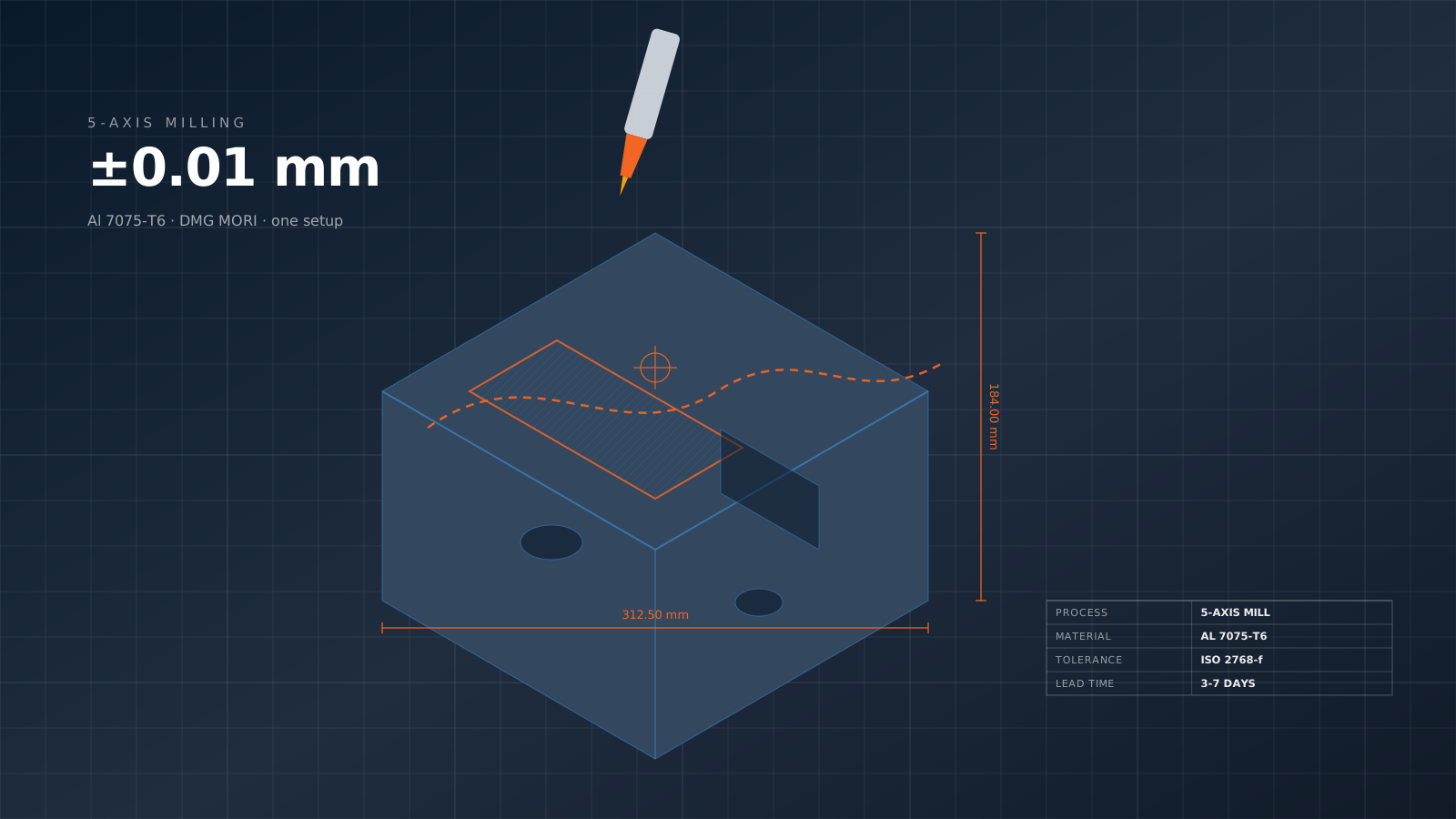
5-axis CNC milling drawing: Al 7075-T6 block with pockets, toolpath and dimensions

Send a CAD file. Get an engineering-reviewed quote.

No minimum quantity, free DFM feedback from a senior manufacturing engineer, and an NDA signed before file review on request.