
ISO 9001:2015ITAR RegisteredRoHS · REACHLead time from 3 business daysMOQ = 1 part
PifyC
Services
Materials
Industries
Applications
Resources
Locations
Company
Request a quote
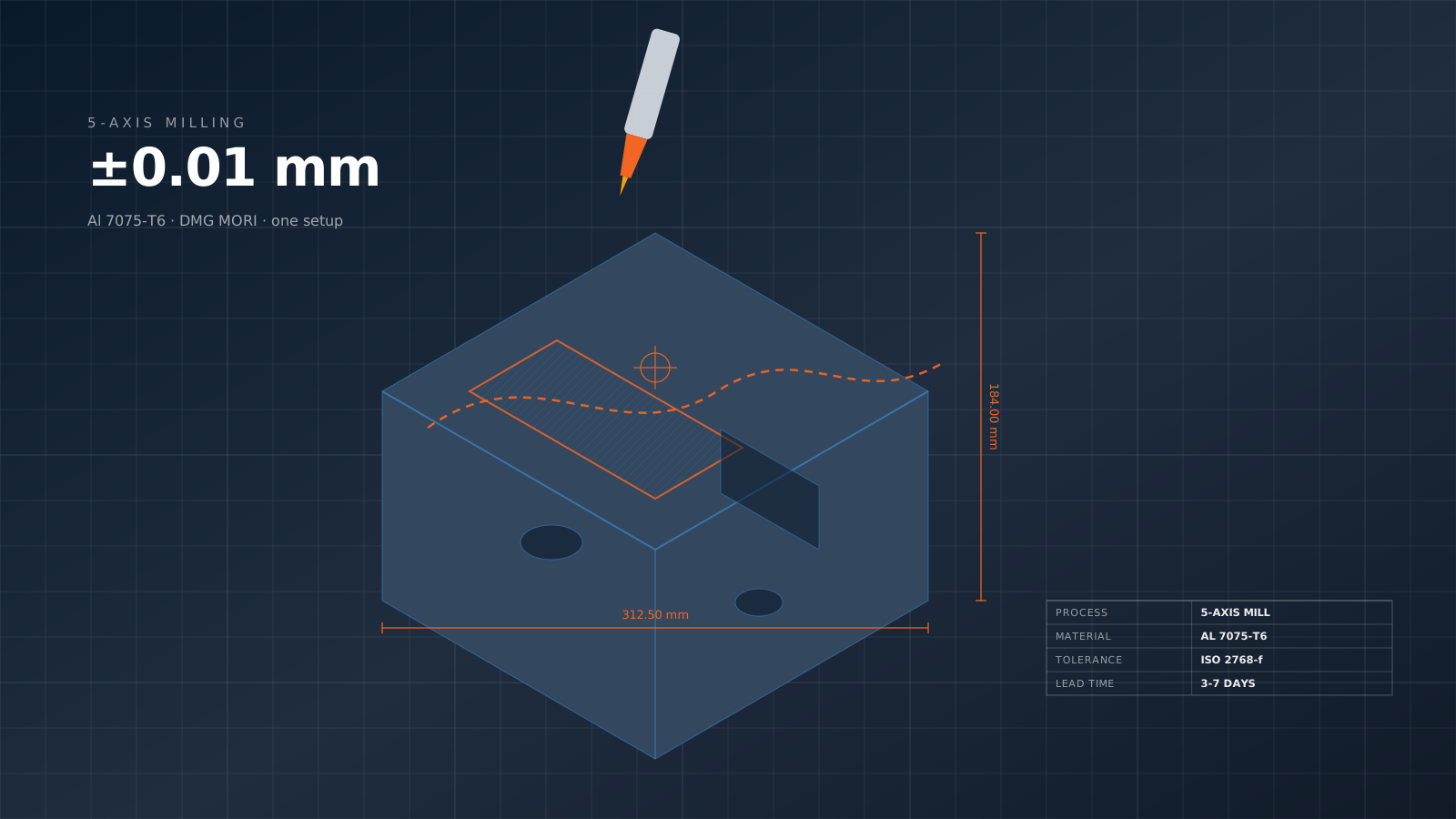
5-axis CNC milling drawing: Al 7075-T6 block with pockets, toolpath and dimensions
3-Axis vs 5-Axis

Three linear axes. Or five coordinated. Complexity decides.

3-axis CNC machining moves the tool in X, Y, and Z. 5-axis adds two rotational axes (A and C, or B and C) for tool tilt and part rotation during machining. The tradeoff: 5-axis costs more per hour but completes complex parts faster with better tolerances. When does 5-axis pay off?

Process comparisonsWuxi, ChinaMOQ 1 partDFM review included

Side-by-side summary.

3-Axis CNC

Standard CNC machining. Cutter moves in X, Y, Z. Part fixed in vise or fixture. Works for 80% of parts. Lower hourly rate. Multiple setups needed for complex geometry.

5-Axis CNC

Adds two rotational axes (tool tilt + part rotation). Complex geometry in single setup. Better tolerance stack-up. Higher hourly rate (1.3×). Wins economically on complex parts requiring 3+ setups on 3-axis.

Feature-by-feature breakdown.

Attribute3-Axis5-Axis
Simultaneous axes3 (X, Y, Z linear)5 (linear + 2 rotary)
Hourly rate (ours)Standard1.3× standard
Simple parts (1-setup)FastestSame speed + higher rate
Complex parts (multiple setups)3–5 setups typical1–2 setups typical
Tolerance stack-up±0.05–0.25 mm across setups±0.01 mm single setup
Undercut featuresNot possible without wire EDMAccessible
Aerospace bracketsMultiple setups, higher riskSingle setup, better tolerances
Mold workLimited to 3D accessibilityUnlimited (ideal for molds)
Turbine componentsImpossiblePurpose-built for impellers, turbines
Tool length reductionsCan need long toolsCan tilt to use short stiff tools
Surface finish (complex 3D)Multiple passes, visible stepsContinuous motion, smoother
Programming timeSimplerMore complex (CAM intensive)
Machine cost$$$$$$
Typical usePrismatic parts, pockets, drillsImpellers, aerospace brackets, molds

When to choose each.

Choose 3-Axis CNC when:

Choose 5-Axis CNC when:

Get an instant quote

Send your CAD — we reply with detailed pricing, lead time, and DFM feedback within 4 working hours.

Talk to an engineer

WhatsApp our team directly. Most messages answered within 12 minutes during work hours.

Explore all services

CNC, 3D printing, injection molding, sheet metal, casting, finishing — one quality system, one partner.

Working on a live project? Send the STEP file and the two or three features you are unsure about — an engineer replies with DFM notes and a price, usually within four working hours.

FAQ

Three linear axes — questions

When does 5-axis save money on a complex part?

Break-even is typically 3 setups on 3-axis. If a part requires 3+ setups on 3-axis, consolidating to 1–2 setups on 5-axis usually wins on total cost despite higher hourly rate. For parts needing 5+ setups on 3-axis, 5-axis is 30–50% cheaper total. For simple parts, 3-axis is cheaper. Our quote compares both approaches when applicable.

What is 3+2 vs simultaneous 5-axis?

3+2 positional: rotary axes lock at a fixed angle, then 3-axis machining proceeds. Useful for accessing angled features without continuous rotation. Simultaneous 5-axis: all five axes move together during the cut. Required for continuous curved surfaces (impeller blades, airfoils). Our machines do both. 3+2 is simpler CAM; simultaneous requires more programming skill and slower feeds.

Tolerance stack-up — real example?

Typical aerospace bracket requiring 5 setups on 3-axis: each setup introduces ±0.03 mm position error. After 5 setups, accumulated error can reach ±0.15 mm between features — exceeding drawing requirements. Same part on 5-axis in 1 setup: all features referenced to one datum, ±0.01 mm relationships maintained. For drawing tolerances below ±0.05 mm between features in different orientations, 5-axis often mandatory.

What size parts on 5-axis?

Our 5-axis envelope: up to 800 × 800 × 600 mm work volume (DMG Mori DMU 80 P). Common part sizes 20 mm to 500 mm. Smaller parts (10 mm or less) better on Swiss-type turning with live tooling. Very large parts (> 800 mm) require multi-part fabrication or partner shop with larger 5-axis.

Programming time difference?

3-axis: CAM programming 1–3 hours per typical part. 5-axis: 3–8 hours typical, up to 20+ hours for complex impellers. Why: simultaneous multi-axis motion requires advanced CAM expertise, collision checking, tool-axis planning. This is why 5-axis is usually reserved for parts that genuinely benefit. Programming overhead is often 10–20% of 5-axis job cost for complex work.

5-axis for mold work?

Yes — 5-axis excels at injection mold and die work. Complex 3D surfaces, undercut features, parting lines all machined in single setup. Tool-axis tilt enables shorter, stiffer tools (better finish). Single-datum reference scheme reduces tolerance issues. For production mold work, 5-axis is increasingly the standard approach.

5-axis CNC milling drawing: Al 7075-T6 block with pockets, toolpath and dimensions

Send a CAD file. Get an engineering-reviewed quote.

No minimum quantity, free DFM feedback from a senior manufacturing engineer, and an NDA signed before file review on request.