
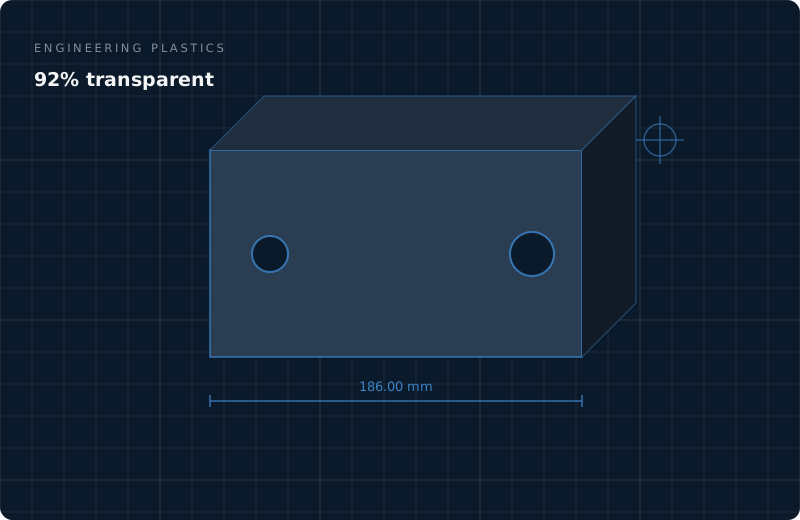
92% transparent. Polishes to optical grade.
Better optical clarity than polycarbonate, harder surface, cheaper material. Acrylic is the default for transparent enclosures, light guides, displays, and optical fluidic devices. Cast or extruded, machined or polished.
At a glance
- Density
- 1.18 g/cc
- Tensile strength
- 72 MPa
- Flexural modulus
- 3.3 GPa
- Elongation
- 5.5 %
- HDT (0.45 MPa)
- 95 °C
- Tg
- 105 °C
- Light transmission
- 92 %
- Refractive index
- 1.49
Key data
- Density
- 1.18 g/cc
- Tensile strength
- 72 MPa
- Flexural modulus
- 3.3 GPa
- Elongation
- 5.5 %
- HDT (0.45 MPa)
- 95 °C
- Tg
- 105 °C
- Light transmission
- 92 %
- Refractive index
- 1.49
PMMA grades.
Cast PMMA
Plexiglas GS / Acrylite GP. Cast-polymerized between glass plates. Superior optical quality, excellent polish, standard for display and optics. Slightly higher cost than extruded.
Extruded PMMA
Plexiglas MC / Acrylite FF. Extruded from molten polymer. Faster to produce, lower cost, slightly less optical quality. Fine for enclosures and general transparent parts.
Impact-modified PMMA
Rubber-toughened acrylic with 5–10× the impact strength of standard PMMA. Less transparent (~88%). Bathroom fixtures, vehicle windows, impact-prone applications.
UV-stabilized PMMA
UV absorber package gives 30+ year outdoor life without yellowing. Standard acrylic yellows modestly; UV grade is indistinguishable new vs after 30 years.
Optical PMMA
Low internal stress, low birefringence for polarization-sensitive applications. Camera lenses, display covers, optical sensor windows.
Medical PMMA
Biocompatible for short-term skin contact and fluid contact. Dental aligners, IVD device housings, microfluidic chips, ophthalmic lens trials.
The main distinction is cast vs extruded, which affects machinability, optical quality, and price. Specialty grades for impact, UV, and optical applications.
Why acrylic over other transparent plastics.
Higher light transmission
92% vs 89% for polycarbonate. Matches or exceeds glass (90–92%). Critical for optical devices, lightguides, and premium display applications.
Scratch resistance
Surface hardness 2H–3H pencil (vs PC 2H). Does not mar as easily under everyday handling. For scratch-critical, specify hardcoated PMMA (5H).
Lower cost
Approximately 50% of polycarbonate cost per kg. For non-impact transparent applications, acrylic is the economic choice.
Polishes to optical finish
Flame, vapor, or diamond polishing achieves Ra 0.05 µm mirror finish. Adequate for many optical applications without coating.
Acrylic dominates transparent plastic applications where impact isn't the driver. It beats PC on clarity, scratch resistance, and cost.
PMMA applications.
Display covers
Trade show displays, POS display cases, museum exhibits
Lightguides & LGPs
Edge-lit LED panels, smartphone backlights, automotive light guides
Microfluidic devices
Lab-on-chip, PCR chips, organ-on-chip research platforms
Signage & POP
Retail signage, dimensional lettering, backlit signs
Optical windows
Scanner glass, instrument viewports, laboratory glazing
Architectural glazing
Skylights, canopies, pool enclosures (UV-stabilized)
Aquariums
Large-format tanks — acrylic replaces glass for strength and clarity
Automotive lenses
Instrument cluster covers, tail lamp components, interior lighting
Medical devices
Infusion chambers, microfluidic chips, IVD reagent cells
PMMA finishing.
As-machined
Typical Ra 1.6 µm frosted finish. Tool marks visible — usually requires secondary polishing for optical use.
Flame polished
Hydrogen or oxygen-propane flame polishes to near-transparent. Fast but less consistent than mechanical.
Diamond polished
Diamond wheel polish to Ra 0.05 µm optical finish. Premium finish for optical components.
Vapor polished
Methylene chloride vapor smooths surface — faster than mechanical, creates slight crazing risk.
Hardcoated
Silica hardcoat raises surface hardness to 5H pencil. For touch-screen covers, scratch-critical applications.
Anti-reflection
Optical AR coating for display covers, reduces surface glare and reflection.
Tinted
Transparent tinted in bronze, grey, green, blue. For privacy glazing, sunglasses lens prototypes.
Laser cut edges
Laser cutting produces polished transparent edge — no secondary polish needed on cut edges.
Get an instant quote
Send your CAD — we reply with detailed pricing, lead time, and DFM feedback within 4 working hours.
Talk to an engineer
WhatsApp our team directly. Most messages answered within 12 minutes during work hours.
Explore all services
CNC, 3D printing, injection molding, sheet metal, casting, finishing — one quality system, one partner.
92% transparent — questions
PMMA vs polycarbonate: which is right for me?
Choose PMMA when: optical clarity is priority, cost matters, surface scratch resistance is needed, part is not impact-critical. Choose PC when: impact resistance is required, high-temperature service needed, part could be struck or dropped. Rule of thumb: PMMA for "display this," PC for "protect this." PMMA is roughly half the cost of PC per kilogram.
Does acrylic crack easily?
Standard acrylic is brittle — impact strength 15 J/m notched Izod (vs polycarbonate 850 J/m). Sharp impacts or over-tightened fasteners can crack acrylic. For applications where impact matters, specify impact-modified PMMA (10× standard impact) or switch to polycarbonate. Avoid sharp internal corners (use fillets R ≥ 1 mm) and avoid tight fastener fits (use oversized holes with shoulder washers).
Can acrylic be bent or formed after machining?
Yes — acrylic thermoforms well at 160–180 °C. CNC machined parts can be line-heated and bent to create 3D shapes. For complex curves, vacuum forming or press forming from flat sheet. Acrylic holds its formed shape indefinitely if fully cooled below Tg (105 °C).
Is acrylic food-safe?
FDA-compliant PMMA grades exist for food contact per 21 CFR 177.1010. Standard cast or extruded acrylic is usually not food-safe by default. For food applications (cake displays, food preparation tools, beverage dispensers), specify FDA-grade acrylic explicitly. USP Class VI grades for medical fluid contact.
Does acrylic UV-discolor outdoors?
Standard acrylic yellows only slightly over decades — far less than polycarbonate or ABS. UV-stabilized PMMA (with UV absorber package) is rated for 30+ years outdoor without visible yellowing. For outdoor signage, skylights, and architectural glazing, specify UV-stabilized grade.
Keep reading
Quote
Get a free CNC machining, 3D printing, injection molding quote from PifyC. Send CAD via WhatsApp or email — q…
Read more →PifyCMaterials
PifyC's 50+ production-grade materials: aluminum, stainless steel, titanium, brass, copper, and engineering p…
Read more →MachiningCNC machine
ISO 9001 certified CNC machining in Wuxi, China. 3, 4 and 5-axis milling, Swiss turning, 40+ materials, ±0.01 mm…
Read more →Additive manufacturing3D printing service
Industrial-grade 3D printing from Wuxi, Jiangsu, China: SLA, SLS, MJF and DMLS metal. Functional prototypes and …
Read more →Moulding & castingInjection molding
Plastic injection molding from China: rapid aluminum tooling in 14 days for 500–10,000 parts, production P20/H13…
Read more →Sheet metal & fabricationSheet metal
Precision sheet metal fabrication from Wuxi: 4 kW fiber laser cutting, Amada press brake bending (±0.1 mm), TIG/…
Read more →Finishing & treatmentFinishing services
Complete in-house surface finishing: Type II/III anodize, powder coating, electroplating, passivation, bead blas…
Read more →Engineering plasticsPTFE Teflon
Precision CNC machining of PTFE (Teflon). Chemically inert, 260 °C service, lowest coefficient of friction of an…
Read more →Send a CAD file. Get an engineering-reviewed quote.
No minimum quantity, free DFM feedback from a senior manufacturing engineer, and an NDA signed before file review on request.