
Busbars. Enclosures. Motor housings. EV supply chain.
CNC machining for EV and battery manufacturers: copper busbars for battery packs, aluminum battery enclosures, motor and inverter housings, EV charging station hardware. Supporting Tier-2/3 EV supply chains globally.
CNC machining for EV
EV and battery manufacturing has specific component families with distinct materials, tolerances, and manufacturing requirements. Here's what we build most often.
EV hardware families.
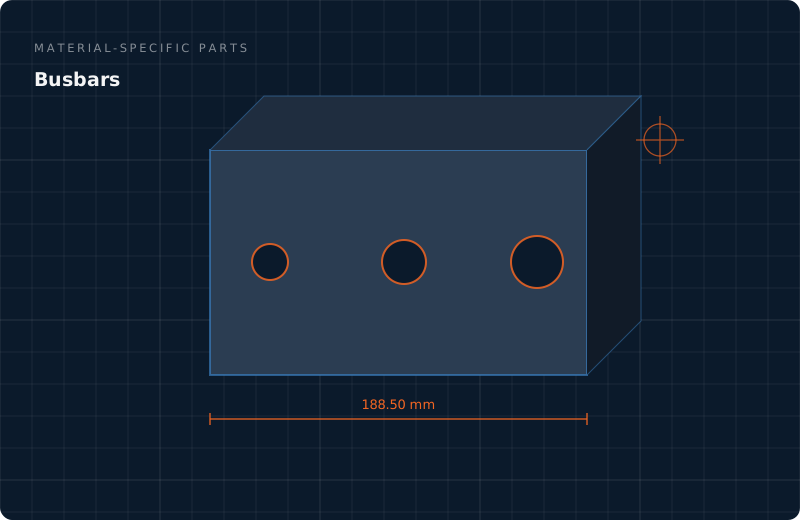
Copper busbars
High-current battery pack busbars for cell interconnection. Silver or tin plating for low contact resistance. Ultrasonic welded to cell tabs
Battery enclosures
Sealed battery pack enclosures with integrated cooling channels, cell mounting features, pressure release valves
Motor housings
EV motor end bells, stator housings, rotor shaft hardware. Precision bearing fits, integrated cooling jacket channels
Inverter heat sinks
High-dissipation heat sinks for traction inverters, on-board chargers. Precision-machined cooling fins
Power electronics
IGBT baseplates, gate driver hardware, DC-link capacitor mounting. EMI-shielded enclosures
EV charging stations
CCS/CHAdeMO/Tesla charging station enclosures, connector hardware, thermal management
EV and battery manufacturing has specific component families with distinct materials, tolerances, and manufacturing requirements. Here's what we build most often.
EV supply chains we serve.
Tesla supply chain
Tesla Tier-2/3 supplier support — motor, battery, and charging infrastructure components
BYD supply chain
BYD (world's largest EV maker) Tier-2 suppliers — battery and EV components
Chinese EV startups
NIO, Xpeng, Li Auto, Zeekr supply chains — Chinese EV ecosystem
Western EV startups
Rivian, Lucid, Fisker-generation EV startups — Tier-2 prototype and production
Traditional OEM EV
Ford, GM, VW, Hyundai/Kia EV transition — Tier-2 EV-specific components
Battery manufacturers
CATL, LG Energy, Panasonic cell-level supply chain — pack hardware
EV charging networks
ChargePoint, EVgo, Electrify America charging station hardware
Energy storage
Grid-scale battery storage (BESS) — rack hardware, HVAC components
EV conversion
Conversion companies (truck, fleet) — retrofit EV hardware for commercial vehicles
Get an instant quote
Send your CAD — we reply with detailed pricing, lead time, and DFM feedback within 4 working hours.
Talk to an engineer
WhatsApp our team directly. Most messages answered within 12 minutes during work hours.
Explore all services
CNC, 3D printing, injection molding, sheet metal, casting, finishing — one quality system, one partner.
Busbars — questions
Busbar manufacturing — what are the key requirements?
EV busbars typically copper C110 ETP or C101 OFE (for ultra-high current). Common thicknesses: 2–10 mm. Tin or silver plating for low contact resistance and corrosion protection. Tight tolerance on mounting hole locations (±0.1 mm for multi-cell stacks). Surface cleanliness matters for electrical contact. We machine, plate, and package busbars ready for ultrasonic welding to cell tabs.
Battery enclosure IP rating?
EV battery packs typically require IP67 — protected against dust ingress and temporary water immersion. Achieved via: compression-gasket sealing on enclosure lid, sealed cable pass-throughs, pressure relief valves for thermal runaway safety. Higher IP68 ratings possible for submarine/marine applications. Our enclosure DFM review includes seal groove design verification.
Thermal management hardware?
Three approaches: (1) Cooling plates with integrated channels — aluminum with CNC-machined serpentine channels, brazed lid or friction-stir welded. (2) Finned heat sinks — extruded 6063 aluminum cut and machined to size. (3) Liquid cold plates — often aluminum casting with machined channels. We handle all three approaches depending on thermal load and package size.
EV motor housing requirements?
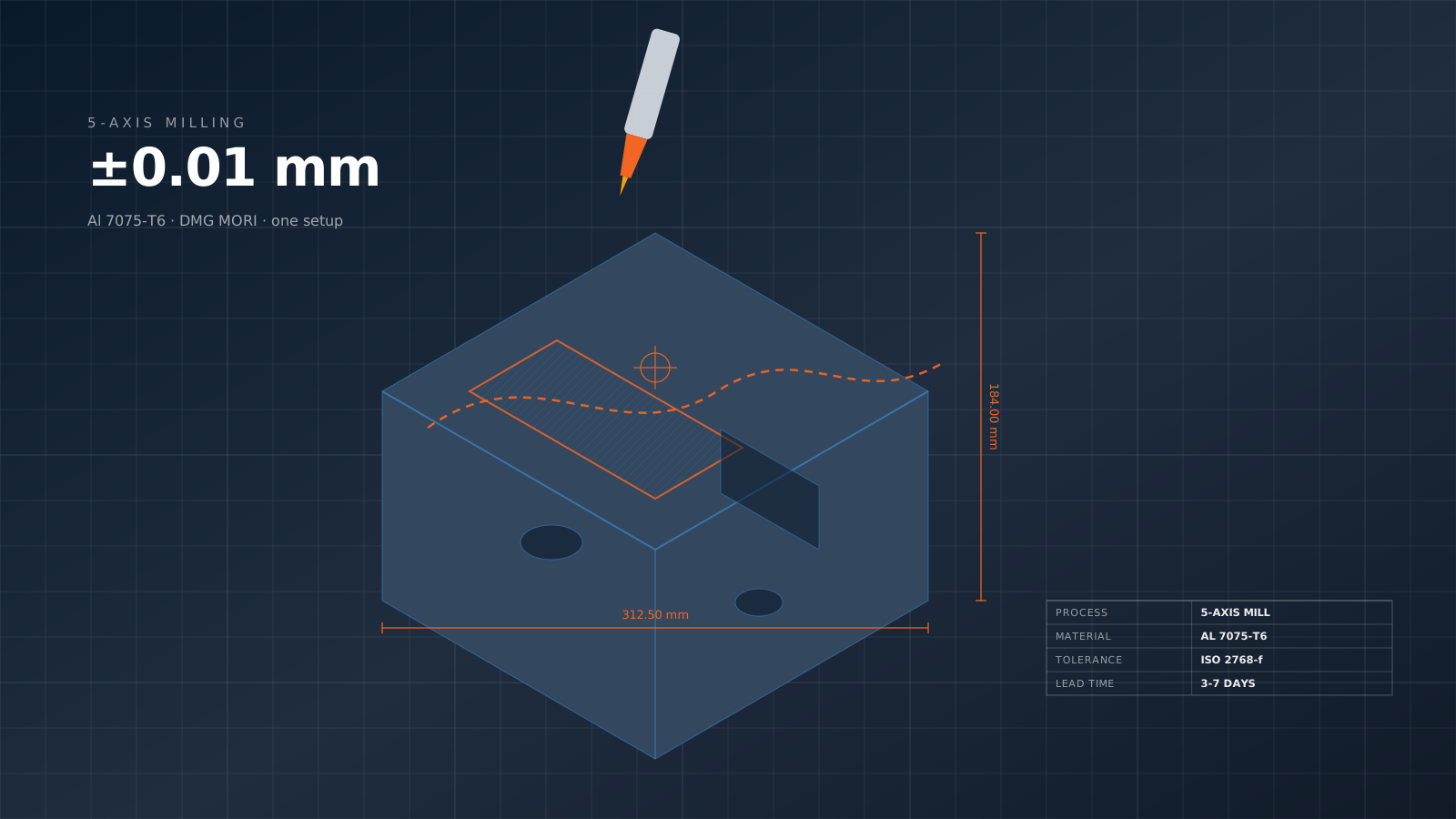
EV motor housings need: precision bearing seats (±0.01 mm), integrated cooling jacket with liquid passages, sealed cover geometry, precision-machined concentricity (run-out < 0.05 mm), and often integrated resolver/sensor mounting. Typically aluminum (6061 or cast A380). Our 5-axis capability handles the integrated cooling channel geometry in single setup.
Do you handle EV charging station enclosures?
Yes — EV charging station hardware is a growing workstream. Requirements: weather-sealed IP44–IP66, UV-resistant powder coat finish, vandalism-resistant construction, cable management integrations, thermal management for continuous current operation. Typical sizes: 1500 × 800 × 300 mm for DC fast chargers. Sheet metal + machined brackets combined work.
Traceability for EV supply chain?
Yes — EV OEMs typically require full traceability similar to automotive. Mill certificates per EN 10204 3.1 on all materials. Lot tracking linking parts to material heats. Inspection records archived for typical 10-year automotive retention period. FAI (AS9102 format acceptable, or PPAP level 3 for automotive) on initial production. Documentation package matches Tier-1 EV supplier expectations.
Keep reading
Quote
Get a free CNC machining, 3D printing, injection molding quote from PifyC. Send CAD via WhatsApp or email — q…
Read more →Energy & heavy industryEnergy renewable
Precision parts for renewable energy: solar tracker components, wind turbine hardware, hydrogen fuel cell bipola…
Read more →MachiningCNC machine
ISO 9001 certified CNC machining in Wuxi, China. 3, 4 and 5-axis milling, Swiss turning, 40+ materials, ±0.01 mm…
Read more →Additive manufacturing3D printing service
Industrial-grade 3D printing from Wuxi, Jiangsu, China: SLA, SLS, MJF and DMLS metal. Functional prototypes and …
Read more →Moulding & castingInjection molding
Plastic injection molding from China: rapid aluminum tooling in 14 days for 500–10,000 parts, production P20/H13…
Read more →Sheet metal & fabricationSheet metal
Precision sheet metal fabrication from Wuxi: 4 kW fiber laser cutting, Amada press brake bending (±0.1 mm), TIG/…
Read more →Finishing & treatmentFinishing services
Complete in-house surface finishing: Type II/III anodize, powder coating, electroplating, passivation, bead blas…
Read more →PifyCMaterials
PifyC's 50+ production-grade materials: aluminum, stainless steel, titanium, brass, copper, and engineering p…
Read more →Send a CAD file. Get an engineering-reviewed quote.
No minimum quantity, free DFM feedback from a senior manufacturing engineer, and an NDA signed before file review on request.