
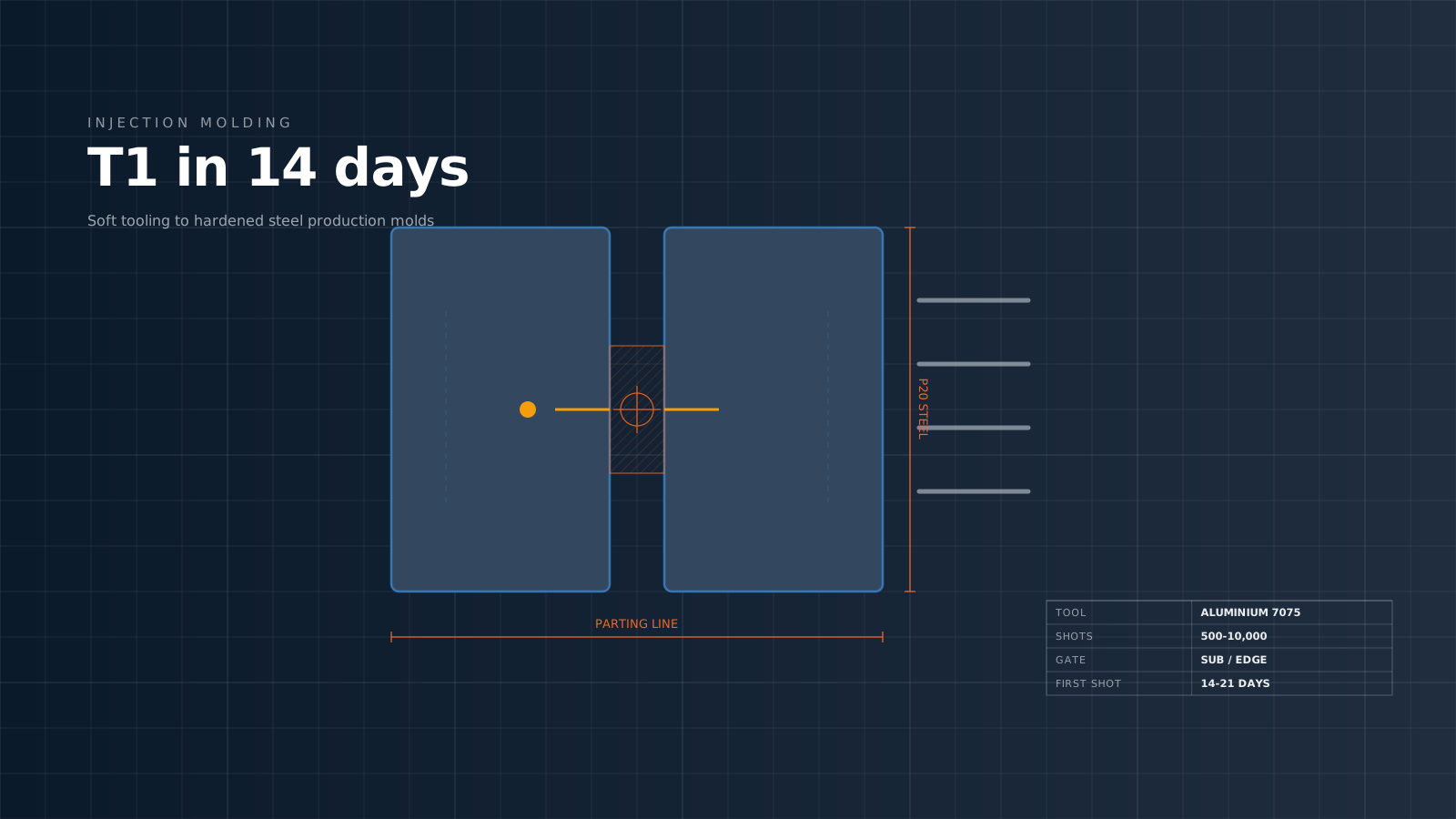
Aluminum tooling. Production plastic. 14 days.
Between prototype and production lies the rapid tooling gap. Ship 500 to 10,000 parts in real ABS, PC, PP or nylon — while your steel production tool builds in parallel. Fastest path from CAD to injection-molded parts.

Rapid tooling
When does rapid win? Below the break-even volume where steel tool amortization kicks in — typically 10,000 parts for simple geometry, less for complex.
Rapid vs production tooling.
| Spec | Rapid (Aluminum) | Production P20 Steel | Production H13 Hardened |
|---|---|---|---|
| Tool material | Al 7075 / AMPCOLOY 944 | Pre-hardened P20 (30 HRC) | Hardened H13 (50 HRC) |
| Build time | 10–14 days | 4–5 weeks | 6–8 weeks |
| Tool cost | $1,500–6,000 | $4,000–25,000 | $15,000–80,000 |
| Tool life | 5,000–10,000 shots | 500,000 shots | 1,000,000+ shots |
| Cycle time | Fast (Al dissipates heat well) | Standard | Standard |
| Surface finish | SPI-B1 / VDI texture | SPI-A2 / any texture | SPI-A1 mirror / any |
| Best for | < 10K parts | 10K – 500K parts | 500K+ parts, GF materials |
When does rapid win? Below the break-even volume where steel tool amortization kicks in — typically 10,000 parts for simple geometry, less for complex.
Where rapid tooling wins.
Startup product launches
Crowdfunding and YC companies shipping first 500–5,000 units while steel tool builds in parallel
Pilot production
EV and consumer electronics brands validating manufacturing before committing to 500K-unit tooling
Bridge tooling
Cover demand gap between prototype and steel-tool production — 4–8 week window
Design validation
Real-material prototypes for drop testing, regulatory submission, and field trials
Discontinued part replacement
Small production runs of obsolete spares where volumes don't justify steel tooling
Regional production
Low-volume runs for specific markets where global tooling isn't economic
Family molds
Multiple cavity mold for different parts in same assembly — all cast together in one shot
Over-molding prototypes
Two-shot prototypes combining rigid and soft-touch plastics for ergonomic validation
Medical device beta
Clinical trial production before commercial launch and regulatory clearance
Aluminum tooling — questions
What is rapid tooling and how does it differ from production tooling?
Rapid tooling uses aluminum 7075 tool steel alternatives (vs hardened P20 or H13 steel used for production tooling). Aluminum machines 5× faster than steel, so tool-build time drops from 4–6 weeks to 10–14 days. Tool life is 5,000–10,000 shots vs 500,000+ for steel. Ideal for bridge production, market validation and pilot runs.
How long does a rapid tool take to build?
Typical timeline: Day 1–2 CAD review and DFM feedback. Day 3–5 tool design and electrode design for any EDM features. Day 5–12 CNC rough and finish machining. Day 13 assembly, trial shot. Day 14 first parts in customer hands. Complex tools or multi-cavity family molds extend to 18–21 days.
What materials can rapid aluminum tools run?
Nearly all thermoplastics: ABS, PC, PP, PE, PA6, PA66, PA66-GF30, POM (Delrin), PBT, PET, PMMA, TPU, TPE. Glass-filled materials wear aluminum tools faster — tool life drops from 10,000 shots to 3,000–5,000 shots. For glass-filled production, upgrade to hardened steel tooling.
What is the typical cost of a rapid tool?
Simple single-cavity aluminum tools: USD 1,500–3,500. Medium complexity with side actions: USD 3,500–6,000. Multi-cavity family molds: USD 5,000–12,000. Compare to production steel tooling at USD 6,000–25,000 for the same complexity. Rapid tooling typically saves 50–70% on tool cost.
Can rapid tools have hot runners?
Yes, on larger aluminum tools. For small tools (<300 mm plate size), cold runner is standard — simpler, cheaper, easier to maintain. For parts needing cosmetic gate location, internal gating via hot runner or 3-plate cold runner is available on rapid tooling. Hot runner upgrades add ~USD 1,500 to tool cost.
What tolerances can rapid tooling hold?
Part tolerance ±0.1 mm typical, ±0.05 mm achievable with careful DFM. Slightly looser than production steel tooling (±0.03 mm) due to aluminum thermal expansion and possible slight dimensional drift over tool life. For precision fits, specify critical dimensions and we'll inspect first article against drawing.
When should I upgrade from rapid tool to production steel?
Three triggers: (1) volume exceeds ~10,000 parts where tool wear becomes visible on parts; (2) material is abrasive (glass-filled, mineral-filled) and tool wears faster than expected; (3) cycle time needs to drop — steel tools run faster cycles due to better thermal conductivity. If your program looks like it will scale, we can help you plan the steel tool while rapid tool services bridge production.
Keep reading
Quote
Get a free CNC machining, 3D printing, injection molding quote from PifyC. Send CAD via WhatsApp or email — q…
Read more →Moulding & castingInjection molding
Plastic injection molding from China: rapid aluminum tooling in 14 days for 500–10,000 parts, production P20/H13…
Read more →Moulding & castingVacuum casting
Precision vacuum casting from Wuxi: silicone tooling for 20–50 polyurethane copies that mimic ABS, PC, PP, PMMA …
Read more →Moulding & castingRapid injection molding
Rapid injection molding service: 14-day aluminum tooling, 5,000-20,000 shot life, all standard thermoplastics. P…
Read more →Moulding & castingOvermolded parts
Overmolded injection molded parts: 2K (two-shot) molding of rigid plastic with elastomer overmold. Soft-touch gr…
Read more →Moulding & castingInsert molded parts
Insert molded injection molded parts: pre-placed metal inserts (threaded brass, electrical contacts, magnets) wi…
Read more →Moulding & castingUrethane casting service
Urethane casting service: silicone RTV molds for 20-50 part production runs, production-grade urethane resins mi…
Read more →Moulding & castingSilicone molded parts
Custom silicone molded parts: LSR (liquid silicone rubber) injection molding, HTV compression molding. Medical (…
Read more →
Send a CAD file. Get an engineering-reviewed quote.
No minimum quantity, free DFM feedback from a senior manufacturing engineer, and an NDA signed before file review on request.