
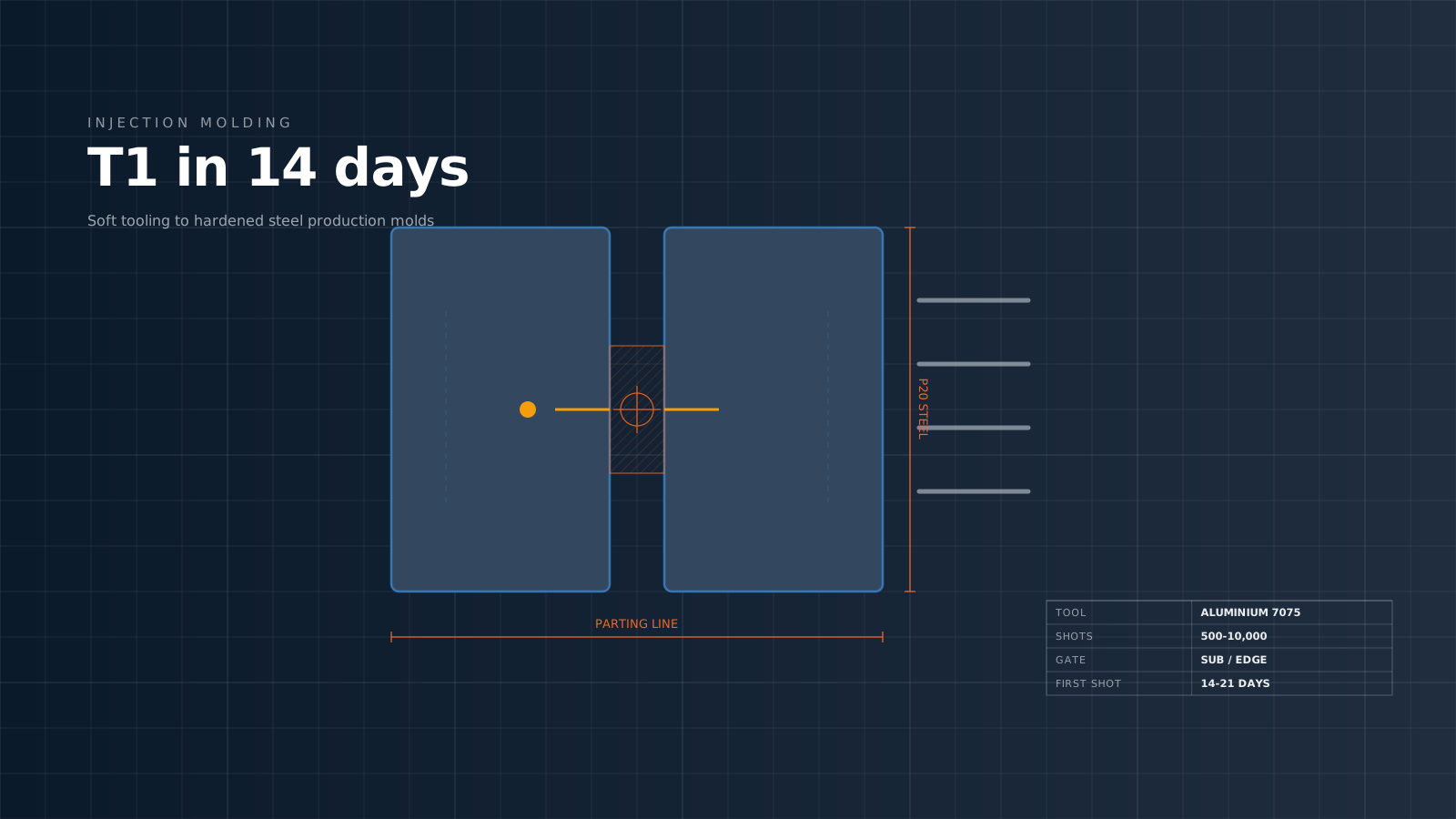
20-50 parts. Silicone molds. No tooling cost.
Urethane casting for 20-50 part production runs. Silicone (RTV) rubber molds created from 3D printed or CNC master pattern. Urethane resins mimic ABS, PC, nylon, rubber elastomers. Perfect gap between 3D printed prototypes and injection molded production.

Urethane casting service
Urethane resins are formulated to mimic the mechanical properties of common injection-molded thermoplastics. Choose based on the production material your final part will be made from.
Resin options by equivalent plastic.
ABS equivalent
Mimics ABS mechanical properties. Most common urethane for functional prototypes. White, black, or custom colors.
PC equivalent
Transparent polycarbonate-equivalent urethane. For clear prototypes needing high impact strength.
Nylon equivalent
Mimics nylon 6/6 mechanical properties. For wear-prone or flexible parts.
Rubber 30-90A
Silicone or TPU-like elastomeric urethanes. Shore A 30-90 hardness. Gaskets, seals, soft-touch parts.
Glass-filled
Glass-filled urethanes for structural prototypes requiring higher modulus than unfilled.
Heat resistant
Higher-temperature urethanes for prototypes testing in elevated temperature applications.
Food grade
Food-contact urethanes for food service prototypes.
Medical grade
Biocompatible urethanes for non-implantable medical device prototypes.
Urethane resins are formulated to mimic the mechanical properties of common injection-molded thermoplastics. Choose based on the production material your final part will be made from.
Where urethane casting excels.
10-50 part runs
Sweet spot quantity — too many for CNC/3D printing, too few for injection tooling
Multiple material testing
Single silicone mold can cast multiple urethane resins — test properties without tooling changes
Rapid product launches
3D print master → silicone mold → 25 parts in 2 weeks. Get to market fast
Color testing
Easy to cast in different colors from same mold — no dye blending, direct resin coloring
Consumer product prototypes
Realistic cosmetic prototypes in production-like material for customer validation
Investor demo units
Professional-quality demo units for pitches, trade shows, customer meetings
Medical device prototypes
Pre-clinical samples in appropriate biocompatible resin
Overmolded prototypes
Multi-material parts (rigid + rubber) — difficult in injection molding at prototype scale
Low-volume production
End-use production for specialty or premium products with lifetime volumes < 500
Get an instant quote
Send your CAD — we reply with detailed pricing, lead time, and DFM feedback within 4 working hours.
Talk to an engineer
WhatsApp our team directly. Most messages answered within 12 minutes during work hours.
Explore all services
CNC, 3D printing, injection molding, sheet metal, casting, finishing — one quality system, one partner.
20-50 parts — questions
How does urethane casting work?
1. Create master pattern via CNC or 3D print (SLA for best surface finish). 2. Embed master in silicone rubber — silicone cures around master. 3. Cut open silicone mold, remove master. 4. Close mold, inject urethane resin into cavity. 5. Cure urethane, open mold, remove part. 6. Clean mold, repeat for next part. Total cycle 1-4 hours per part depending on size and resin.
Mold life and quantity limits?
Silicone molds typically produce 20-50 parts before degradation. Degradation factors: cumulative heat from exothermic urethane curing, parting line wear, release agent buildup. For larger quantities, multiple molds created from same master. Above 200 parts, rapid injection molding typically more economical.
Dimensional accuracy vs injection molded?
Urethane casting: ±0.3% typical (so 100 mm part = ±0.3 mm). Injection molding: ±0.1% (so 100 mm = ±0.1 mm). Urethane has more shrinkage and less consistent dimensional control. For functional testing: adequate. For precision fit-critical applications: may require dimensional compensation in master, or may indicate CNC machining is better choice.
Surface finish possible?
Surface finish from silicone mold replicates master surface. SLA master = Ra 2-5 µm smooth. CNC master = Ra 0.8 µm or polished. Secondary polishing of master enables very smooth urethane parts. For cosmetic parts, master pattern finish determines final part appearance.
Cost comparison?
Master pattern: $50-200 (SLA master) or $200-1,000 (CNC master). Silicone mold: $200-1,500 depending on complexity. Each cast part: $15-80 depending on resin and size. Total for 25 parts: typically $2,000-8,000. Compare to: CNC 25 parts at $100-400/part = $2,500-10,000. Or: rapid injection mold $5,000-10,000 + $5-10/part = $5,125-10,250. Urethane often competitive for 10-50 part runs.
Lead time?
Simple urethane casting program: master pattern 3-7 days + silicone mold 2-3 days + casting 25 parts 2-3 days = 2-3 weeks total. Complex parts: up to 4 weeks. Rush possible to 10-12 days. Compare to rapid injection molding which takes 4-6 weeks total for first parts.
Keep reading
Quote
Get a free CNC machining, 3D printing, injection molding quote from PifyC. Send CAD via WhatsApp or email — q…
Read more →Moulding & castingRapid injection molding
Rapid injection molding service: 14-day aluminum tooling, 5,000-20,000 shot life, all standard thermoplastics. P…
Read more →MachiningCNC machine
ISO 9001 certified CNC machining in Wuxi, China. 3, 4 and 5-axis milling, Swiss turning, 40+ materials, ±0.01 mm…
Read more →Additive manufacturing3D printing service
Industrial-grade 3D printing from Wuxi, Jiangsu, China: SLA, SLS, MJF and DMLS metal. Functional prototypes and …
Read more →Moulding & castingInjection molding
Plastic injection molding from China: rapid aluminum tooling in 14 days for 500–10,000 parts, production P20/H13…
Read more →Sheet metal & fabricationSheet metal
Precision sheet metal fabrication from Wuxi: 4 kW fiber laser cutting, Amada press brake bending (±0.1 mm), TIG/…
Read more →Finishing & treatmentFinishing services
Complete in-house surface finishing: Type II/III anodize, powder coating, electroplating, passivation, bead blas…
Read more →PifyCMaterials
PifyC's 50+ production-grade materials: aluminum, stainless steel, titanium, brass, copper, and engineering p…
Read more →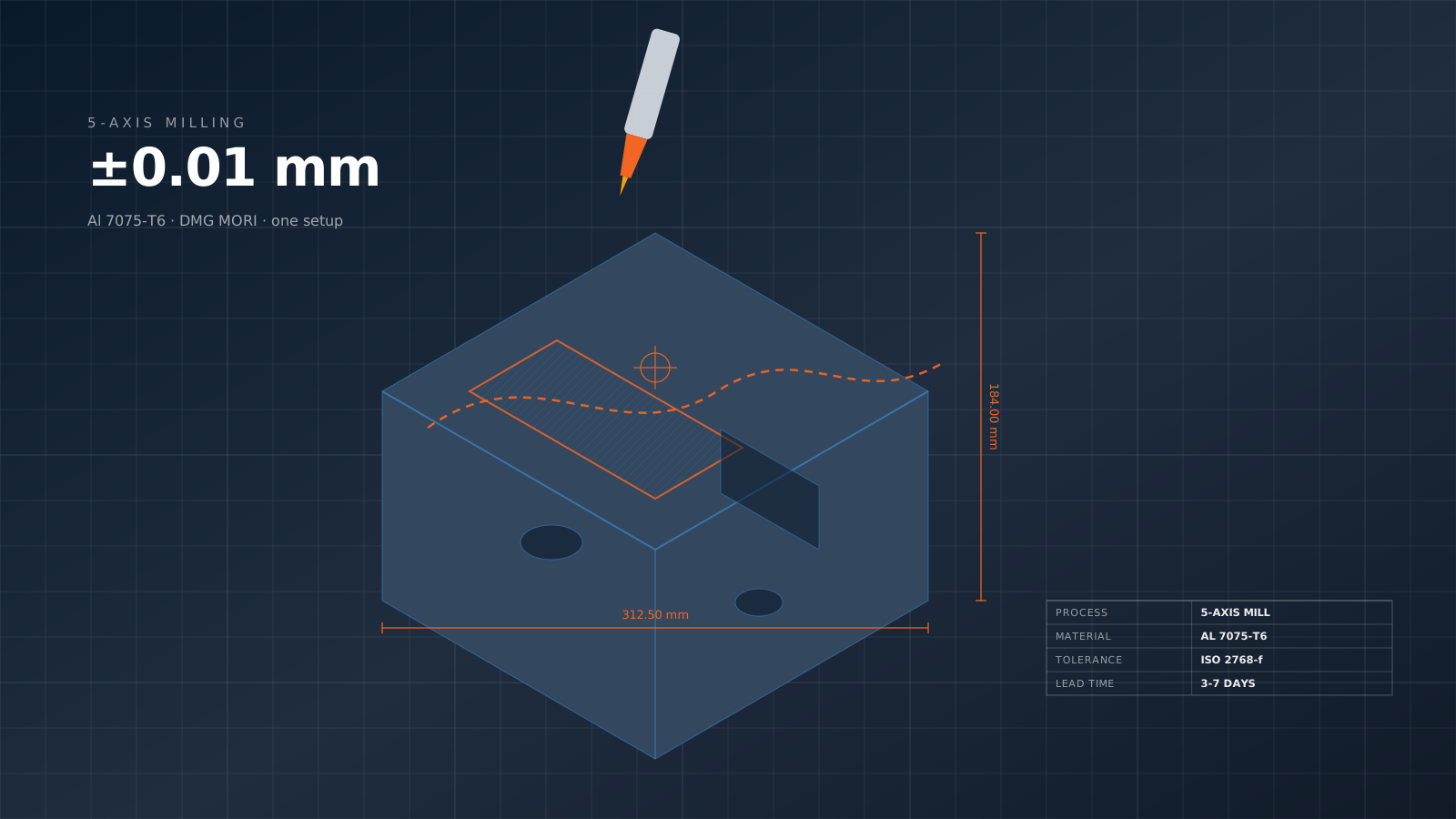
Send a CAD file. Get an engineering-reviewed quote.
No minimum quantity, free DFM feedback from a senior manufacturing engineer, and an NDA signed before file review on request.