
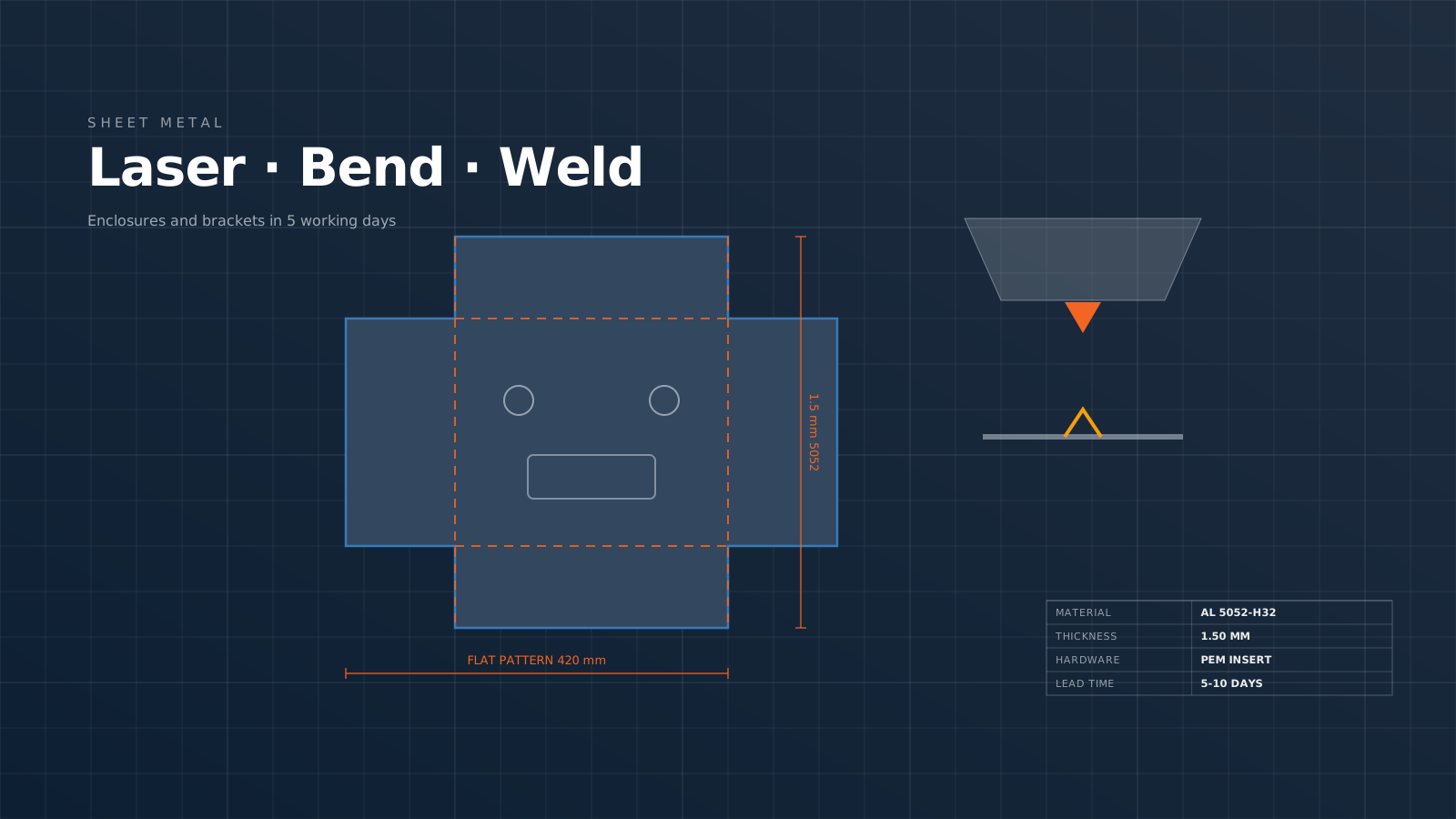
Any material. No heat. 150 mm thick.
CNC waterjet cutting uses high-pressure water with garnet abrasive to erode material — no heat, no HAZ, cuts any material. Thick metals, stone, glass, composites, food-grade materials. The go-to process when heat sensitivity or material diversity matters.

Waterjet cutting
Waterjet cutting uses water pressurized to 400–600 MPa (60,000–90,000 psi) through a small orifice (0.25–0.4 mm) to create a high-velocity water stream. Garnet abrasive is added to the stream, creating an abrasive water stream that erodes material by micro-abrasion rather than melting or shearing.
How Waterjet Cutting works.
Waterjet cutting uses water pressurized to 400–600 MPa (60,000–90,000 psi) through a small orifice (0.25–0.4 mm) to create a high-velocity water stream. Garnet abrasive is added to the stream, creating an abrasive water stream that erodes material by micro-abrasion rather than melting or shearing.
Because cutting occurs at room temperature without any heat input, waterjet produces no heat-affected zone, no thermal stress, no material phase changes. This makes it the universal cutting process — works on virtually any material regardless of heat sensitivity, conductivity, hardness, or reflectivity.
Primary advantages: cuts any material (metals, stone, glass, composites, food), no HAZ, thick material capability (150+ mm). Primary disadvantages: slower than laser on thin metal, larger kerf (1–1.5 mm), higher operating cost (garnet + water consumption). Best for heat-sensitive, thick, or non-metallic materials.
Capability specs.
Steel 150 mm, aluminum 200 mm, stone 300 mm+ — practical limits vary
±0.1 mm typical on precision waterjets. Standard waterjet: ±0.2 mm
Wider than laser (0.2 mm) and plasma (1 mm) — accounts for waterjet kerf in design
Typical cut edge. Smooth waterjet mode (slower): Ra 3 µm achievable
No thermal effects. Material properties unchanged adjacent to cut
Metals, stone, glass, composites, food, cloth — if it exists, waterjet cuts it
60,000–90,000 psi water. Garnet abrasive added for metal cutting
Multiple thin sheets can be cut simultaneously in one cycle for efficiency
Where Waterjet Cutting excels.
Thick aluminum plate
Aerospace aluminum plate above 20 mm — avoids heat-affected zone of laser
Titanium cutting
Thick titanium plate — no HAZ preserves aerospace material properties
Stone & granite
Architectural stone, kitchen countertops — only waterjet cuts natural stone precisely
Composite materials
Carbon fiber, fiberglass, laminated composites — cuts without delamination
Glass
Cosmetic glass, windows, technical glass — no thermal stress or cracking
Gasket materials
Silicone, rubber, cork gaskets — waterjet is standard for gasket cutting
Food-grade cutting
Food portion cutting, sanitary process equipment — no contamination
Heat-sensitive metals
Beryllium copper springs, hardened steel where heat would re-soften
Very thick plate
Applications above laser/plasma capability — marine, construction, heavy industry
Not suitable for:
Every process has its limits. Being honest about where Waterjet Cutting isn\'t the right answer saves time and money.
- Thin sheet metal below 2 mm — laser is much faster and cleaner
- Parts needing tighter than ±0.1 mm tolerance — CNC milling is more precise
- Very high volume production of simple thin shapes — laser or plasma cheaper per unit
- Parts requiring sharp inside corners below 1.5 mm radius (kerf width limit)
- Applications where wet processing is problematic (must dry parts after cutting)
Get an instant quote
Send your CAD — we reply with detailed pricing, lead time, and DFM feedback within 4 working hours.
Talk to an engineer
WhatsApp our team directly. Most messages answered within 12 minutes during work hours.
Explore all services
CNC, 3D printing, injection molding, sheet metal, casting, finishing — one quality system, one partner.
Any material — questions
Why no heat-affected zone?
Waterjet cuts by abrasion — garnet particles traveling at 3× speed of sound physically erode material particle by particle. Zero thermal energy imparted to the material. Contrast with laser (melts/vaporizes) and plasma (melts), both of which create HAZ. For aerospace aluminum in T6 temper, heat-sensitive hardened steels, and heat-treatable alloys, waterjet is the only cutting process that doesn't degrade material properties at the cut edge.
How fast is waterjet vs laser?
Thin material (< 6 mm): laser 3–5× faster. Medium (6–15 mm): roughly even. Thick (> 15 mm): waterjet faster, can cut thicknesses laser cannot. Laser cuts 10 mm steel at 3000 mm/min; waterjet cuts same at 1500 mm/min. But waterjet handles 50 mm steel at 500 mm/min while laser cannot practically cut that thickness.
Cost per linear meter?
Typical pricing: thin metal $3–8 per linear meter (vs laser $1–3). Thick metal $8–20 per linear meter (vs laser impossible). Stone: $10–30 per linear meter. Waterjet is more expensive than laser for thin material but competitive or cheaper for thick/difficult material. Operating cost driven by garnet consumption and water pressure system energy.
Can waterjet cut tight corners?
Minimum inside corner radius: 0.8 mm for thin material, 1.5 mm for thick. Below this, kerf width interferes. For tight inside corners, waterjet produces a small radius, not a sharp corner. If sharp internal corners are needed, specify drilled starting holes at corners, or use wire EDM for sharp-corner cutting.
Material waste and chip handling?
Waterjet generates a slurry of water + cut material particles + used garnet. This waste is separated in settling tanks — cut material recovered for recycling, used garnet disposed per regulations, water filtered and reused. For stainless and aluminum, chip recovery offsets some material cost. Operationally cleaner than plasma (no fumes) or laser (no vaporization).
Minimum thickness?
Waterjet can cut very thin materials (below 1 mm) but kerf width becomes significant relative to part size. For thin sheet below 2 mm, laser is preferred for cleaner cuts. Waterjet sweet spot: 3–150 mm thickness across any material type.
Keep reading
Quote
Get a free CNC machining, 3D printing, injection molding quote from PifyC. Send CAD via WhatsApp or email — q…
Read more →Process comparisonsLaser cutting vs waterjet
Laser cutting vs waterjet cutting: speed, heat-affected zone, material thickness, precision, cost. When to choos…
Read more →MachiningCNC machine
ISO 9001 certified CNC machining in Wuxi, China. 3, 4 and 5-axis milling, Swiss turning, 40+ materials, ±0.01 mm…
Read more →Additive manufacturing3D printing service
Industrial-grade 3D printing from Wuxi, Jiangsu, China: SLA, SLS, MJF and DMLS metal. Functional prototypes and …
Read more →Moulding & castingInjection molding
Plastic injection molding from China: rapid aluminum tooling in 14 days for 500–10,000 parts, production P20/H13…
Read more →Sheet metal & fabricationSheet metal
Precision sheet metal fabrication from Wuxi: 4 kW fiber laser cutting, Amada press brake bending (±0.1 mm), TIG/…
Read more →Finishing & treatmentFinishing services
Complete in-house surface finishing: Type II/III anodize, powder coating, electroplating, passivation, bead blas…
Read more →PifyCMaterials
PifyC's 50+ production-grade materials: aluminum, stainless steel, titanium, brass, copper, and engineering p…
Read more →
Send a CAD file. Get an engineering-reviewed quote.
No minimum quantity, free DFM feedback from a senior manufacturing engineer, and an NDA signed before file review on request.