
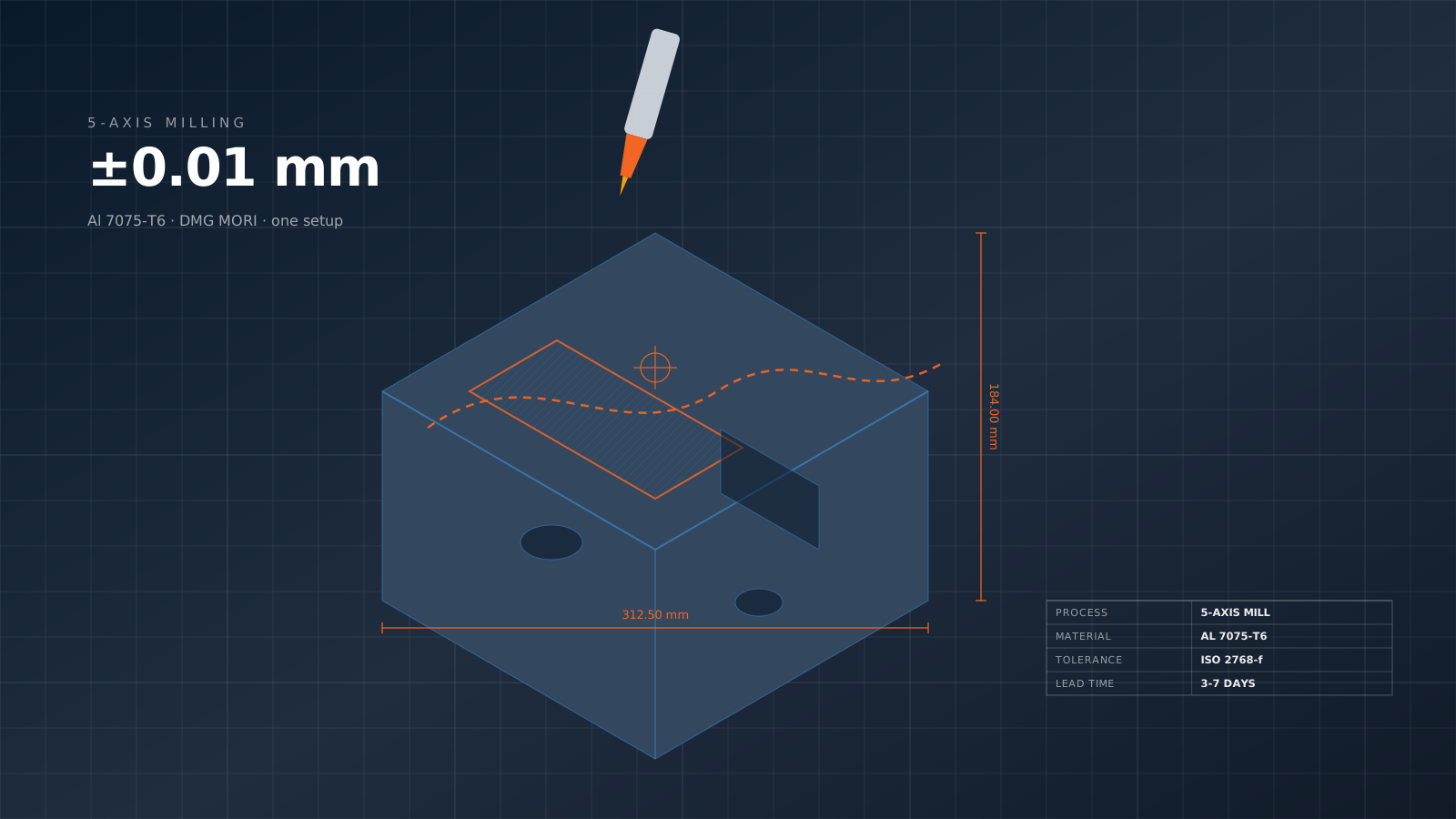
±0.005 mm tolerance. CMM verified. Precision at scale.
Precision CNC machining with tolerances to ±0.005 mm. CMM-verified every critical dimension. Temperature-controlled shop floor for dimensional stability. Swiss-level precision on watch, instrument, and aerospace components.
Precision machining services
Not all precision work is the same. We categorize work into four tiers, each with different equipment, process controls, and cost implications.
Four precision tiers.
Standard tier
Standard CNC work. Tolerance per ISO 2768-m. Appropriate for most industrial, consumer, and general engineering parts
Precision tier
Tighter tolerance with process controls. First-article CMM inspection. Good for instrument housings, mechanical assemblies
High precision tier
CMM inspection on every critical feature. Temperature-compensated measurements. Suitable for aerospace critical, precision mechanisms
Ultra precision tier
All critical features CMM-verified. Dedicated precision machines, temperature-stable shop. Scientific instruments, metrology, watchmaking
Not all precision work is the same. We categorize work into four tiers, each with different equipment, process controls, and cost implications.
Precision applications.
Scientific instruments
Optical mounts, microfluidic components, research-grade specialty hardware
Metrology equipment
Calibration artifacts, measurement standards, precision gauge hardware
Swiss watch components
Watch cases, bridges, balance wheel hardware — horological precision
Aerospace critical
Flight-critical precision features — bearing seats, mating interfaces
Semiconductor photolithography
ASML Tier-2 optical mount hardware, stepper component precision
Medical precision
Surgical robotic end-effectors, orthopedic fit features, diagnostic equipment precision
Defense precision
Missile components, precision optical mounts, targeting system hardware
Precision automation
Robot joint bearing seats, precision linear motion hardware
Quantum computing
Cryogenic hardware, ion trap components — precision at extreme conditions
Get an instant quote
Send your CAD — we reply with detailed pricing, lead time, and DFM feedback within 4 working hours.
Talk to an engineer
WhatsApp our team directly. Most messages answered within 12 minutes during work hours.
Explore all services
CNC, 3D printing, injection molding, sheet metal, casting, finishing — one quality system, one partner.
±0 — questions
What's the tightest tolerance you can actually hold?
±0.002 mm (2 µm) on features below 25 mm, with appropriate process controls. For tighter than ±0.002 mm, post-machining grinding, honing, or lapping is required — we coordinate with specialty partners for sub-micron work. In practice, ±0.005 mm is our reliable production tier for ultra-precision work. Below that, cost increases exponentially and application validation matters.
How do you achieve and verify these tolerances?
Process controls: precision CNC machines (Makino V56i for micro-precision), temperature-controlled shop floor (20 ±0.5 °C), climatized inspection room, calibrated precision measurement tools. Verification: Hexagon Global S CMM with ±1.8 µm accuracy, custom hand tools for specific inspections, ISO 17025-calibrated measurement equipment. Critical features inspected by CMM, dimensional reports provided with parts.
Why is precision expensive?
Multiple cost drivers: (1) Slower cutting — precision requires slow speeds and light cuts. (2) Multiple passes — roughing + semi-finishing + finishing + spring passes. (3) Inspection overhead — CMM programming, calibrated equipment, documented reports. (4) Scrap rate — precision work has higher scrap from tool wear and temperature drift. Typical precision part is 2–4× cost of equivalent standard-tolerance part.
Temperature-controlled manufacturing?
Yes — dedicated precision machining area with temperature controlled to 20 ±0.5 °C. Humidity controlled to prevent thermal gradient from condensation. Parts and gauges soak in measuring room (20 °C ±0.1 °C) before CMM inspection. Important because 1 mm aluminum part changes 0.023 mm per 1 °C — without temperature control, measurements can't be trusted at ±0.005 mm tolerance.
What materials can you machine to precision tolerances?
All standard materials — but some are easier than others. Best: free-machining brass C360 (easiest precision), free-machining stainless 303, aluminum 6061 (dimensional stability). Challenging: titanium (work hardens), Inconel (tool wear), PEEK (thermal expansion during cut). For very tight tolerances in difficult materials, more process development time is needed — we'll discuss during quote.
Inspection documentation?
Every precision order ships with full inspection report. Standard report format: critical dimensions with measured values + tolerance band + pass/fail indication, CMM-generated when applicable. ISO 17025-calibrated equipment used. For aerospace or regulated orders, AS9102 FAI format. Full archive retained for customer retrieval if needed later.
Keep reading
Quote
Get a free CNC machining, 3D printing, injection molding quote from PifyC. Send CAD via WhatsApp or email — q…
Read more →Tolerances & inspectionTolerance guide
Complete tolerance reference: ISO 2768 general tolerance classes, GD&T primer (form, orientation, location, runo…
Read more →MachiningCNC machine
ISO 9001 certified CNC machining in Wuxi, China. 3, 4 and 5-axis milling, Swiss turning, 40+ materials, ±0.01 mm…
Read more →Additive manufacturing3D printing service
Industrial-grade 3D printing from Wuxi, Jiangsu, China: SLA, SLS, MJF and DMLS metal. Functional prototypes and …
Read more →Moulding & castingInjection molding
Plastic injection molding from China: rapid aluminum tooling in 14 days for 500–10,000 parts, production P20/H13…
Read more →Sheet metal & fabricationSheet metal
Precision sheet metal fabrication from Wuxi: 4 kW fiber laser cutting, Amada press brake bending (±0.1 mm), TIG/…
Read more →Finishing & treatmentFinishing services
Complete in-house surface finishing: Type II/III anodize, powder coating, electroplating, passivation, bead blas…
Read more →PifyCMaterials
PifyC's 50+ production-grade materials: aluminum, stainless steel, titanium, brass, copper, and engineering p…
Read more →Send a CAD file. Get an engineering-reviewed quote.
No minimum quantity, free DFM feedback from a senior manufacturing engineer, and an NDA signed before file review on request.