
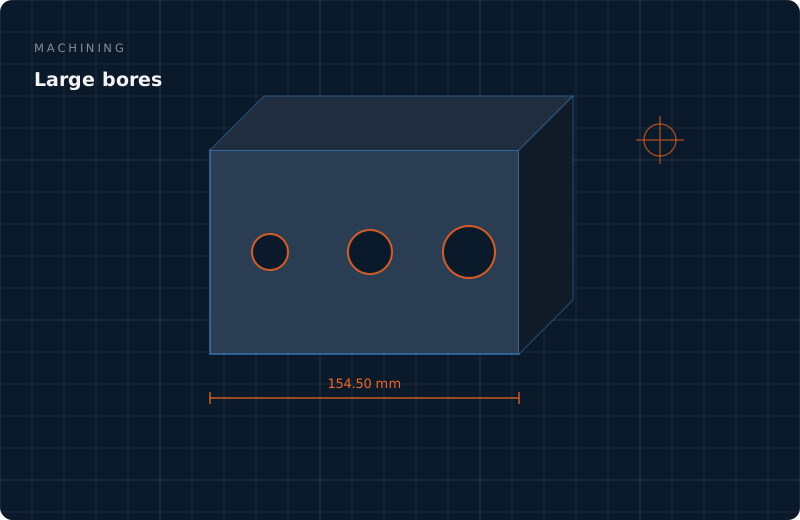
Large bores. Precision concentric. ±0.005 mm.
CNC boring produces large-diameter holes with precision tolerances beyond drilling capability. Jig boring for precision-positioned holes. Line boring for concentric multi-bearing alignment. Standard CNC boring for hydraulic cylinders and large bearing seats.
CNC boring operations
CNC boring enlarges a pre-drilled hole to precise dimensions using a single-point cutting tool on a boring head. Unlike drilling (which creates new holes with a multi-point twist drill), boring removes material from the sides of an existing hole, producing very accurate diameters, excellent roundnes
How CNC Boring works.
CNC boring enlarges a pre-drilled hole to precise dimensions using a single-point cutting tool on a boring head. Unlike drilling (which creates new holes with a multi-point twist drill), boring removes material from the sides of an existing hole, producing very accurate diameters, excellent roundness, and precise positioning.
Standard CNC boring handles common precision bores — typically 50 mm to 300 mm diameter. For specialty applications: jig boring uses extremely precise machines for position-critical bores (tolerance ±0.005 mm on hole centers). Line boring uses a long boring bar spanning multiple bearing housings to machine them all concentrically in one pass — essential for engine blocks and long shaft assemblies.
Boring is the standard finishing operation for hydraulic cylinder bores, engine cylinder walls, large bearing seats, and any bore too large for reaming to handle. Often combined with honing for final surface finish on hydraulic and sealing applications.
Capability specs.
Standard boring range. Larger bores via specialty boring equipment
Precision boring tolerance. ±0.01 mm typical standard production
Single-pass finish. Better than drilling (Ra 3.2 µm)
Boring depth limited by boring bar length, not fundamentally limited
Precision jig boring position accuracy for critical features
Multiple bores machined in single pass maintain concentric alignment
Slower than drilling but faster than reaming for large holes
Standard ductile metals. Hardened materials may require grinding
Where CNC Boring excels.
Hydraulic cylinder bores
Precision bore for hydraulic cylinders — diameter tolerance for seal performance
Engine blocks
Engine cylinder walls — precise diameter, straight bore, correct finish for rings
Large bearing seats
Bearing bores above 50 mm diameter where reaming is impractical
Line bored bearing housings
Engine camshaft bearings, transmission gear bearings — concentric alignment
Pump bodies
Pump impeller and volute bores — precision dimensions for flow performance
Mill spindle housings
Machine tool spindle bearing bores — extreme concentric and dimensional accuracy
Crankcase bores
Engine crankcase main bearing bores — line bored for shaft alignment
Jig plate features
Precision jig and fixture bores — positioning accuracy for tooling
Large-port manifolds
Aerospace and hydraulic manifolds with large fluid ports
Not suitable for:
Every process has its limits. Being honest about where CNC Boring isn\'t the right answer saves time and money.
- Small diameter holes (< 25 mm) — reaming faster and cheaper
- Very rough tolerance bores (±0.1 mm) — drilling alone adequate, cheaper
- Hardened materials (>45 HRC) — grinding or honing preferred
- Bores requiring tighter than ±0.005 mm — grinding or honing
- Bores with asymmetric features — milling operations preferred
Get an instant quote
Send your CAD — we reply with detailed pricing, lead time, and DFM feedback within 4 working hours.
Talk to an engineer
WhatsApp our team directly. Most messages answered within 12 minutes during work hours.
Explore all services
CNC, 3D printing, injection molding, sheet metal, casting, finishing — one quality system, one partner.
Large bores — questions
When is boring better than drilling + reaming?
Diameter above 50 mm (reamers become expensive and unwieldy above this size). Position-critical bores where drift matters (drilling wanders slightly, boring corrects). Roundness-critical applications (boring achieves better roundness than drilling). Bores where dimensions change multiple times during development (boring can adjust to any diameter; reamers are fixed-size).
What is line boring?
Machining multiple bearing bores in a single straight-line pass with a long boring bar. Essential for engine crankshaft bearings, camshaft bearings, transmission gear shafts. The bar spans all bore locations, ensuring they're perfectly concentric (within ±0.01 mm). Cannot be achieved by boring each bore independently — individual errors would compound to unacceptable misalignment.
Jig boring vs standard CNC boring?
Standard CNC boring: ±0.01 mm position tolerance, adequate for most precision applications. Jig boring: dedicated ultra-precision boring machine with lead screw accuracy of ±0.002 mm, temperature-controlled environment, specialized for position-critical bores. Used for: injection mold plates, precision tooling, aerospace tooling plates where bore positions must be within 0.005 mm of specified location.
Roundness and cylindricity?
Boring produces excellent roundness — typically 0.005 mm on standard production. For critical cylindricity (round both in cross-section and along length), boring with rigid boring bar setup + cylindrical grinding for finish is the path. Hydraulic cylinder bores often boring + honing for optimal combination of dimensions and surface finish.
Boring time vs drilling?
Boring takes longer than drilling per inch of depth. Boring cycle time: 100–500 mm/min feed rate. Drilling: 500–1500 mm/min. For shallow holes, drill is faster; for deep holes or precision, boring is required regardless of time. Boring cost is justified by accuracy, not speed.
Line boring capacity?
Our line boring capacity: up to 2 m span across multiple bearing houses, bore diameter 50–300 mm. Larger via specialty partners. For line bored engine blocks, crankcases, and multi-bearing assemblies, plan 7–14 day lead time including setup, boring cycle, and inspection. Line boring is a specialty operation — setup time is significant but production quality is exceptional.
Keep reading
Quote
Get a free CNC machining, 3D printing, injection molding quote from PifyC. Send CAD via WhatsApp or email — q…
Read more →MachiningDeep hole drilling
Deep hole drilling services: gun drilling for 3–50 mm diameter to depths of 2 meters, BTA drilling for larger di…
Read more →MachiningCNC machine
ISO 9001 certified CNC machining in Wuxi, China. 3, 4 and 5-axis milling, Swiss turning, 40+ materials, ±0.01 mm…
Read more →Additive manufacturing3D printing service
Industrial-grade 3D printing from Wuxi, Jiangsu, China: SLA, SLS, MJF and DMLS metal. Functional prototypes and …
Read more →Moulding & castingInjection molding
Plastic injection molding from China: rapid aluminum tooling in 14 days for 500–10,000 parts, production P20/H13…
Read more →Sheet metal & fabricationSheet metal
Precision sheet metal fabrication from Wuxi: 4 kW fiber laser cutting, Amada press brake bending (±0.1 mm), TIG/…
Read more →Finishing & treatmentFinishing services
Complete in-house surface finishing: Type II/III anodize, powder coating, electroplating, passivation, bead blas…
Read more →PifyCMaterials
PifyC's 50+ production-grade materials: aluminum, stainless steel, titanium, brass, copper, and engineering p…
Read more →Send a CAD file. Get an engineering-reviewed quote.
No minimum quantity, free DFM feedback from a senior manufacturing engineer, and an NDA signed before file review on request.