
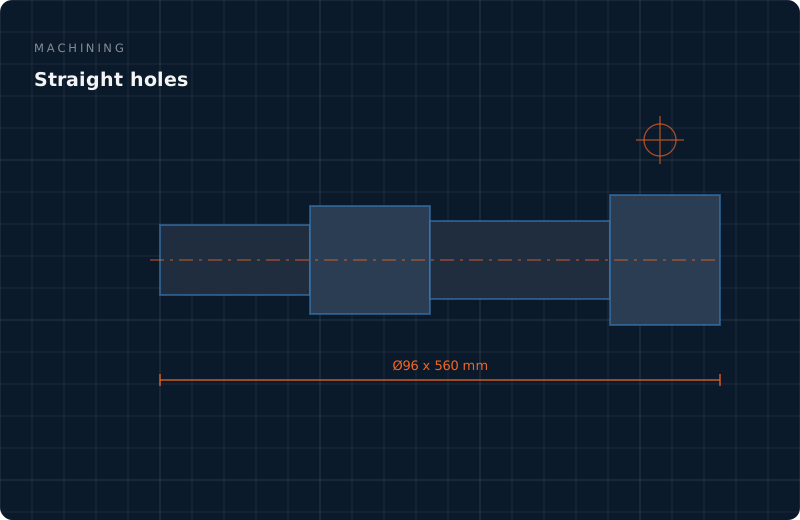
Straight holes. 100× diameter deep. Gun drilled.
Specialty deep hole drilling for hydraulic components, oil and gas hardware, aerospace fuel systems, and precision tooling. Gun drilling, BTA drilling, and ejector drilling achieve straightness and accuracy impossible with twist drills.
Deep hole drilling
Deep hole drilling refers to specialty drilling processes for holes where the depth-to-diameter ratio exceeds ~10:1 — the practical limit of conventional twist drilling. Three primary specialty processes handle different size ranges:
How Deep Hole Drilling works.
Deep hole drilling refers to specialty drilling processes for holes where the depth-to-diameter ratio exceeds ~10:1 — the practical limit of conventional twist drilling. Three primary specialty processes handle different size ranges:
Gun drilling: Single-flute carbide drill with high-pressure through-coolant. Used for 3–50 mm diameter holes up to 2 m deep. Precision straightness. Ideal for hydraulic cylinder bores, injector bodies, aerospace fuel system deep holes, small-diameter precision work.
BTA drilling (Boring and Trepanning Association): Ejector-style drilling for larger diameters (50–150 mm+). Coolant flows through annulus between drill and hole wall; chips ejected back through the drill. For large hydraulic cylinders, gun barrels, aerospace cannons, large-bore applications.
Ejector drilling: Medium depth/diameter range (10–60 mm diameter, up to 500 mm depth). Compromise between gun drill speed and BTA drill robustness. Used when gun drilling is too slow but BTA is overkill.
Capability specs.
Gun drill 3–50 mm, ejector 10–60 mm, BTA 50–150+ mm
Length-to-diameter ratio achievable. Conventional drilling limit: ~10:1
Gun drilling practical limit. BTA can reach similar depths on larger bores
Typical straightness accuracy — better than any alternative process
Hole diameter achievable. Reaming to ±0.01 mm for precision applications
Interior surface finish — typical for gun-drilled holes
High-pressure through-coolant essential for chip evacuation and heat management
Steel, stainless, Inconel, titanium, tool steel — any machinable metal
Where Deep Hole Drilling excels.
Hydraulic cylinders
Hydraulic cylinder bores — precision straightness critical for seal performance
Injection mold cooling
Cooling channel passages in injection molds — conformal cooling layouts
Oil & gas mandrels
Downhole tool internal bores — sour service materials (Inconel, duplex)
Gun barrels
Firearm barrels — rifled or smooth bore precision deep-hole drilling
Aerospace fuel system
Deep cross-drilled fuel passages in aerospace manifolds and valve bodies
Heat exchanger tubes
Tube sheet holes for shell-and-tube heat exchangers
Print roller cores
Printing industry roller cores with heated/cooled passages
Medical tubing
Deep small-diameter bores for medical catheter tooling
Research hardware
Pressure vessel deep bores, particle accelerator components
Not suitable for:
Every process has its limits. Being honest about where Deep Hole Drilling isn\'t the right answer saves time and money.
- Shallow holes under 10:1 L/D — conventional drilling faster and cheaper
- Holes smaller than 3 mm diameter — micro-machining territory
- Short production runs of 1–5 pieces — setup cost per part high
- Material harder than 55 HRC — deep hole drilling limited on hardened material
- Non-round cross-sections — deep hole drilling is round bore only
Get an instant quote
Send your CAD — we reply with detailed pricing, lead time, and DFM feedback within 4 working hours.
Talk to an engineer
WhatsApp our team directly. Most messages answered within 12 minutes during work hours.
Explore all services
CNC, 3D printing, injection molding, sheet metal, casting, finishing — one quality system, one partner.
Straight holes — questions
Why not just use a long twist drill?
Twist drill deflection and chip evacuation problems limit practical depth to ~5× diameter. Beyond that, drills wander off-center, chips pack and break tools, heat builds up catastrophically. Gun drilling solves all three: single-flute design improves rigidity, through-coolant at high pressure flushes chips efficiently, steady-rest design maintains straightness. Result: 100:1 L/D achievable vs 5:1 with twist drill.
Straightness accuracy explained?
Conventional drill: can wander 0.5–2 mm off-center at depths over 10× diameter. Gun drill: 0.05 mm drift per 100 mm depth — at 1 meter depth, total drift under 0.5 mm. For precision applications (hydraulic cylinders, aerospace fuel systems, gun barrels), this straightness is mandatory. Post-drilling honing further improves straightness and surface finish.
Can deep hole drilling handle Inconel or titanium?
Yes. Gun drilling Inconel requires: slower speeds (15–25 m/min vs 60 for steel), careful coolant pressure management, premium carbide tooling. Typical inconel gun drilling cost: 3–4× equivalent steel cost. Our experience with difficult materials includes gun drilling NACE-qualified Inconel 718 for oil and gas downhole tool work.
Rifling vs smooth bore?
Smooth bore gun drilling: standard process, produces straight round hole. Rifled bores (for firearms): gun drill produces smooth bore, then button rifling or broaching adds the rifling grooves. We handle smooth bore through partner for rifling operations. For hydraulic cylinders and general deep hole work: smooth bore is what's needed.
Coolant and chip management?
Gun drilling uses high-pressure through-coolant (20–40 bar) that flows through the center of the drill and exits at the cutting edge. This flushes chips back along the outside of the drill. For very long holes, intermediate chip-breaking cycles may be needed. Specialized cutting fluid (not standard machine coolant) matched to material is required.
Lead times for deep hole work?
Typical deep hole drilling: 7–14 business days. Depends on: specific material availability, drill stocking (specialty diameters may need special tooling), combined operations (usually machined externally too). For one-off custom-diameter work, additional 5–10 days for custom tool procurement. For recurring production of standard bores, 7 days typical.
Keep reading
Quote
Get a free CNC machining, 3D printing, injection molding quote from PifyC. Send CAD via WhatsApp or email — q…
Read more →PifyCManufacturing services
PifyC delivers six integrated manufacturing processes from one Wuxi facility: CNC machining, 3D printing, inj…
Read more →MachiningCNC machine
ISO 9001 certified CNC machining in Wuxi, China. 3, 4 and 5-axis milling, Swiss turning, 40+ materials, ±0.01 mm…
Read more →Additive manufacturing3D printing service
Industrial-grade 3D printing from Wuxi, Jiangsu, China: SLA, SLS, MJF and DMLS metal. Functional prototypes and …
Read more →Moulding & castingInjection molding
Plastic injection molding from China: rapid aluminum tooling in 14 days for 500–10,000 parts, production P20/H13…
Read more →Sheet metal & fabricationSheet metal
Precision sheet metal fabrication from Wuxi: 4 kW fiber laser cutting, Amada press brake bending (±0.1 mm), TIG/…
Read more →Finishing & treatmentFinishing services
Complete in-house surface finishing: Type II/III anodize, powder coating, electroplating, passivation, bead blas…
Read more →PifyCMaterials
PifyC's 50+ production-grade materials: aluminum, stainless steel, titanium, brass, copper, and engineering p…
Read more →Send a CAD file. Get an engineering-reviewed quote.
No minimum quantity, free DFM feedback from a senior manufacturing engineer, and an NDA signed before file review on request.