
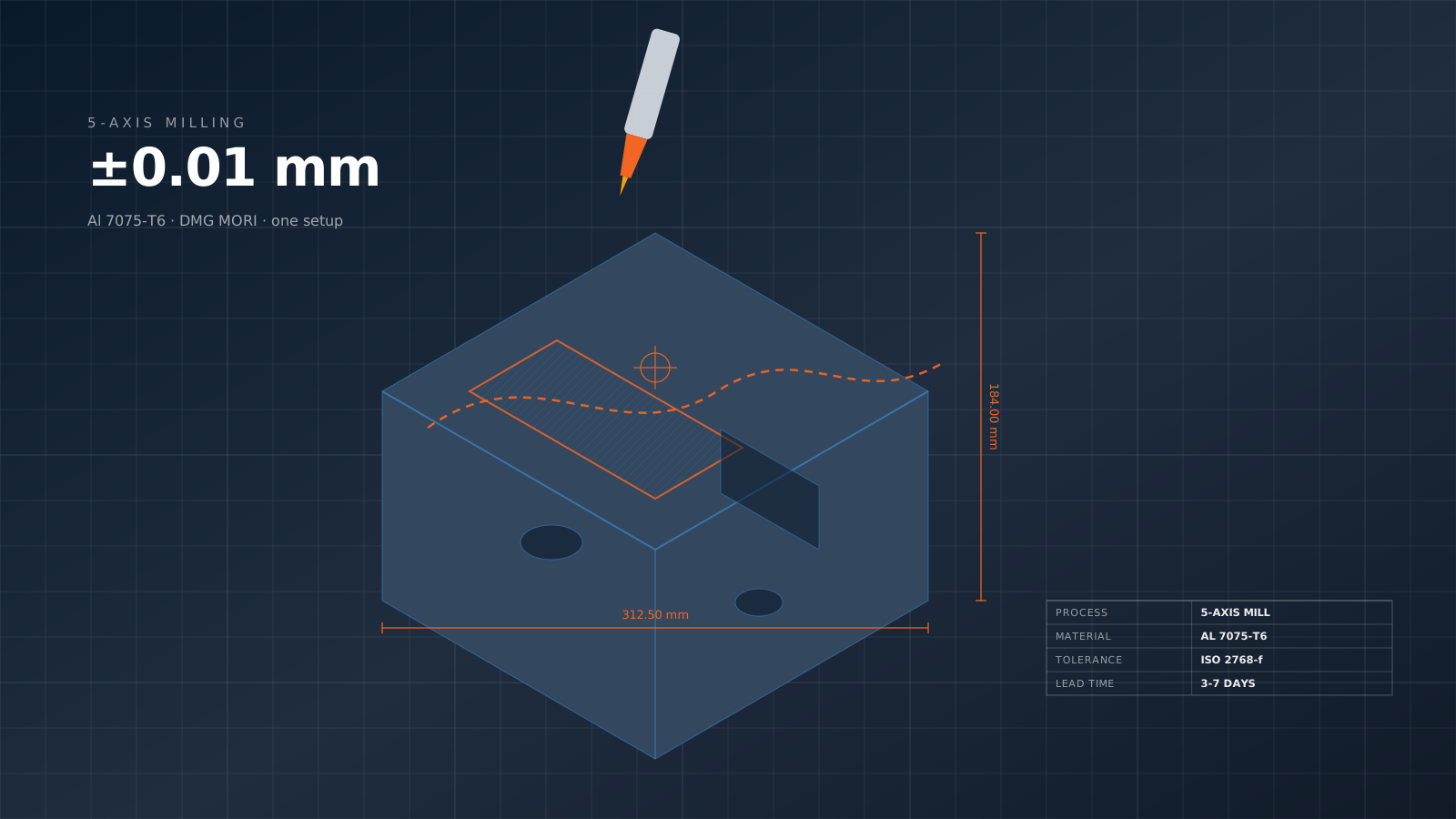
3, 4 and 5-axis milling. From prototype to production.
32 milling centers from Haas, DMG MORI and Mazak, organized into dedicated cells by axis count and job profile. Tolerance down to ±0.01 mm, envelopes up to 1200 × 800 × 600 mm, materials from aluminum to Inconel.
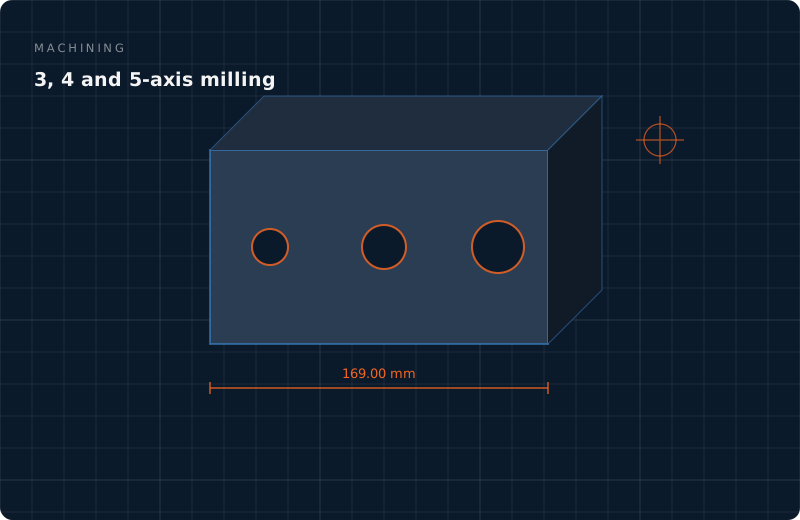
CNC milling
Axis count isn't about "more is better" — it's about matching the machine to your geometry. Over-specifying 5-axis for a simple plate doubles your cost; under-specifying 3-axis for a complex impeller doubles your lead time.
Which axis configuration do you need?
3-Axis Milling
4-Axis Milling
5-Axis Milling
Key data
- Machines
- 18 (Haas VF-2/VF-4)
- Envelope
- 760 × 508 × 508 mm
- Accuracy
- ±0.025 mm
- Spindle
- 10,000 rpm · 15 kW
- Machines
- 8 (Haas + TRT rotary)
- Envelope
- 1020 × 510 × 635 mm
- Accuracy
- ±0.02 mm
- 4th axis
- A-axis, 360°
- Machines
- 6 (DMG MORI DMU 50/65)
- Envelope
- Ø 650 × 560 mm
- Accuracy
- ±0.01 mm
- Spindle
- 18,000 rpm · 35 kW
Axis count isn't about "more is better" — it's about matching the machine to your geometry. Over-specifying 5-axis for a simple plate doubles your cost; under-specifying 3-axis for a complex impeller doubles your lead time.
3, 4 and 5-axis milling — questions
What is the difference between 3-axis, 4-axis and 5-axis milling?
3-axis milling moves the cutter in X, Y and Z — adequate for most prismatic parts. 4-axis adds a rotary A or B axis, letting you machine around a cylindrical part or reach the four sides of a block in a single setup. 5-axis adds a second rotary axis, so the tool can approach any surface at any angle — essential for impellers, turbine blades, complex aerospace brackets, and any part with undercuts or compound angles.
When should I specify 5-axis milling?
Specify 5-axis when: (1) your part has surfaces that can't be accessed in 3 or 4-axis setups without multiple fixtures; (2) you need tolerance stack-up below ±0.05 mm across multiple features (5-axis machines all features in one setup); (3) your geometry has compound angles or organic curves (turbine blades, orthopedic implants); (4) setup cost of multiple 3-axis fixtures exceeds the premium of single 5-axis setup.
What is your largest milling envelope?
Our largest 3-axis envelope is 1200 × 800 × 600 mm (Haas VF-5 class). 4-axis envelope 1020 × 510 × 635 mm. 5-axis maximum Ø 650 × 560 mm (DMG MORI DMU 65). For larger parts, we can subdivide and fixture-weld, or partner with sister shops for sub-assembly approach.
What surface finish can milling achieve?
Standard as-milled finish is Ra 3.2 µm. Fine finish passes achieve Ra 1.6 µm. With high-speed machining and sharp tools on aluminum, Ra 0.8 µm is achievable directly on the machine. Below 0.8 µm requires secondary polishing, lapping, or grinding.
Can you mill hardened tool steels?
Yes — we routinely mill pre-hardened P20 (30 HRC), H13 (45 HRC), and D2 (58–62 HRC) for tooling and die components, using carbide and CBN tooling. For materials above 50 HRC, expect 3–5× longer machining time vs soft steel.
What fixturing options do you offer?
Standard vises, custom aluminum soft-jaws, vacuum fixtures for thin parts, dedicated hard fixtures for repeat production, modular fixture kits (Zero Point), and 5-axis trunnion setups. For production runs above 500 parts, we design and fabricate custom fixtures to minimize cycle time.
Keep reading
Quote
Get a free CNC machining, 3D printing, injection molding quote from PifyC. Send CAD via WhatsApp or email — q…
Read more →MachiningCNC machine
ISO 9001 certified CNC machining in Wuxi, China. 3, 4 and 5-axis milling, Swiss turning, 40+ materials, ±0.01 mm…
Read more →MachiningTapping services
CNC tapping services for internal threads in any material. Standard tapping for production volumes, thread milli…
Read more →MachiningReaming services
CNC reaming services for precision hole diameters. H7 tolerance bores, ±0.005 mm diameter, Ra 0.4 µm surface fin…
Read more →MachiningThread rolling
Thread rolling: cold-formed threads with superior strength, surface finish, and fatigue life. Standard for produ…
Read more →MachiningSwiss screw machining
Swiss-type CNC screw machining: small-diameter precision parts (< 32 mm), tolerances to ±0.005 mm, long length-t…
Read more →MachiningHoning and lapping
Honing and lapping services: bore honing for hydraulic cylinders, flat lapping for precision surfaces. Sub-micro…
Read more →MachiningBroaching services
CNC broaching services: internal keyways, spline cutting, square and hexagon holes, gear teeth. Linear and rotar…
Read more →Send a CAD file. Get an engineering-reviewed quote.
No minimum quantity, free DFM feedback from a senior manufacturing engineer, and an NDA signed before file review on request.