
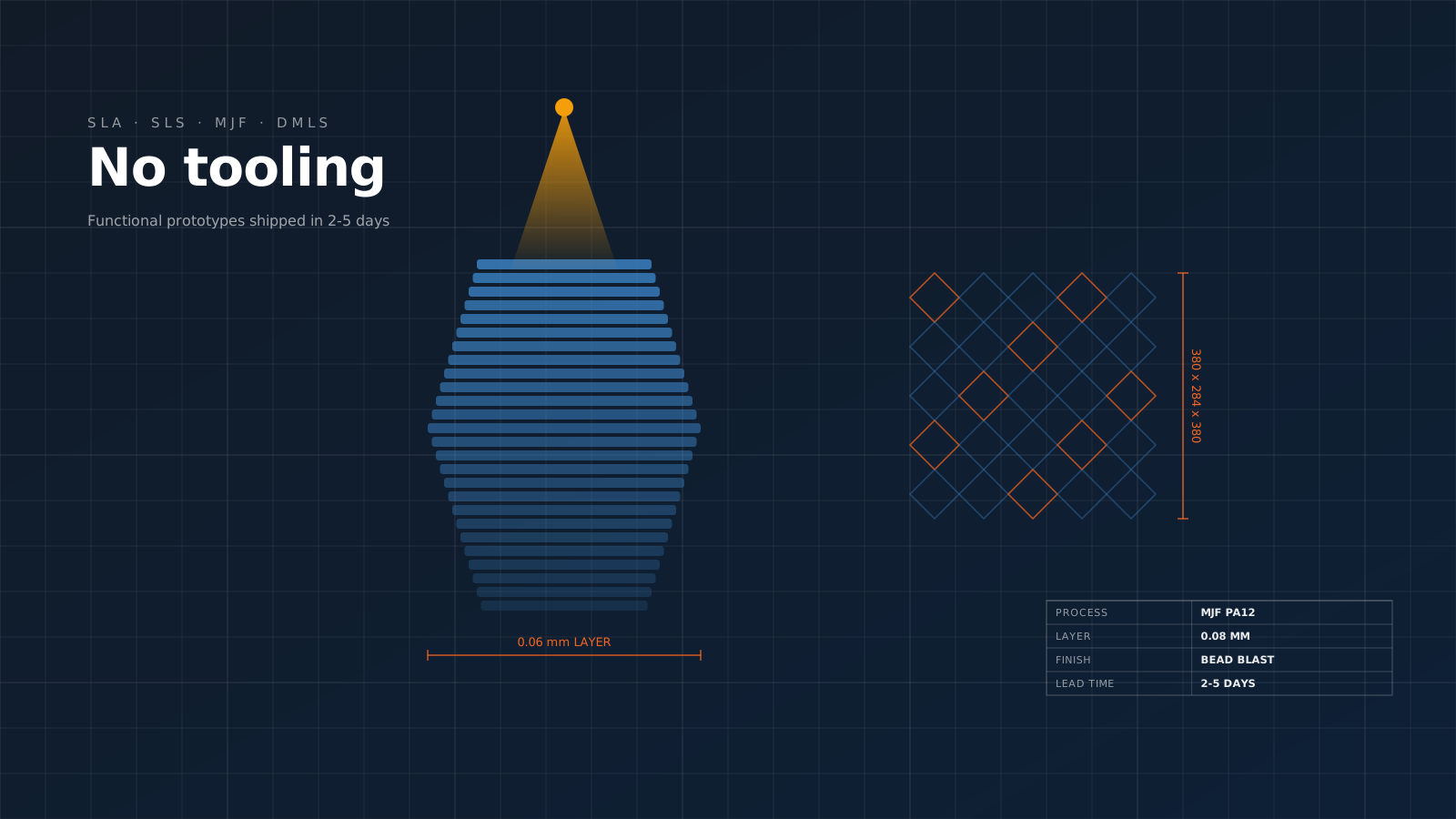
Production-grade nylon. No support structures.
EOS SLS and HP MJF 5200 printers running PA12, PA11, glass/carbon-filled, flame-retardant, and TPU elastomer. From 1-piece prototypes to 10,000-piece production runs. 3–5 day lead time.
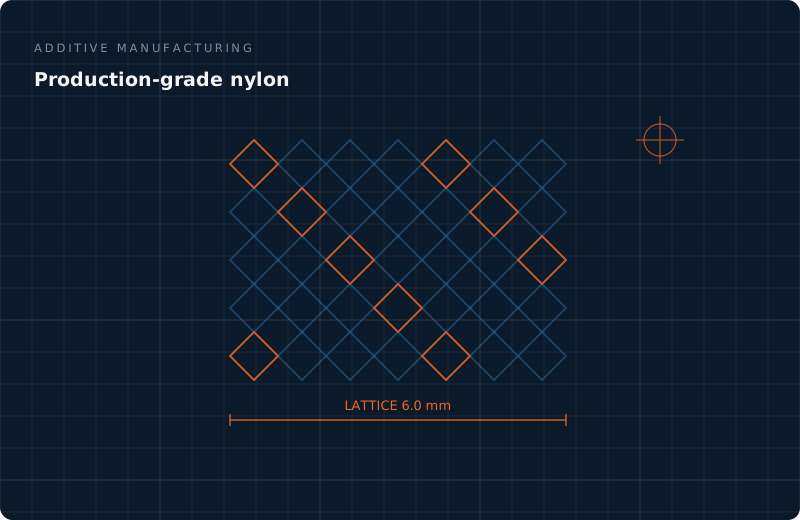
SLS printer technology
Both produce durable nylon parts without support structures. The differences are speed, isotropy, and available materials.
Two powder-bed nylon technologies.
SLS · Selective Laser Sintering
Strength: best of both worlds for materials (PA11, PA12-FR flame retardant). Slower than MJF for large build densities.
MJF · Multi Jet Fusion
Strength: faster production runs, more isotropic properties, superior cosmetic black parts. Our default for 50+ part orders.
Key data
- Printers
- 3× EOS P-series
- Build envelope
- 340 × 340 × 620 mm
- Layer height
- 60–120 µm
- Tolerance
- ±0.3 mm
- Materials
- Widest (incl PA11, PA12-FR)
- Printers
- 2× HP Jet Fusion 5200
- Build envelope
- 380 × 284 × 380 mm
- Layer height
- 80 µm
- Tolerance
- ±0.3 mm
- Speed
- 10× faster than SLS
Both produce durable nylon parts without support structures. The differences are speed, isotropy, and available materials.
Production-grade nylon — questions
What is the difference between SLS and MJF?
SLS (Selective Laser Sintering) uses a CO2 laser to fuse fine nylon powder layer by layer. MJF (Multi Jet Fusion) uses an HP inkjet head to deposit fusing and detailing agents, then an IR lamp fuses the powder. MJF is 10× faster than SLS for large builds, with more isotropic mechanical properties. SLS offers slightly wider material selection (PA11, PA12-FR). Both deliver comparable part quality for most applications.
What is PA12 nylon and why is it so popular for SLS?
Polyamide 12 (PA12) is an engineering nylon with excellent balance of strength, flexibility, and chemical resistance. Tensile strength 48 MPa, elongation at break 20%, HDT 171°C at 0.45 MPa load. Self-supporting during the print (no support structures needed), so complex internal geometries print at no extra cost. Production-grade for medical ducting, aerospace brackets, industrial housings, robotic end-effectors.
Can SLS/MJF parts be used for end-use production?
Yes. MJF is production-qualified for thousands of end-use applications. HP Jet Fusion PA12 meets UL 94 HB flammability, ISO 10993-5 cytotoxicity, and USP Class I–VI biocompatibility depending on grade. Used in production for medical prosthetics, automotive clips and brackets, ducting, industrial spare parts, architectural detailing.
What post-processing is standard for SLS/MJF parts?
As-printed parts have a slightly rough "sugar cube" surface. Standard post-processing: air blast to remove loose powder, bead blast to uniform matte finish, optional tumble polish for smoother feel. For cosmetic appearance: vapor smoothing (uses hydrocarbon vapor to melt surface smooth), dyeing in black/blue/red, or spray painting. MJF black parts have excellent as-printed cosmetic appearance.
What tolerances should I expect from SLS/MJF?
Standard tolerance ±0.3 mm or ±0.3% of feature dimension (whichever is greater). Repeatability within a single build is excellent (±0.1 mm). For mating features below 0.1 mm tolerance, specify critical surfaces for post-machining. Thread accuracy: threaded holes up to M6 can be self-tapped in-print; for M8 and larger, insert threaded inserts or post-tap.
What specialty materials are available beyond PA12?
PA11 (higher impact, plant-based), PA12-GF (30% glass-filled, stiffer), PA12-CF (15% carbon-filled, structural), PA12-FR (flame-retardant UL 94 V-0), TPU 88A (thermoplastic elastomer, Shore 88A), PP (polypropylene, chemical resistance), ESD-safe PA12 (surface resistivity 10^6 Ω). Material datasheets available on request.
Keep reading
Quote
Get a free CNC machining, 3D printing, injection molding quote from PifyC. Send CAD via WhatsApp or email — q…
Read more →Additive manufacturing3D printing service
Industrial-grade 3D printing from Wuxi, Jiangsu, China: SLA, SLS, MJF and DMLS metal. Functional prototypes and …
Read more →Additive manufacturingOvernight 3D printing
Overnight 3D printing service: SLA resin parts next-day, SLS nylon parts 48 hours, MJF parts 48 hours. Upload ST…
Read more →Additive manufacturingLarge format 3D printing
Large format 3D printing service: parts up to 900 mm via large-format SLS, industrial FDM, and segmented assembl…
Read more →Additive manufacturingMJF 3D printing service
HP Multi Jet Fusion (MJF) 3D printing: best surface finish in nylon, production-scale batch processing, faster t…
Read more →Additive manufacturingMetal 3D printing DMLS
Metal 3D printing service: DMLS/SLM (Direct Metal Laser Sintering/Selective Laser Melting). Ti Gr.23, Inconel 71…
Read more →Additive manufacturingFDM 3D printing
Industrial FDM 3D printing: ABS, PC, Ultem 9085, PEEK. Large parts up to 914 mm, engineering-grade thermoplastic…
Read more →Additive manufacturingSLA 3D printing service
SLA (stereolithography) 3D printing service: fine-detail resin prototypes, smooth surface finish Ra 2-5 µm, tran…
Read more →
Send a CAD file. Get an engineering-reviewed quote.
No minimum quantity, free DFM feedback from a senior manufacturing engineer, and an NDA signed before file review on request.