
Strong as steel. Half the weight. Biocompatible.
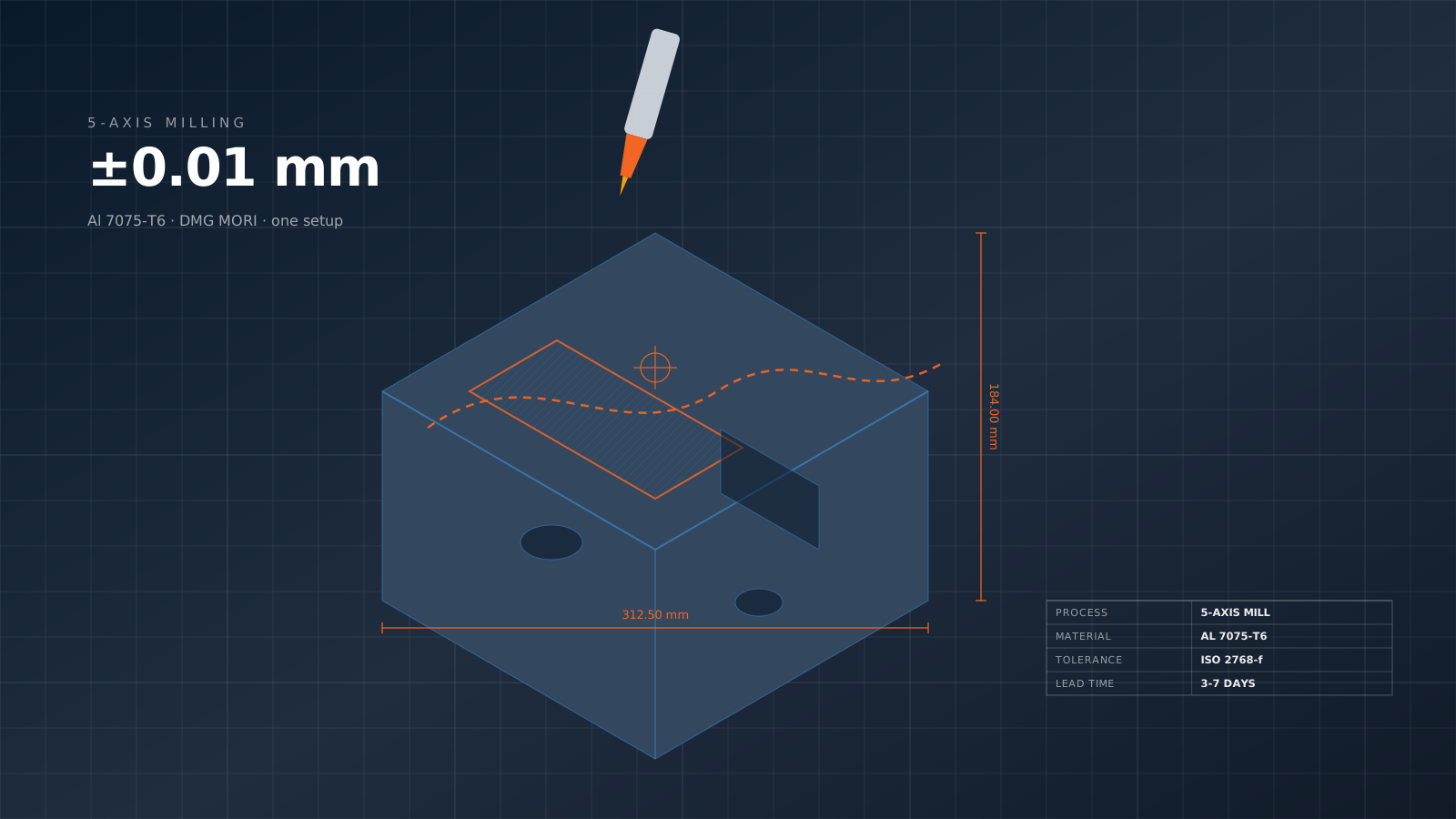
Ti-6Al-4V and Ti-6Al-4V ELI are workhorses of aerospace and medical manufacturing. 5-axis CNC machined with carbide or PCD tooling, climb-milled to avoid work hardening.
At a glance
- Density
- 4.43 g/cc
- Yield strength
- 828 MPa
- Tensile strength
- 895 MPa
- Elongation
- 10 %
- Hardness
- 334 HB
- Melting point
- 1,604–1,660 °C
- Thermal cond.
- 6.7 W/m·K
- Biocompatible
- Yes (bone-integrating)
Key data
- Density
- 4.43 g/cc
- Yield strength
- 828 MPa
- Tensile strength
- 895 MPa
- Elongation
- 10 %
- Hardness
- 334 HB
- Melting point
- 1,604–1,660 °C
- Thermal cond.
- 6.7 W/m·K
- Biocompatible
- Yes (bone-integrating)
Titanium grades we machine.
Grade 2
Unalloyed CP titanium with excellent corrosion resistance, especially in chloride environments. Marine, chemical, desalination. Good formability, welds well.
Grade 5 (Ti-6Al-4V)
The most common titanium alloy — "the workhorse". 6% Al + 4% V. High strength, good fatigue, heat-treatable. Aerospace structural, medical general.
Grade 23 (Ti-6Al-4V ELI)
Extra Low Interstitial version of Grade 5 — lower oxygen, nitrogen, carbon, iron. Better fracture toughness and ductility. Standard for orthopedic and dental implants.
Grade 9 (Ti-3Al-2.5V)
Intermediate strength, excellent formability. Hydraulic tubing, bicycle frames, sport equipment.
Grade 12
Ti-0.3Mo-0.8Ni. Improved crevice corrosion resistance over Gr.2. Power plant heat exchangers.
Grade 19 (Ti-3Al-8V-6Cr-4Mo-4Zr)
Beta titanium alloy. Spring temper for aerospace springs, connectors. 1,200 MPa yield.
Commercially pure titanium (Grade 1–4) for corrosion applications. Ti-6Al-4V alloys (Grade 5 and 23) for load-bearing aerospace and medical. Specialty alloys on request.
What makes titanium special.
Strength-to-weight
50% lighter than steel at similar strength. Critical for aerospace where every gram of orbital mass costs dollars to lift.
Corrosion resistance
TiO2 passive layer resists seawater, chlorides, most acids. Nearly inert in human body fluids — unlike stainless which releases trace nickel.
Biocompatibility
Bone osseointegrates directly to titanium surface. Standard for hip stems, knee components, dental implants, bone plates.
Thermal stability
Retains strength from cryogenic to 400 °C. Modulus close to bone (110 GPa) — reduces stress shielding in implants.
Few materials compete on strength-to-weight, corrosion resistance, and biocompatibility combined. The trade-off is price and machining difficulty.
Titanium applications.
Aerospace structural
Engine pylons, landing gear, bulkhead fittings — Grade 5
Orthopedic implants
Hip stems, knee components, bone plates — Grade 23 ELI
Dental implants
Screws and abutments — Grade 4 CP and Grade 23
Marine hardware
Shafts, fittings, heat exchangers — Grade 2
Chemical processing
Heat exchangers, reactor vessels — Grade 2, 7
Racing & motorsport
Connecting rods, exhaust, suspension — Grade 5
Sporting goods
Bicycle frames, golf clubs — Grade 9
Defense & firearms
Bolt carriers, suppressor bodies — Grade 5
Medical instruments
Forceps, bone saws, retractors — Grade 2 CP
Titanium finishes.
As-machined
Typical Ra 1.6 µm with sharp carbide tooling. Slight golden tint from heat at high cutting speeds.
Bead blasted
Uniform matte grey — standard medical finish. Pre-passivation prep.
Passivated
Nitric or citric acid removes embedded iron and enhances passive layer. Required before anodizing.
Anodized Type II
Decorative color via oxide-interference. Gold, blue, purple, green — no dye. Used for surgical tool identification.
Anodized Type III
Hard wear-resistant coating (15+ µm). Dental screw heads, implant surfaces.
Plasma-sprayed HA
Hydroxyapatite coating on bone-contacting implants promotes osseointegration. Through specialty partners.
Electropolished
Mirror-smooth surface for fatigue-critical implants. Reduces crack initiation sites.
Colored oxide
Heat-coloring yields gold (20 V), blue (30 V), purple (40 V), teal (50 V) without dye.
Get an instant quote
Send your CAD — we reply with detailed pricing, lead time, and DFM feedback within 4 working hours.
Talk to an engineer
WhatsApp our team directly. Most messages answered within 12 minutes during work hours.
Explore all services
CNC, 3D printing, injection molding, sheet metal, casting, finishing — one quality system, one partner.
Strong as steel — questions
Why is titanium so expensive?
Three factors: raw material cost (titanium ore refining via the Kroll process is energy-intensive), slow machining (cutting speeds are 1/4 of steel, so machine time is 4× longer), and expensive tooling (carbide and PCD tools, frequent replacement). Raw Ti-6Al-4V billet is typically 6–8× the cost of equivalent steel; finished parts are often 10–15× the cost of steel equivalents.
What is the difference between Grade 5 and Grade 23?
Both are Ti-6Al-4V by nominal composition. Grade 23 ELI has stricter limits on interstitial elements (oxygen, nitrogen, carbon, hydrogen), yielding better fracture toughness and ductility — critical for implantable devices that must survive fatigue loading for decades. Grade 5 is adequate for aerospace; Grade 23 is mandatory for surgical implants.
Is titanium magnetic?
No. Pure titanium and Ti-6Al-4V are effectively non-magnetic (paramagnetic with very weak response). Titanium is used in MRI-compatible implants, spacecraft, and sensitive electronic equipment where magnetic interference must be avoided.
Can you 3D print titanium?
Yes. DMLS (Direct Metal Laser Sintering) prints Ti-6Al-4V Grade 5 and Grade 23 on our metal 3D printer. Enables topology-optimized aerospace brackets, complex medical implant geometry, and internal lattice structures impossible to machine. See our <a href="/metal-3d-printing.html">metal 3D printing page</a> for details.
Do you provide material traceability for titanium?
Yes. Every titanium batch is documented with heat number, mill certificate (EN 10204 3.1) showing chemical composition and mechanical test results. Lot traceability flows through production and is documented on the shipping paperwork. For aerospace and medical customers, this is standard at no cost.
Keep reading
Quote
Get a free CNC machining, 3D printing, injection molding quote from PifyC. Send CAD via WhatsApp or email — q…
Read more →PifyCMaterials
PifyC's 50+ production-grade materials: aluminum, stainless steel, titanium, brass, copper, and engineering p…
Read more →MachiningCNC machine
ISO 9001 certified CNC machining in Wuxi, China. 3, 4 and 5-axis milling, Swiss turning, 40+ materials, ±0.01 mm…
Read more →Additive manufacturing3D printing service
Industrial-grade 3D printing from Wuxi, Jiangsu, China: SLA, SLS, MJF and DMLS metal. Functional prototypes and …
Read more →Moulding & castingInjection molding
Plastic injection molding from China: rapid aluminum tooling in 14 days for 500–10,000 parts, production P20/H13…
Read more →Sheet metal & fabricationSheet metal
Precision sheet metal fabrication from Wuxi: 4 kW fiber laser cutting, Amada press brake bending (±0.1 mm), TIG/…
Read more →Finishing & treatmentFinishing services
Complete in-house surface finishing: Type II/III anodize, powder coating, electroplating, passivation, bead blas…
Read more →MetalsTungsten parts
Precision CNC machining of pure tungsten and tungsten heavy metal (W-Ni-Fe, W-Ni-Cu). Extreme density (19.3 g/cc…
Read more →Send a CAD file. Get an engineering-reviewed quote.
No minimum quantity, free DFM feedback from a senior manufacturing engineer, and an NDA signed before file review on request.