
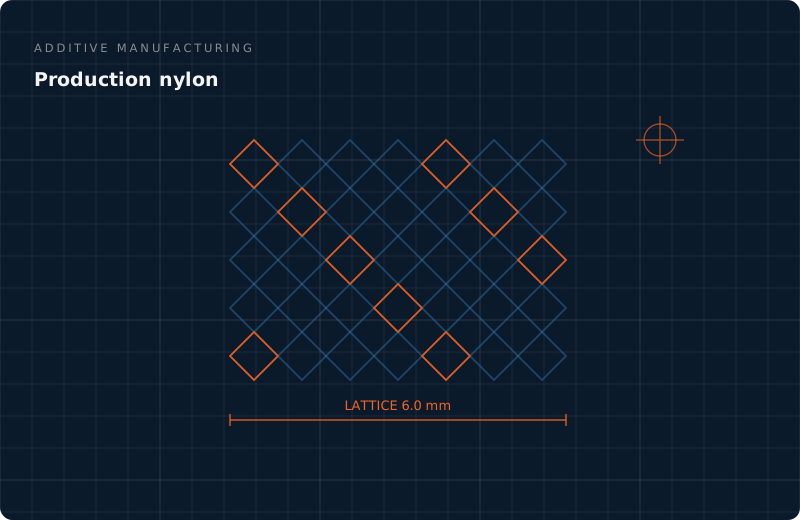
Production nylon. Functional grade. No supports needed.
SLS (Selective Laser Sintering) 3D printing with nylon PA12 powder. Production-grade mechanical properties — drop-testable, living hinges, snap-fits all possible. No support structures needed (powder supports part). For functional prototypes and low-volume production.
SLS 3D printing service
PA12 is standard — covers 90% of SLS applications. Specialty variants for specific properties.
SLS material options.
PA12 natural
Standard unfilled PA12 nylon. Ra 6-10 µm surface, 48 MPa tensile. Workhorse functional prototype material.
PA12-GF
Glass-filled PA12 for improved stiffness and dimensional stability. Higher modulus, less ductility.
PA12-CF
Carbon-filled PA12 for ESD applications and improved stiffness. Slightly conductive, jet-black appearance.
PA11
Plant-based nylon 11 — tougher than PA12, better impact resistance, slightly higher cost. For impact-critical parts.
PA6 equivalent
Higher modulus nylon 6 equivalent for structural applications where PA12 isn't stiff enough.
TPU powder
Thermoplastic polyurethane — flexible SLS material for gaskets, cushions, wearable components.
Dyed parts
SLS parts can be dyed post-print — standard colors include black, grey, and specific brand colors.
Medical PA12
Biocompatible PA12 for medical device prototypes — wearables, external medical hardware.
PA12 is standard — covers 90% of SLS applications. Specialty variants for specific properties.
Where SLS excels.
Functional prototypes
Drop-testable prototypes with production-grade nylon mechanical properties
Low-volume production
Bridge production 50-500 parts before injection molding tooling built
Complex geometry
Internal channels, lattices, organic shapes impossible to mold or machine
Living hinges
Flexible integrated hinges in single-piece parts
Snap-fit enclosures
Functional snap-fits that survive multiple assembly/disassembly cycles
Jigs and fixtures
Custom jigs for low-volume specialty production
Automotive prototypes
Functional automotive prototype parts for testing
Aerospace interior
Aircraft interior prototype components — FR-grade nylon available
Custom tooling
One-off tooling for specialty manufacturing applications
Get an instant quote
Send your CAD — we reply with detailed pricing, lead time, and DFM feedback within 4 working hours.
Talk to an engineer
WhatsApp our team directly. Most messages answered within 12 minutes during work hours.
Explore all services
CNC, 3D printing, injection molding, sheet metal, casting, finishing — one quality system, one partner.
Production nylon — questions
Why no support structures needed in SLS?
SLS prints in a bed of nylon powder — laser fuses powder where part is, unfused powder supports part from all sides. When print completes, unfused powder brushed away. No supports to remove = complex geometry, nested parts, internal features all possible. This is SLS's biggest advantage over SLA and FDM printing.
SLS surface finish?
SLS parts have characteristic grainy surface Ra 6-10 µm from fused powder particles. Can be smoothed via: bead blasting (uniform matte), vapor smoothing (glossy finish), tumbling (slightly smoother). For cosmetic applications, MJF produces smoother native finish. For functional applications, SLS surface is adequate and untouched.
Packing orientation matters?
SLS builds vertically (layer by layer). Orientation affects: feature accuracy (vertical walls most accurate), feature detail (small horizontal features may not print well), surface finish (top/bottom surfaces smoother than vertical walls), material properties (slightly anisotropic — properties weaker perpendicular to build direction). Good DFM accounts for build orientation — we optimize during programming.
Dimensional accuracy?
SLS accuracy: ±0.2 mm typical, ±0.1 mm on small features. Larger parts have thermal shrinkage during cooling — dimensional accuracy worse on large parts. For tolerance-critical features, post-print machining can bring specific dimensions to CNC tolerance while keeping overall SLS geometry.
Costs vs alternatives?
SLS cost driver: volume of part (material consumption) and build time. Small parts: $10-30. Medium: $30-100. Large: $100-500. For functional prototypes, SLS cost-effective in quantities 1-500. Above 500 parts, injection molding becomes cheaper per part (tool amortization). For one-off, SLA or MJF may be cheaper depending on part size.
Build size?
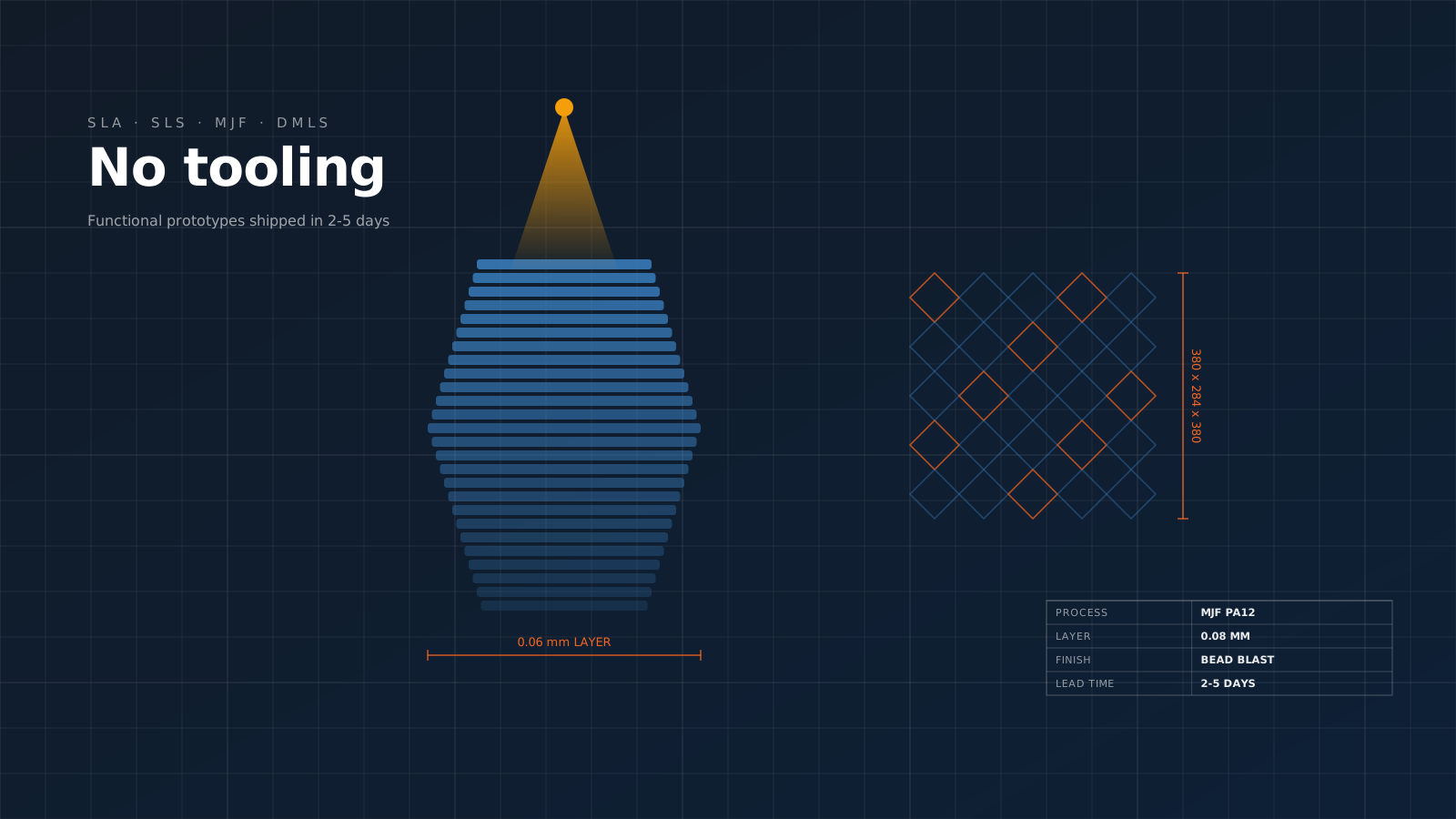
Our SLS (EOS) build envelope: 340 × 340 × 600 mm. Single large parts or many small parts nested for economic batch. Our MJF build (HP) 380 × 284 × 380 mm. Most production prototypes and specialty parts fit these envelopes. Larger parts split and bonded.
Keep reading
Quote
Get a free CNC machining, 3D printing, injection molding quote from PifyC. Send CAD via WhatsApp or email — q…
Read more →Process comparisonsSLA vs SLS vs MJF
SLA vs SLS vs MJF 3D printing comparison: materials, mechanical properties, surface finish, cost, lead time. Dec…
Read more →MachiningCNC machine
ISO 9001 certified CNC machining in Wuxi, China. 3, 4 and 5-axis milling, Swiss turning, 40+ materials, ±0.01 mm…
Read more →Additive manufacturing3D printing service
Industrial-grade 3D printing from Wuxi, Jiangsu, China: SLA, SLS, MJF and DMLS metal. Functional prototypes and …
Read more →Moulding & castingInjection molding
Plastic injection molding from China: rapid aluminum tooling in 14 days for 500–10,000 parts, production P20/H13…
Read more →Sheet metal & fabricationSheet metal
Precision sheet metal fabrication from Wuxi: 4 kW fiber laser cutting, Amada press brake bending (±0.1 mm), TIG/…
Read more →Finishing & treatmentFinishing services
Complete in-house surface finishing: Type II/III anodize, powder coating, electroplating, passivation, bead blas…
Read more →PifyCMaterials
PifyC's 50+ production-grade materials: aluminum, stainless steel, titanium, brass, copper, and engineering p…
Read more →
Send a CAD file. Get an engineering-reviewed quote.
No minimum quantity, free DFM feedback from a senior manufacturing engineer, and an NDA signed before file review on request.