
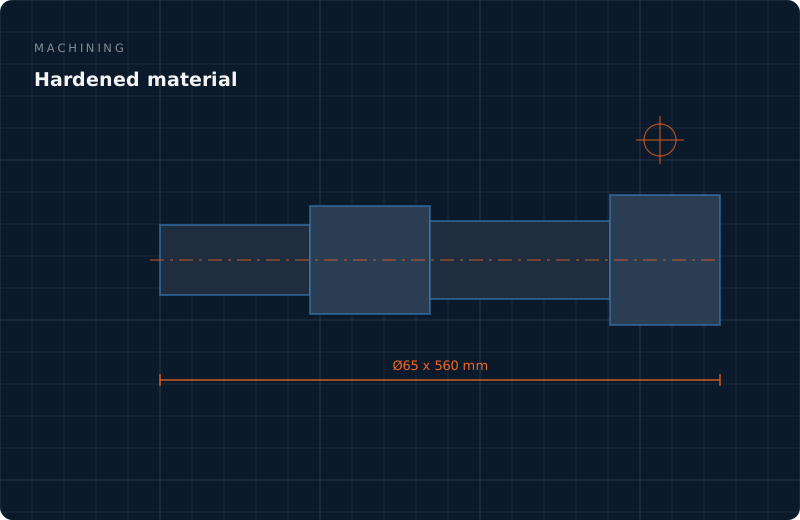
Hardened material. Micron tolerance. Surface, cylindrical, centerless.
Precision grinding finishes hardened materials to tolerances and surface finishes beyond CNC machining capability. Surface grinding for flat parts, cylindrical grinding for round parts, centerless grinding for high-volume cylindrical production.
Precision grinding
Grinding uses a rotating abrasive wheel to remove small amounts of material with high precision. Each abrasive particle acts as a tiny cutting edge, removing material one chip at a time. The accumulated effect produces tight tolerances, fine surface finishes, and the ability to machine hardened mate
How Precision Grinding works.
Grinding uses a rotating abrasive wheel to remove small amounts of material with high precision. Each abrasive particle acts as a tiny cutting edge, removing material one chip at a time. The accumulated effect produces tight tolerances, fine surface finishes, and the ability to machine hardened materials that conventional cutting tools cannot handle.
Surface grinding: Flat table moves workpiece past rotating abrasive wheel. Produces precision flat surfaces on plates, blocks, fixtures. Tolerance ±0.005 mm flatness, Ra 0.4 µm surface finish standard.
Cylindrical grinding: Part rotates between centers while rotating wheel grinds the outside diameter. Standard for precision shafts, pins, bearing journals. ±0.002 mm diameter tolerance, Ra 0.2 µm finish.
Centerless grinding: Part held between two rotating wheels (regulating and grinding) with no center support. Ideal for high-volume cylindrical production. Thousands of parts per hour. Very precise diameter but no fixed axis reference.
Capability specs.
Precision grinding tolerance. ±0.001 mm achievable on selected features
Typical ground surface finish. Ra 0.05 µm with polishing pass
Surface grinding flatness across plate surfaces
Grinding works on fully hardened material — beyond CNC cutting capability
Hardened tool steel, carbide, ceramic — materials CNC cannot machine
Cylindrical grinding capacity for shafts and pins
Flat surface grinding table size
Thousands of small cylindrical parts per hour capability
Where Precision Grinding excels.
Hardened tool steel
D2, H13, A2 tool steel components after heat treatment — only grinding cuts hardened steel
Precision shafts
Motor shafts, pump shafts requiring concentric bearing journals
Pins and gauges
Precision pins, gauge pins, locating pins — ground to ±0.002 mm
Bearing races
Ball and roller bearing inner/outer races — final finish operation
Flat reference surfaces
Precision gauge blocks, reference flats, tooling plates
Mold plates
Injection mold plates after heat treatment — flat parallel surfaces
Punch & dies
Stamping punches and dies in hardened D2 — precision working surfaces
Carbide tooling
Tungsten carbide cutting tool grinding — only grinding cuts carbide
High-volume pins
Centerless grinding of dowel pins, roller pins — production quantities
Not suitable for:
Every process has its limits. Being honest about where Precision Grinding isn\'t the right answer saves time and money.
- Soft aluminum or copper — grinding wheel loads rapidly, inefficient
- Large material removal — grinding removes microns, not mm per pass
- Complex 3D geometry — grinding is primarily 2D flat or cylindrical
- Low-quantity prismatic work — CNC milling cheaper and faster
- Parts where CNC tolerance (±0.025 mm) is adequate
Get an instant quote
Send your CAD — we reply with detailed pricing, lead time, and DFM feedback within 4 working hours.
Talk to an engineer
WhatsApp our team directly. Most messages answered within 12 minutes during work hours.
Explore all services
CNC, 3D printing, injection molding, sheet metal, casting, finishing — one quality system, one partner.
Hardened material — questions
When is grinding necessary vs CNC finish?
Three scenarios: (1) Material is harder than ~45 HRC — CNC cutting tools wear prohibitively fast. (2) Tolerance tighter than ±0.025 mm required — CNC struggles to maintain below this consistently. (3) Surface finish better than Ra 0.8 µm required — CNC finish passes can't reach Ra 0.2 µm reliably. When any of these apply, grinding is the right process.
Grinding after heat treatment workflow?
Standard for hardened precision parts. Workflow: CNC machine to slightly oversize (leave 0.2–0.5 mm grinding stock), heat treat to required hardness, grind to final dimension. Heat treatment distorts parts (0.1–0.3% typical), so CNC to final dimension before heat treatment doesn't work. Grinding stock allows recovering final dimension after heat-treat distortion.
Centerless grinding advantages?
High volume: thousands of parts per hour for small cylindrical pins. No chucking or fixturing — parts fed continuously between wheels. Excellent diameter tolerance (±0.005 mm typical). Limitation: no reference axis — cannot grind features referenced to one end of the part. For high-volume dowel pins, roller pins, bearing rollers: centerless is unbeatable.
Can you grind ceramic or carbide?
Yes with diamond grinding wheels. Tungsten carbide cutting tools, ceramic bearings, and even sapphire components can be precision ground with appropriate wheel selection. Cost is higher (diamond wheels expensive, slower cutting) but grinding is often the only practical process for these ultra-hard materials.
Typical costs?
Surface grinding: $30–100 per hour plus setup. Cylindrical grinding: $40–120 per hour plus setup. Centerless grinding at production volume: $0.10–1 per part (scales with volume). For a single precision shaft, cylindrical grinding adds $30–100 to CNC cost. For production quantities, grinding cost is small relative to overall part cost and often justified by tolerance requirements.
Lead times?
Grinding typically adds 3–7 days to overall lead time. Surface grinding: 3–5 days. Cylindrical: 5–7 days. Centerless setup: 3–5 days then production runs fast. For rush orders, grinding can be expedited but the manual nature of setup limits how much time can be saved.
Keep reading
Quote
Get a free CNC machining, 3D printing, injection molding quote from PifyC. Send CAD via WhatsApp or email — q…
Read more →MachiningHoning and lapping
Honing and lapping services: bore honing for hydraulic cylinders, flat lapping for precision surfaces. Sub-micro…
Read more →MachiningCNC machine
ISO 9001 certified CNC machining in Wuxi, China. 3, 4 and 5-axis milling, Swiss turning, 40+ materials, ±0.01 mm…
Read more →Additive manufacturing3D printing service
Industrial-grade 3D printing from Wuxi, Jiangsu, China: SLA, SLS, MJF and DMLS metal. Functional prototypes and …
Read more →Moulding & castingInjection molding
Plastic injection molding from China: rapid aluminum tooling in 14 days for 500–10,000 parts, production P20/H13…
Read more →Sheet metal & fabricationSheet metal
Precision sheet metal fabrication from Wuxi: 4 kW fiber laser cutting, Amada press brake bending (±0.1 mm), TIG/…
Read more →Finishing & treatmentFinishing services
Complete in-house surface finishing: Type II/III anodize, powder coating, electroplating, passivation, bead blas…
Read more →PifyCMaterials
PifyC's 50+ production-grade materials: aluminum, stainless steel, titanium, brass, copper, and engineering p…
Read more →Send a CAD file. Get an engineering-reviewed quote.
No minimum quantity, free DFM feedback from a senior manufacturing engineer, and an NDA signed before file review on request.