
ISO 9001:2015ITAR RegisteredRoHS · REACHLead time from 3 business daysMOQ = 1 part
PifyC
Services
Materials
Industries
Applications
Resources
Locations
Company
Request a quote
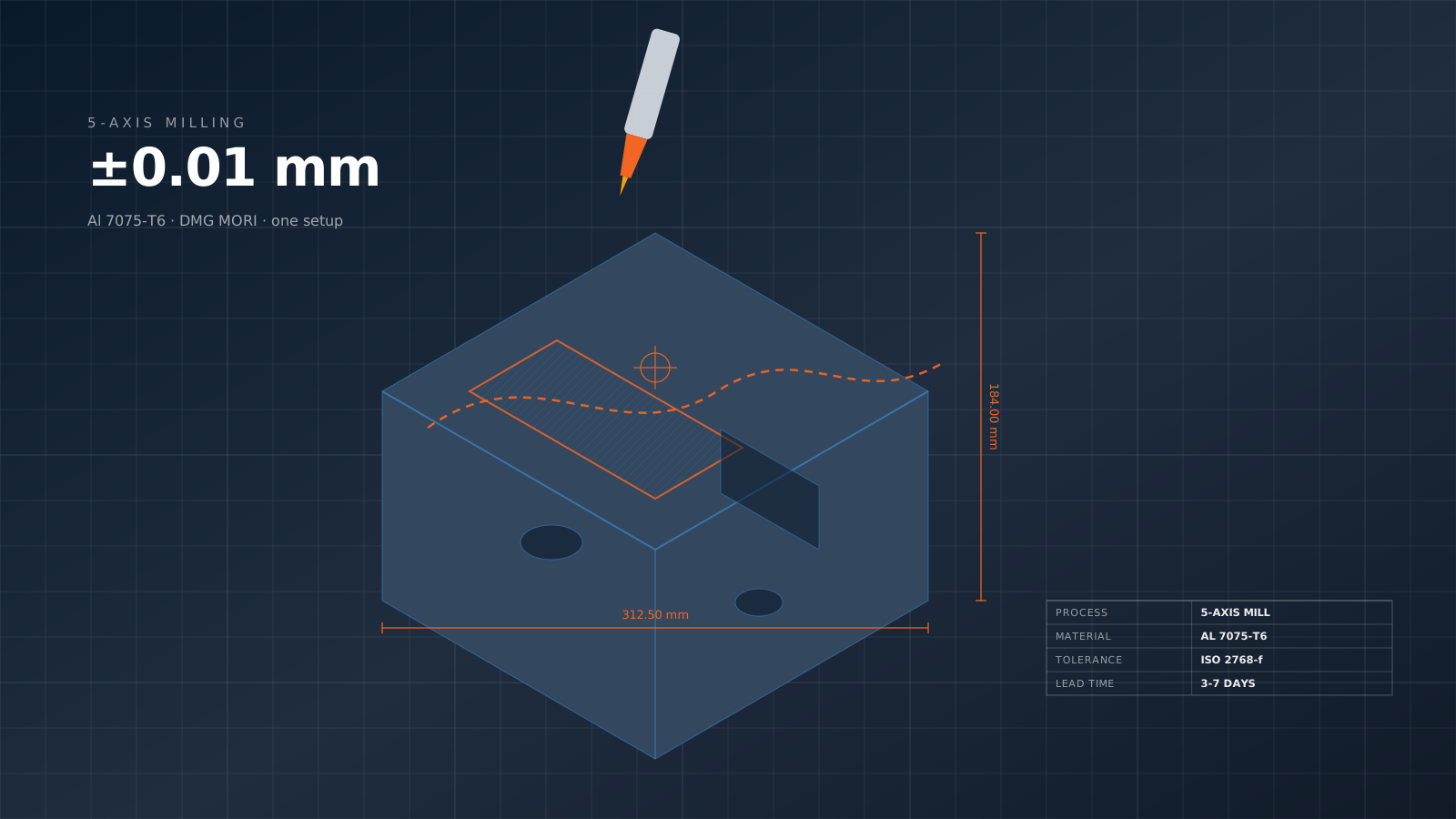
5-axis CNC milling drawing: Al 7075-T6 block with pockets, toolpath and dimensions
Material Selection Guide

Four questions. The right alloy. Every time.

Material selection shouldn\'t take a week. Answer four questions about your part, and we\'ll narrow 50+ engineering materials down to 2–3 strong candidates — with specific alloy recommendations.

Material & property dataWuxi, ChinaMOQ 1 partDFM review included

Four questions narrow the field.

What load and strength?

Ultimate driver for many material choices. Matching yield strength to expected load, with appropriate safety factor (typically 2–3× for static, 3–5× for dynamic).

What temperature?

Continuous operating temperature determines what materials survive. Thermal expansion and material strength both vary with temperature.

What environment?

Corrosion, chemicals, biological contact, UV exposure. Specific environments eliminate entire material families.

What's your budget?

Cost per part drives final choice between otherwise viable candidates. Material cost and machining cost both matter.

Work through these in order. Each question eliminates 50–80% of remaining materials. By question 4, you should have 2–3 strong candidates.

Quick recommendations.

Cosmetic consumer enclosure

Al 6061-T6 anodized, or PC/ABS injection molded

Aerospace structural bracket

Al 7075-T6 or Ti-6Al-4V — 5-axis CNC, full traceability

Medical implant prototype

Ti-6Al-4V Gr.23 ELI or PEEK — not for final production

EV battery pack enclosure

Al 5052 sheet metal + TIG welded, powder coated

Precision gear

Delrin POM for noise, 4140 steel for load

High-temperature engine part

Inconel 718 (hot section), Ti Gr.5 (under 450 °C)

Hydraulic cylinder body

Steel 4140 QT, hard chrome bore, precision ground

Lightguide or transparent

PMMA (clarity), PC (impact) — CNC machined and polished

Chemical reactor component

PTFE (best inert), PEEK (structural), titanium (metallic)

Precision shaft

Steel 4140 QT ground, or Ti Gr.5 for weight-critical

Dynamic seal

PTFE (filled with bronze or glass), PEEK-bearing

Electrical connector body

Nylon 66-GF30 for standard, PEEK for high-temperature

If your application matches one of these, the right answer is usually obvious. Use these as starting points, then refine with the 4-question framework above.

Working on a live project? Send the STEP file and the two or three features you are unsure about — an engineer replies with DFM notes and a price, usually within four working hours.

FAQ

Four questions — questions

How do I choose between metal and plastic?

Match to the dominant requirement. Choose metal when: high structural loads (> 100 MPa), high temperature (> 150 °C continuous), strict dimensional stability under humidity and load, electrical conductivity needed, or wear resistance critical. Choose plastic when: weight matters, corrosive environment, electrical insulation, noise dampening, lower cost per complex geometry, or safety from injury (smooth soft surfaces).

What is the best all-around metal?

Aluminum 6061-T6 for 80% of general-purpose metal parts. Good strength (276 MPa yield), excellent machinability, corrosion resistant, anodizes beautifully, weldable, available everywhere at reasonable cost. Only move away from 6061 when you have a specific reason: need higher strength (7075), higher corrosion resistance (316L, titanium), or higher temperature (titanium, Inconel).

What is the best all-around plastic?

ABS for cost-sensitive cosmetic applications, nylon (PA66) for mechanical parts. ABS is cheap, impact resistant, paintable, platable, and handles any cosmetic enclosure. Nylon is tough, wear-resistant, and handles moderate loads. Upgrade to polycarbonate for higher impact or transparency, Delrin for precision mechanical, PEEK for extreme temperature or biocompatibility.

What about cost trade-offs?

Material cost per kg is only part of the picture — manufacturing cost depends on machinability too. Approximate relative raw costs: commodity steels ($2–4/kg), aluminum 6061 ($6–10/kg), stainless 304 ($8–15/kg), brass ($10–15/kg), titanium Gr.5 ($50–80/kg), PEEK ($300–500/kg). Machining cost scales with hardness and cutting speed, so a $5 steel part and $50 titanium part can easily become $50 and $400 finished.

Do you have a material specialist to consult?

Yes — our engineering team has 14+ years of material selection experience across aerospace, medical, automotive, robotics, consumer electronics and semiconductor applications. Free material consultation included with every quote request. If you're unsure between two materials, describe the functional requirements and we'll recommend with reasoning.

5-axis CNC milling drawing: Al 7075-T6 block with pockets, toolpath and dimensions

Send a CAD file. Get an engineering-reviewed quote.

No minimum quantity, free DFM feedback from a senior manufacturing engineer, and an NDA signed before file review on request.