
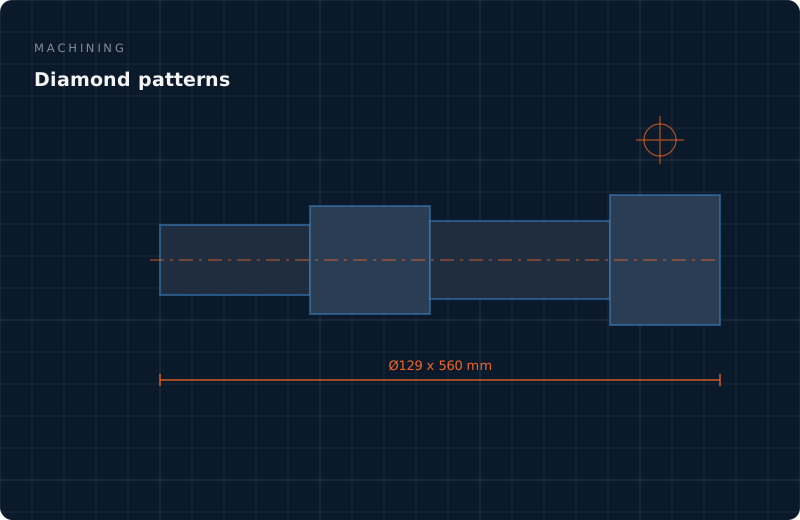
Diamond patterns. Grip surface. Integrated with turning.
Knurling creates repeating surface patterns — typically diamond, straight, or helical — for grip, press-fit interference, or decorative effect. Applied during CNC turning operations. Fast, precise, and consistent across production quantities.
Knurling services
Knurling is a machining process that creates a textured pattern on cylindrical surfaces by pressing hardened knurl wheels into the workpiece. Two knurl wheels with reverse helical patterns produce a diamond pattern; a single straight-patterned wheel produces straight knurls; single helical wheels pr
How Knurling works.
Knurling is a machining process that creates a textured pattern on cylindrical surfaces by pressing hardened knurl wheels into the workpiece. Two knurl wheels with reverse helical patterns produce a diamond pattern; a single straight-patterned wheel produces straight knurls; single helical wheels produce helical patterns. The pressure displaces material (cold working) rather than cutting — the raised pattern is formed by material flow, not removal.
Three primary functional purposes: grip (knurled tool handles, knobs, adjustment screws — provide finger grip), press-fit interference (knurled shafts provide bite when press-fit into smooth holes, creating a rotational lock), and decorative (visual pattern on cosmetic parts like knobs, levers, premium hardware).
DIN 82 specifies knurl pattern types and pitches: RAA (right-hand helical), RBL (left-hand helical), RGV (rectangular straight), and diamond variants. Common pitches 0.5–1.5 mm. CNC-integrated knurling means the pattern forms during lathe production without secondary operation — fast and cost-effective at volume.
Capability specs.
Standard specification for knurl patterns and pitches
Standard knurl pitch range. Fine (0.5), medium (0.8), coarse (1.2–1.5)
Three primary pattern families. Custom patterns via tool selection
Applied during CNC turning in production run — no secondary operation
Knurled shaft pressed into smooth hole creates rotational lock
No material removal — surface displaced, slightly work-hardened
Knurl depth tolerance — typical for production knurling
Steel, stainless, aluminum, brass, copper — ductile metals cold-form well
Where Knurling excels.
Tool handles
Manual tools requiring grip — wrenches, screwdrivers, knobs
Adjustment knobs
Rotary adjustment controls — thumbscrews, fine adjusters, lab equipment
Press-fit shafts
Shafts knurled where press-fit into plastic or soft metal housings
Manual operating controls
Industrial machine controls requiring tactile grip
Valve handles
Precision valve handles where finger grip matters
Specialty fasteners
Knurled thumbscrews, captive panel fasteners, specialty hardware
Premium hardware
Cosmetic knurled hardware for high-end products
Instrument controls
Test equipment knobs, scientific instrument controls
Medical device controls
Medical device adjustment knobs requiring grip even with gloves
Not suitable for:
Every process has its limits. Being honest about where Knurling isn\'t the right answer saves time and money.
- Cosmetic surfaces requiring smooth appearance
- Parts that will be plated with thin coating (knurls may show through)
- Very small diameters (below 3 mm) — tooling limitations
- Brittle materials that crack rather than deform plastically
- Applications requiring consistent seal against O-rings (knurl disrupts seal)
Get an instant quote
Send your CAD — we reply with detailed pricing, lead time, and DFM feedback within 4 working hours.
Talk to an engineer
WhatsApp our team directly. Most messages answered within 12 minutes during work hours.
Explore all services
CNC, 3D printing, injection molding, sheet metal, casting, finishing — one quality system, one partner.
Diamond patterns — questions
What knurl pattern should I specify?
Diamond: most common, maximum grip in all directions. Use for hand-operated knobs, handles. Straight: axial grip, prevents rotation. Use for press-fit shafts into plastic housings. Helical: single-direction grip, used for specific rotational direction requirements. Rule of thumb: for grip, diamond. For interference, straight or diamond depending on load direction.
How does knurled press-fit work?
Knurled shaft OD is slightly larger than the mating hole ID. When pressed in, the peaks of the knurl pattern bite into the hole material, creating a rotational lock. Typical design: shaft knurled to OD 0.05–0.15 mm larger than hole ID. For soft housings (plastic, aluminum), smaller interference. For hard housings (steel), larger. Proven technique for attaching shafts to plastic gears and knobs.
Knurled shaft dimensions?
Specify base shaft OD (before knurling), knurl pitch and pattern, and target post-knurl OD. Example: "Shaft Ø10.0, knurled RAA 0.8, final Ø10.15 +0.05/-0.00." Material is displaced upward during knurling, so final OD is larger than base OD. We calculate knurl depth to achieve target final OD based on material properties.
Production cost?
Knurling adds minimal cost when integrated with CNC turning production. Typical: $0.50–2 added per part at production volume. Knurl tooling is inexpensive ($50–200 per knurl wheel set), amortizes across many jobs. For low-volume parts (under 50 pieces), setup cost may add $30–100 total. For high-volume production, knurling is negligible cost.
Plastic knurling?
Yes — knurled plastic parts common for knobs and handles. Process varies: molded-in knurl pattern during injection (most common for production), or machined knurl on turned plastic parts. Delrin and nylon knurl well on lathe. ABS and PC are more challenging — may require higher speeds or different tooling approach.
Knurling in production vs secondary operation?
In-line (on lathe during turning): preferred — no extra setup, no handling between operations, consistent positioning. Standard for production. Secondary operation: only used for parts requiring knurl on features not accessible during primary turning. Rare — usually designed out of the process.
Keep reading
Quote
Get a free CNC machining, 3D printing, injection molding quote from PifyC. Send CAD via WhatsApp or email — q…
Read more →MachiningCNC turning
Precision CNC turning in Wuxi: 10 conventional lathes and 4 Citizen Swiss-type lathes. Diameters 2–450 mm, lengt…
Read more →MachiningCNC machine
ISO 9001 certified CNC machining in Wuxi, China. 3, 4 and 5-axis milling, Swiss turning, 40+ materials, ±0.01 mm…
Read more →Additive manufacturing3D printing service
Industrial-grade 3D printing from Wuxi, Jiangsu, China: SLA, SLS, MJF and DMLS metal. Functional prototypes and …
Read more →Moulding & castingInjection molding
Plastic injection molding from China: rapid aluminum tooling in 14 days for 500–10,000 parts, production P20/H13…
Read more →Sheet metal & fabricationSheet metal
Precision sheet metal fabrication from Wuxi: 4 kW fiber laser cutting, Amada press brake bending (±0.1 mm), TIG/…
Read more →Finishing & treatmentFinishing services
Complete in-house surface finishing: Type II/III anodize, powder coating, electroplating, passivation, bead blas…
Read more →PifyCMaterials
PifyC's 50+ production-grade materials: aluminum, stainless steel, titanium, brass, copper, and engineering p…
Read more →Send a CAD file. Get an engineering-reviewed quote.
No minimum quantity, free DFM feedback from a senior manufacturing engineer, and an NDA signed before file review on request.