
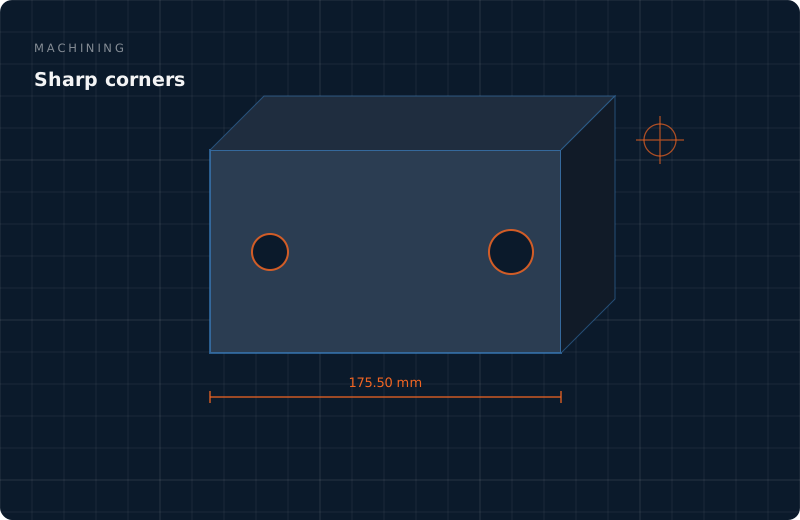
Sharp corners. Hardened steel. No cutting forces.
EDM removes material through precisely controlled electrical sparks — no mechanical cutting, no tool wear, no part deformation. The right process for hardened mold cavities, sharp internal corners, and delicate features that would chatter on a mill.
EDM wire cutting
One engineer owns the job from quote to dock: DFM review before cutting, inspection through the run, and an inspection report in the box.
Three variants — pick by geometry.
Wire EDM
Continuous brass wire cuts through workpiece like a band saw — but electrically, without mechanical forces. Sharp internal corners (no rotating tool radius). Through-features only.
Sinker EDM
Custom-shaped copper or graphite electrode plunges into workpiece. Creates mirror-image of electrode. Ideal for mold cavities, buttons, complex internal features.
Fast-Hole EDM
Rotating tubular electrode with high-pressure dielectric flush. Drills small-diameter deep holes 10–50× faster than twist drills. Standard for starter holes and cooling passages.
Where EDM is the only right answer.
Injection mold cavities
Hardened H13/S136 cavities with complex 3D surfaces — sinker EDM with polished copper electrodes
Extrusion dies
Aluminum extrusion die profiles with sharp corners and fine detail — wire EDM through hardened H13
Gear teeth
Internal and external gears in hardened steel — wire EDM profile cutting
Aerospace structural
Lightening holes and features in hardened Inconel and titanium structural parts
Medical instruments
Sharp internal features on hardened stainless surgical tools — wire EDM
Precision punches & dies
D2 tool steel blanking punches and stripper plates with ±0.005 mm fit
Turbine cooling holes
Inconel turbine blade cooling passages — fast-hole EDM at 100:1 aspect
Printed-circuit fixtures
Hardened stainless bed-of-nails test fixtures with precision locating features
Complex carbide tooling
Tungsten carbide cutting tool profiles — only EDM can machine carbide]
Sharp corners — questions
What is EDM and when is it the right process?
EDM (Electrical Discharge Machining) removes material through controlled electrical sparks between an electrode and the workpiece — no mechanical cutting forces, no tool wear on the part. Use EDM when: material is hardened (above 50 HRC) where conventional cutting is difficult; features have sharp internal corners impossible with rotating tools; parts are delicate and would deform under cutting forces; deep small-diameter holes need straightness better than drilling achieves.
Sinker EDM vs wire EDM — which do I need?
Sinker EDM: uses a custom-shaped copper or graphite electrode plunged into the workpiece. Used for blind-bottom cavities (mold cavities, buttons, logos, internal features). Wire EDM: uses a continuous brass wire cutting through the workpiece like a band saw. Used for through-cuts with sharp internal corners, profiles, gear teeth, extrusion dies. If the feature exits both sides of the workpiece, wire EDM. If it's a blind cavity, sinker EDM.
What tolerances does EDM hold?
Wire EDM: ±0.005 mm on profile, straightness below 0.002 mm/inch, surface finish Ra 0.4 µm standard, Ra 0.1 µm with fine-finishing passes. Sinker EDM: ±0.005 mm on cavity depth and width, surface finish Ra 0.8 µm standard, polishable to Ra 0.1 µm. For gauge-quality tolerances below ±0.002 mm, grinding or honing follow EDM.
Can EDM machine any conductive material?
Yes — EDM works on any electrically conductive material regardless of hardness. This is its unique advantage: hardened tool steels (D2 at 62 HRC, H13 at 52 HRC), carbide, titanium, Inconel, even aerospace superalloys. Non-conductive materials (plastics, ceramics) cannot be EDM'd. For non-conductive hard materials, laser cutting or abrasive water-jet is used instead.
What is fast-hole EDM?
Fast-hole EDM drills small-diameter (0.3–6 mm) deep holes at rates 10–50× faster than conventional drilling. Uses a tubular rotating electrode with high-pressure dielectric flush. Standard for starter holes before wire EDM, cooling passages in mold inserts, fuel injection orifices, and turbine blade cooling holes. Aspect ratios 100:1 (length:diameter) achievable — impossible with twist drills.
How long does EDM take?
EDM is slow by modern cutting standards. Metal removal rate on wire EDM is typically 5–40 mm²/min of profile, on sinker EDM 2–30 mm³/min of cavity. A complex injection mold cavity can take 8–40 hours of sinker EDM time. This is why EDM is reserved for features where no other process works — the cost per cubic millimeter is high, but for hardened materials and sharp corners, it's often the only option.
Keep reading
Quote
Get a free CNC machining, 3D printing, injection molding quote from PifyC. Send CAD via WhatsApp or email — q…
Read more →PifyCManufacturing services
PifyC delivers six integrated manufacturing processes from one Wuxi facility: CNC machining, 3D printing, inj…
Read more →MachiningCNC machine
ISO 9001 certified CNC machining in Wuxi, China. 3, 4 and 5-axis milling, Swiss turning, 40+ materials, ±0.01 mm…
Read more →MachiningTapping services
CNC tapping services for internal threads in any material. Standard tapping for production volumes, thread milli…
Read more →MachiningReaming services
CNC reaming services for precision hole diameters. H7 tolerance bores, ±0.005 mm diameter, Ra 0.4 µm surface fin…
Read more →MachiningThread rolling
Thread rolling: cold-formed threads with superior strength, surface finish, and fatigue life. Standard for produ…
Read more →MachiningSwiss screw machining
Swiss-type CNC screw machining: small-diameter precision parts (< 32 mm), tolerances to ±0.005 mm, long length-t…
Read more →MachiningHoning and lapping
Honing and lapping services: bore honing for hydraulic cylinders, flat lapping for precision surfaces. Sub-micro…
Read more →Send a CAD file. Get an engineering-reviewed quote.
No minimum quantity, free DFM feedback from a senior manufacturing engineer, and an NDA signed before file review on request.