
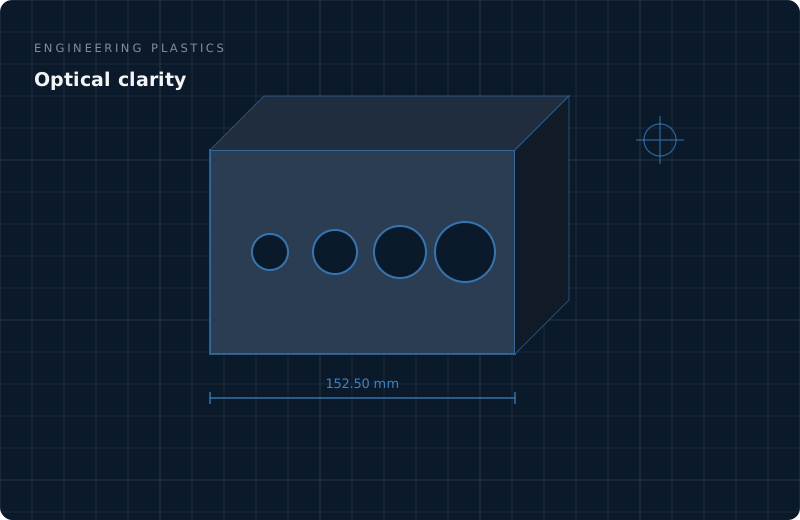
Optical clarity. UV stable. Polishable.
Acrylic (PMMA) offers 93% optical transmission — better than glass. UV-stable for outdoor use, lighter than glass, easier to machine, shatter-resistant. Standard for display cases, light pipes, aquarium windows, machine guards, signage.
At a glance
- Density
- 1.19 g/cc
- Tensile strength
- 72 MPa
- Flexural modulus
- 3.3 GPa
- Hardness
- M 94 Rockwell
- HDT
- 95 °C
- Light transmission
- 93%
- Refractive index
- 1.49
- UV stability
- Excellent (20+ years)
Key data
- Density
- 1.19 g/cc
- Tensile strength
- 72 MPa
- Flexural modulus
- 3.3 GPa
- Hardness
- M 94 Rockwell
- HDT
- 95 °C
- Light transmission
- 93%
- Refractive index
- 1.49
- UV stability
- Excellent (20+ years)
Acrylic grades.
Cast PMMA
Premium optical grade. Best clarity, best machinability, most uniform. Used for high-end displays, precision optical, aquarium windows.
Extruded PMMA
Lower cost. Slightly lower optical quality, more internal stress (can stress-crack). Used for general signage, industrial windows.
Impact-Modified
Rubber-modified for impact resistance. Machine guard applications where shattering is a concern.
UV-Filtering
Blocks UV below 400nm. Museum display cases, archival photo protection, sensitive artifact protection.
Anti-Static
Surface-treated anti-static acrylic for electronic assembly viewing windows, semiconductor handling.
Colored Cast
Cast in transparent colors (red, blue, green, amber, etc.) for signage, displays, decorative applications.
Cast vs extruded affects machinability and optical quality. Specialty grades for impact resistance, UV protection, anti-static.
Why acrylic beats glass.
93% transmission
Better than standard glass (91%). Near-invisible clear windows in displays and instruments.
Half the weight
Density 1.19 vs 2.5 for glass. Critical for portable displays, aerospace windows, large signage.
Shatter resistant
Doesn't shatter like glass. Fragments are blunt. Safety advantage for machine guards, public displays.
CNC machinable
Precise features, threads, internal geometry achievable. Glass requires grinding for equivalent work.
Where optical clarity matters but glass is too heavy, too fragile, or too hard to machine — acrylic wins.
Acrylic applications.
Display cases
Museum and retail display cases — optical clarity + UV protection
Aquarium windows
Large aquarium windows — half glass weight, superior impact resistance
Light pipes
LED light pipe components for automotive, medical, signage
Machine guards
Clear machine safety guards — shatter-proof vs glass
Medical device windows
Equipment viewing windows in CT scanners, surgical equipment
Signage
Backlit signs, channel letters, point-of-purchase displays
Aerospace windows
Smaller aircraft windows, instrument panel windows
Architectural
Skylights, canopies, decorative architectural panels
Solar concentrators
Fresnel lenses, solar collection optics
Acrylic finishing.
As-machined
Slightly translucent from cutting marks. Ra 0.8 µm typical. Requires polish for optical use.
Flame polished
Brief flame pass melts surface to optical clarity. Fast, standard for edges.
Diamond polished
Mechanical polishing with diamond paste. Optical-grade surface. Premium appearance.
Vapor polished
Methylene chloride vapor creates optical finish. Chemical process, controlled environment.
Solvent cemented
Acrylic parts bond to each other with methyl methacrylate cement — creates optically continuous joints.
Laser cut/engraved
Laser cutting leaves polished edges automatically. Laser engraving creates matte frost effect.
Painted
Accepts standard paints. UV-resistant paint for outdoor signage.
Screen printed
Standard graphics printing for signage and display applications.
Get an instant quote
Send your CAD — we reply with detailed pricing, lead time, and DFM feedback within 4 working hours.
Talk to an engineer
WhatsApp our team directly. Most messages answered within 12 minutes during work hours.
Explore all services
CNC, 3D printing, injection molding, sheet metal, casting, finishing — one quality system, one partner.
Optical clarity — questions
Acrylic vs polycarbonate?
Acrylic: better optical clarity (93% vs 88%), scratch resistant, UV stable, cheaper, brittle. Polycarbonate: 250× impact resistance, slightly lower clarity, softer surface (scratches easily), more expensive. For displays and decorative: acrylic. For safety (bulletproof, impact): polycarbonate. For outdoor long-term: acrylic. For high-abuse: polycarbonate.
Can you achieve optical surface finish?
Yes via diamond polishing or vapor polishing after CNC. Typical sequence: CNC machine to near-final dimension, fine sand progressively (400, 600, 1200, 2500 grit), diamond polish or vapor polish. Final finish Ra 0.05 µm — truly optical. For less-critical applications, flame polishing edges alone gives visually acceptable result at much lower cost.
Stress cracking issue?
Acrylic crazes (fine network of cracks) when exposed to certain chemicals under stress. Common offenders: solvents, some cleaners, aromatic hydrocarbons, specific adhesives. Cast acrylic is more resistant than extruded. Design considerations: avoid concentrated stress risers, test cleaning chemicals before use, use polycarbonate if stress-crack-prone chemistry is expected.
UV resistance — really 20 years?
Yes for cast acrylic. UV-grade cast PMMA maintains 85% of original clarity after 10-20 years outdoor exposure. Better than most plastics. Extruded acrylic has shorter outdoor service life (5-10 years typical). For long-life outdoor applications (signage, architectural), specify cast acrylic with UV-stabilized formulation.
Machining tips?
Sharp tools essential (dull tools cause melting). Slow feeds initially to prevent cracking. Avoid flood coolant — can cause stress cracks. Air blast or mist coolant preferred. Climb milling over conventional. For cast acrylic, standard CNC tolerances (±0.05 mm) easy. Extruded acrylic: plan for 0.1-0.3% dimensional change from stress relief after machining.
Lead times?
Standard cast acrylic sheet: in stock 1-3 day lead time. Custom thickness: 7-10 days. Colored cast: 5-10 days. Custom tint colors: 3-4 weeks. With polishing: add 3-5 days. Specialty grades (museum UV, anti-static): 2-3 weeks.
Keep reading
Quote
Get a free CNC machining, 3D printing, injection molding quote from PifyC. Send CAD via WhatsApp or email — q…
Read more →PifyCMaterials
PifyC's 50+ production-grade materials: aluminum, stainless steel, titanium, brass, copper, and engineering p…
Read more →MachiningCNC machine
ISO 9001 certified CNC machining in Wuxi, China. 3, 4 and 5-axis milling, Swiss turning, 40+ materials, ±0.01 mm…
Read more →Additive manufacturing3D printing service
Industrial-grade 3D printing from Wuxi, Jiangsu, China: SLA, SLS, MJF and DMLS metal. Functional prototypes and …
Read more →Moulding & castingInjection molding
Plastic injection molding from China: rapid aluminum tooling in 14 days for 500–10,000 parts, production P20/H13…
Read more →Sheet metal & fabricationSheet metal
Precision sheet metal fabrication from Wuxi: 4 kW fiber laser cutting, Amada press brake bending (±0.1 mm), TIG/…
Read more →Finishing & treatmentFinishing services
Complete in-house surface finishing: Type II/III anodize, powder coating, electroplating, passivation, bead blas…
Read more →Engineering plasticsPTFE Teflon
Precision CNC machining of PTFE (Teflon). Chemically inert, 260 °C service, lowest coefficient of friction of an…
Read more →Send a CAD file. Get an engineering-reviewed quote.
No minimum quantity, free DFM feedback from a senior manufacturing engineer, and an NDA signed before file review on request.