
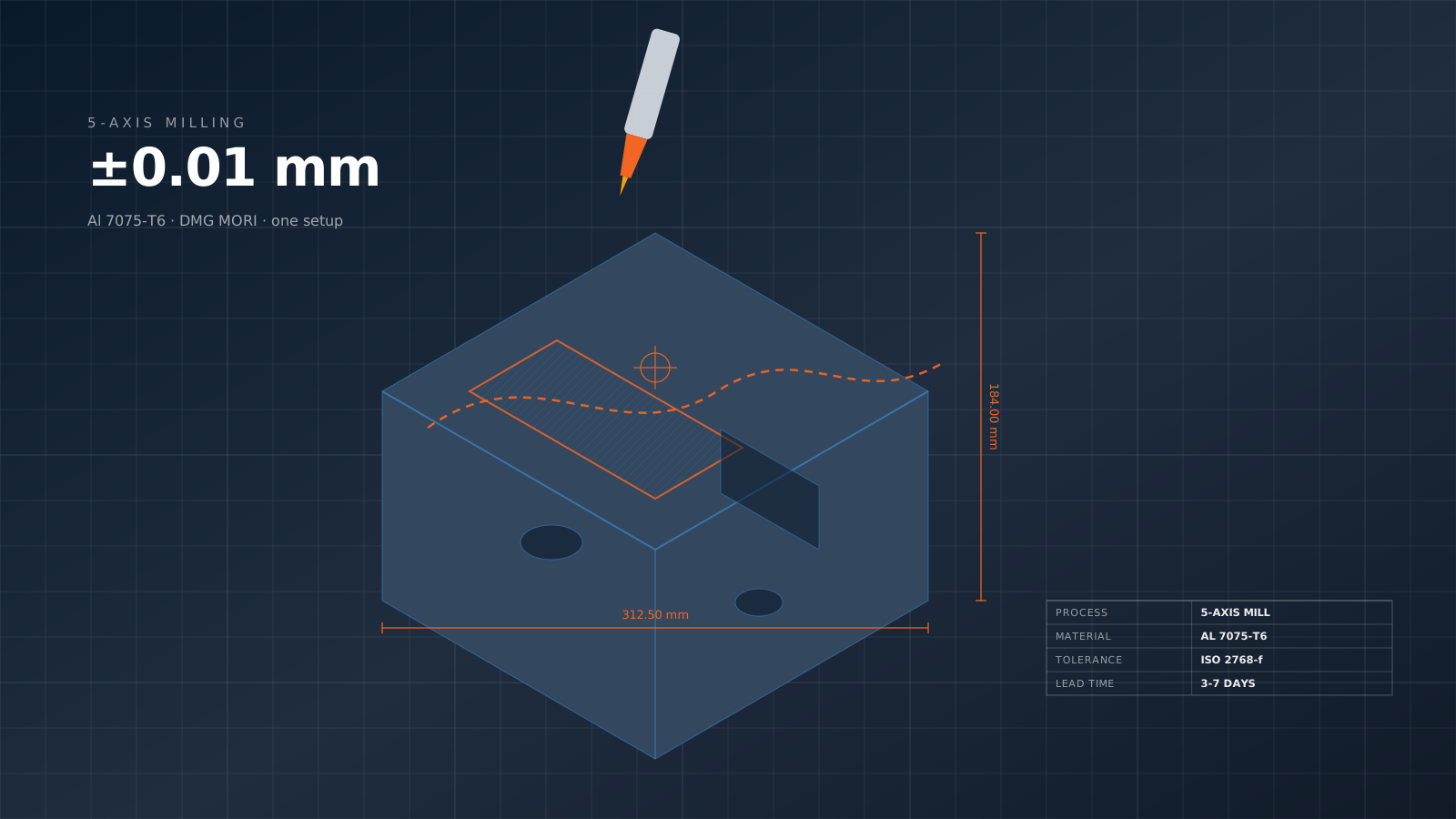
Impellers. Turbines. Structural brackets. In one setup.
Full simultaneous 5-axis on DMG Mori, Hermle and Makino platforms. Complex contours, undercut features, multi-face geometry — machined complete with tolerance stack-up below 0.01 mm. Aerospace brackets, medical implants, turbomachinery.
5 axis machining
Beyond "complex geometry" — 5-axis delivers concrete economic and quality advantages that 3-axis cannot match on the right parts.
Why 5-axis wins.
Single-setup tolerance
All critical features referenced to one datum. No stack-up from multiple setups. Sub-0.01 mm relationships maintained.
Reduced fixturing cost
One holding device vs 3–5 different fixtures. Lower NRE on complex parts.
Shorter tools, better finish
Tool-axis tilt enables shorter, stiffer tools. Better surface finish (Ra 0.8 µm vs 1.6 µm typical on long tools).
Access to undercuts
B-axis rotation enables undercut features impossible on 3-axis without wire EDM or separate operations.
Consolidated operations
Full part complete in 1–2 setups vs 5+ on 3-axis. 30–50% total cycle time reduction on complex parts.
Flight-ready quality
Single-datum reference scheme matches aerospace design intent. FAI-ready parts without stack-up issues.
Beyond "complex geometry" — 5-axis delivers concrete economic and quality advantages that 3-axis cannot match on the right parts.
Parts we build on 5-axis.
Aerospace brackets
Topology-optimized structural brackets with complex organic geometry. Single-setup for tolerance-critical mounting features.
Impellers
Pump and compressor impellers with curved blades. True 5-axis simultaneous for continuous blade surface.
Turbine components
Turbine vanes, blade test articles. Superalloy 5-axis with tool-axis control for heat management.
Medical implants
Joint components, spine cages with complex 3D surfaces. Single-setup for precision mounting geometry.
Robot joint housings
Integrated bearing seats, cable passages, mounting flanges all machined in single setup.
Automotive prototypes
Suspension uprights, transmission cases, cylinder heads with integrated ports and passages.
Mold cores & cavities
Injection mold tool work with complex 3D surfaces, parting lines, and interlocking features.
Marine propellers
Twin-pitch propellers, impellers for marine and submersible applications. Pitched blade 5-axis.
Aerospace fuel system
Valve bodies, manifolds with multi-axis porting. Cross-drilled passages with blending and deburring.
Our 5-axis cells.
DMU 80 P duoBLOCK
Full 5-axis simultaneous. Optimized for aerospace titanium and superalloy work.
C 42 U
Swiss-German precision. Dual-pallet for reduced non-cut time.
V56i
High-speed machining. Preferred for aluminum unibody and consumer electronics.
Key data
- Envelope:
- 800 × 800 × 600 mm
- Spindle:
- 15,000 rpm · HSK-A63
- Envelope:
- 800 × 800 × 550 mm
- Spindle:
- 18,000 rpm · HSK-A63
- Envelope:
- 800 × 600 × 500 mm
- Spindle:
- 20,000 rpm · BT40
Impellers — questions
What is the difference between 3+2 and simultaneous 5-axis?
3+2 positional: the rotary axes (A and C) lock at a fixed angle, then 3-axis machining proceeds. Access to angled features is possible but each angle is a discrete setup. Simultaneous 5-axis: all five axes move continuously during the cut. Required for impeller blades, turbine vanes, undercut contours, and any surface where the tool orientation must change mid-cut. We run both, selecting based on geometry.
When does 5-axis save money vs multiple setups on 3-axis?
When a part needs 3+ setups on a 3-axis machine. Each setup adds: fixturing design, operator time, tolerance stack-up, inspection between setups. For parts requiring 5+ setups on 3-axis, consolidating into 1–2 setups on 5-axis often cuts total cost 30–50% despite the higher hourly rate. Break-even is usually around 3 setups.
What tolerance stack-up improvement does 5-axis give?
Every setup introduces 0.02–0.05 mm position error. A 5-setup 3-axis part accumulates 0.1–0.25 mm stack-up; the same part machined in a single 5-axis setup retains ±0.01 mm across the whole part. For aerospace critical features with GD&T callouts to multiple datums, 5-axis is often the only way to meet drawing.
What are your 5-axis work envelopes?
Our production 5-axis centers (DMG Mori, Hermle, Makino) cover: 800 × 600 × 500 mm work envelope, B-axis ±110°, C-axis 360° continuous. For parts exceeding that envelope, we split into sub-assemblies or use 5-sided 3+2 positioning. Larger envelopes through machining partners when needed.
What materials do you 5-axis machine?
Everything we cut on 3-axis: aluminum, steel (pre-hardened and through-hardened), stainless, titanium (Gr.2, Gr.5, Gr.23), Inconel, brass, copper, all engineering plastics. Titanium and Inconel 5-axis work is where our 14 years of experience shows — we use tool-axis control to manage heat concentration and chip evacuation on difficult-to-machine alloys.
Do 5-axis parts cost more per piece?
Higher hourly rate (roughly 1.3× 3-axis), but often lower total part cost due to setup consolidation. For simple geometry doable in 1 setup on 3-axis, 3-axis wins. For complex geometry requiring multiple setups, 5-axis wins. We quote both where applicable and recommend the lower-cost approach.
Keep reading
Quote
Get a free CNC machining, 3D printing, injection molding quote from PifyC. Send CAD via WhatsApp or email — q…
Read more →MachiningCNC machine
ISO 9001 certified CNC machining in Wuxi, China. 3, 4 and 5-axis milling, Swiss turning, 40+ materials, ±0.01 mm…
Read more →MachiningTapping services
CNC tapping services for internal threads in any material. Standard tapping for production volumes, thread milli…
Read more →MachiningReaming services
CNC reaming services for precision hole diameters. H7 tolerance bores, ±0.005 mm diameter, Ra 0.4 µm surface fin…
Read more →MachiningThread rolling
Thread rolling: cold-formed threads with superior strength, surface finish, and fatigue life. Standard for produ…
Read more →MachiningSwiss screw machining
Swiss-type CNC screw machining: small-diameter precision parts (< 32 mm), tolerances to ±0.005 mm, long length-t…
Read more →MachiningHoning and lapping
Honing and lapping services: bore honing for hydraulic cylinders, flat lapping for precision surfaces. Sub-micro…
Read more →MachiningBroaching services
CNC broaching services: internal keyways, spline cutting, square and hexagon holes, gear teeth. Linear and rotar…
Read more →Send a CAD file. Get an engineering-reviewed quote.
No minimum quantity, free DFM feedback from a senior manufacturing engineer, and an NDA signed before file review on request.